- Witness Meditation Sit quietly, allowing thoughts and emotions to arise and pass without interference. Watch them as clouds in the sky. With time, you will notice the sky-like quality of consciousness — vast, open, and still, no matter how many clouds appear.
- Breath Awareness Focus on the natural rhythm of the breath without altering it. Feel the breath entering and leaving the body. With each breath, awareness deepens, and the mind begins to settle into the silent space between inhalation and exhalation.
- Sensory Presence Instead of resisting sensations, open fully to them. Whether it is sound, touch, or sight, experience it completely. This total openness dissolves the boundary between observer and observed, leading to a silent merging with the present moment.
- Heart Meditation Bring attention to the center of the chest and imagine breathing into your heart. Feel love and gratitude radiating from within. This practice softens inner tension, creating a natural expansion into stillness.
- Silent Gazing Sit before a candle flame, a flower, or even another person, and gaze softly without labeling or analyzing. The outer focus becomes a mirror to the inner stillness, and gradually both dissolve into one field of awareness.
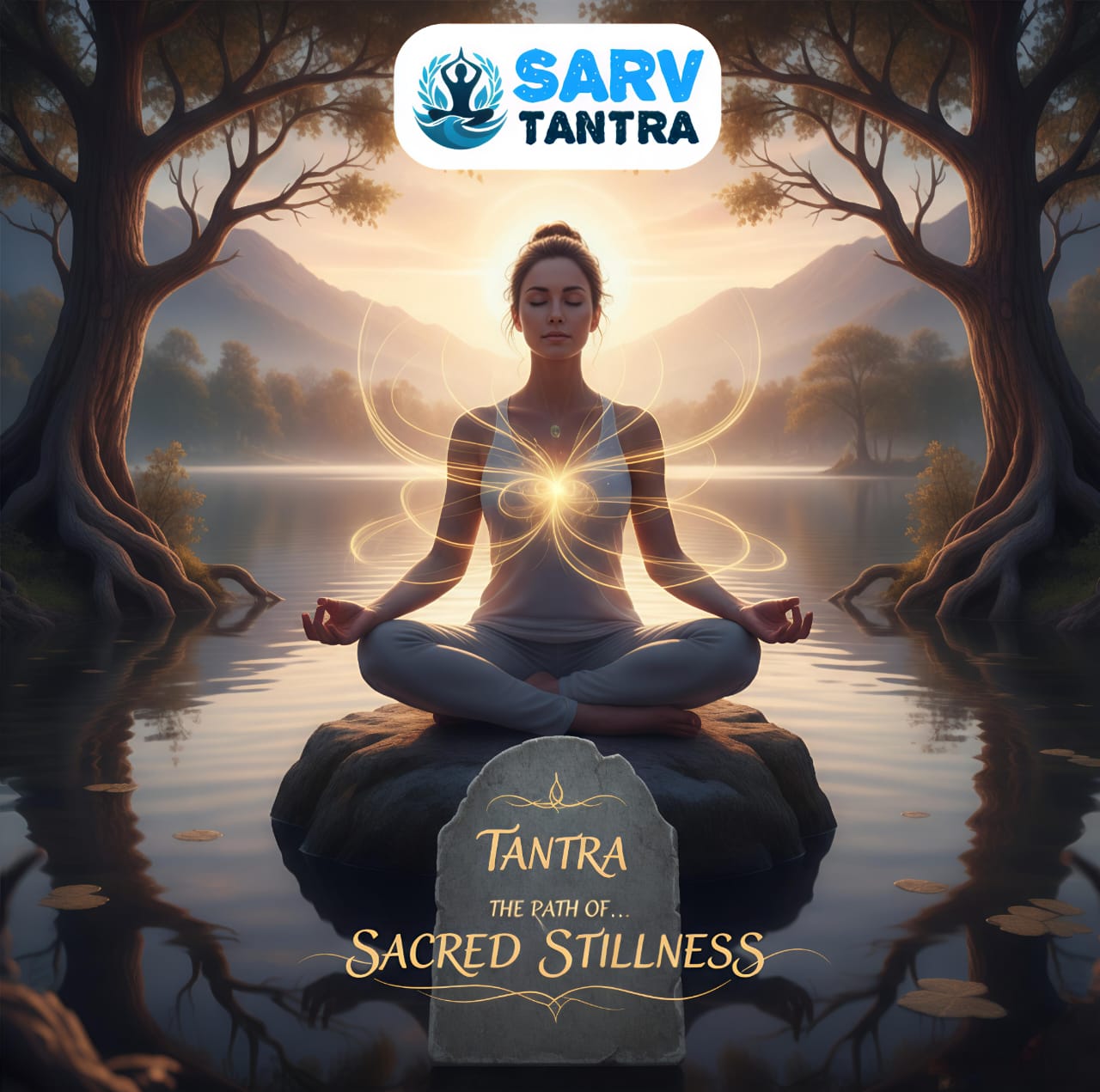
Tantra and the Path of Sacred Stillness
Introduction
In the ever-moving currents of life, where thoughts, emotions, and desires constantly arise and dissolve, Tantra invites us to return to the source of all — stillness. Sacred stillness in Tantra is not the absence of activity or noise, but a profound awareness that remains untouched amidst all movement. It is the silent witness, the eternal presence that observes everything without judgment. Through sacred stillness, Tantra reveals the ultimate truth of existence: that beyond all doing, there is pure being.
Understanding Sacred Stillness
Sacred stillness is not something to be achieved; it is the natural state of consciousness that exists before the mind interferes. Tantra views the mind as a beautiful tool that often forgets its master. When the mind is restless, it creates separation — between self and other, between sacred and mundane. In stillness, this separation dissolves. What remains is oneness, an intimate communion with existence itself. This state is not passive or lifeless; it is vibrant, pulsating with life energy, yet utterly peaceful.
The Nature of Stillness in Tantra
In Tantric philosophy, stillness and motion are two aspects of the same reality — Shiva and Shakti. Shiva represents the unmoving consciousness, while Shakti is the dynamic expression of that consciousness in the form of creation. Tantra does not reject movement or desire but invites awareness into it. The path of sacred stillness is not about escaping life; it is about entering life fully, yet remaining rooted in the silent depth within. Through this balance, Tantra transcends dualities — it unites spirit and matter, silence and sound, male and female, form and formlessness.
The Role of Awareness
Awareness is the bridge between chaos and stillness. Tantra teaches that one cannot force stillness through suppression or control. Instead, awareness transforms restlessness into peace. When one observes thoughts, sensations, and emotions without resistance, they naturally dissolve, revealing the silent consciousness beneath. This is the essence of Tantric meditation — to be aware of everything, yet identified with nothing. Awareness is the light that reveals the eternal stillness already present in every moment.
Meditative Practices for Sacred Stillness
Tantra offers many meditative techniques to experience sacred stillness. These practices are not about withdrawal from the world but deepening presence within it.