

Tantra for Self-Trust: Rebuilding Confidence Through Body-Based Awareness


Self-trust is the quiet confidence that allows you to listen to your inner knowing and act from it. It’s not loud, aggressive, or performative. It’s subtle, embodied, and deeply personal. Yet in the modern world, self-trust is one of the most damaged inner capacities.
From an early age, many of us are trained to look outside ourselves for approval, validation, and direction. We’re taught to prioritize logic over intuition, productivity over sensitivity, and external success over inner alignment. Over time, this conditioning disconnects us from our bodies—the very place where authentic self-trust lives.
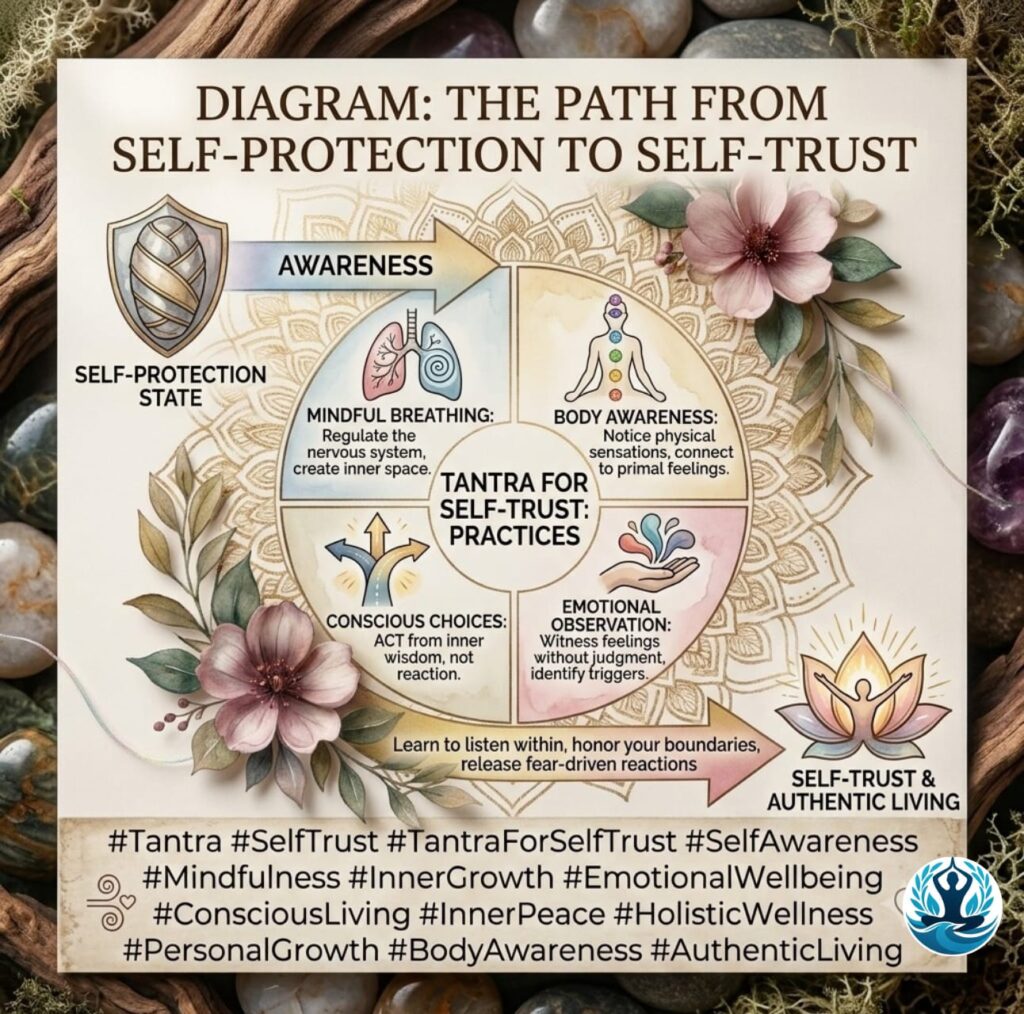
Tantra offers a radically different approach. Rather than teaching confidence through affirmations, willpower, or mindset hacks, Tantra rebuilds self-trust from the inside out—through body-based awareness. By restoring a felt sense of safety, presence, and inner listening, Tantra helps confidence arise naturally, without force.
This article explores how Tantra supports self-trust, why the body is essential in rebuilding confidence, and how embodied awareness becomes the foundation for authentic decision-making and self-respect.
Understanding Self-Trust Through the Tantric Lens
In Tantra, self-trust is not a belief—it is a felt relationship with your own experience.
You trust yourself when:
-
You can feel what is true for you
-
You can stay present with discomfort without abandoning yourself
-
You can sense your limits, needs, and desires clearly
-
You act in alignment with your inner signals
From a Tantric perspective, mistrust doesn’t come from weakness or failure. It comes from disconnection—especially disconnection from the body.
When you are disconnected from bodily sensation, you rely on mental narratives, social conditioning, or fear-based patterns to guide your life. This creates confusion, self-doubt, and chronic second-guessing.
Tantra restores trust by bringing awareness back to the body—not as an object to control or improve, but as an intelligent, living source of wisdom.
Why Confidence Cannot Be Forced
Modern self-help culture often treats confidence as something you must build through effort:
-
“Fake it till you make it”
-
“Push past fear”
-
“Silence self-doubt”
While these strategies may produce short-term results, they often deepen inner fragmentation. The body may feel overwhelmed or unsafe while the mind pushes forward. This inner split erodes self-trust rather than strengthening it.
Tantra recognizes that true confidence emerges when the nervous system feels safe.
Without safety, the body stays in survival mode—fight, flight, freeze, or fawn. In these states, intuition becomes inaccessible, and self-trust collapses.
Tantric practices work gently with the nervous system, allowing confidence to arise organically as the body learns that it is safe to feel, sense, and respond.
The Body as the Source of Inner Authority
In Tantra, the body is not secondary to the mind—it is primary.
Your body communicates constantly through:
-
Sensation
-
Tension and relaxation
-
Breath patterns
-
Subtle impulses and impulses to move
-
Emotional waves
When you listen to these signals without judgment, the body becomes a reliable compass.
Self-trust grows when you:
-
Notice sensations instead of overriding them
-
Respect signals of “yes,” “no,” and “not yet”
-
Stay present with uncertainty instead of rushing to conclusions
This kind of listening retrains the nervous system to trust itself—and in turn, you begin to trust yourself.
How Trauma and Conditioning Break Self-Trust
Many people struggle with self-trust not because they lack intuition, but because they’ve learned not to listen to it.
Experiences that commonly disrupt self-trust include:
-
Emotional invalidation in childhood
-
Chronic criticism or control
-
Being rewarded for compliance instead of authenticity
-
Cultural or spiritual shaming of the body
-
Trauma that required disconnection to survive
In these situations, ignoring bodily signals becomes a coping mechanism. Over time, this creates confusion, self-doubt, and a sense of inner unreliability.
Tantra does not force people to “trust again.” It rebuilds trust slowly by helping the body experience choice, consent, and presence.
Body-Based Awareness: The Core of Tantric Practice
Body-based awareness means sensing what is happening in the body without trying to change it.
This is radically different from most performance-based approaches to growth.
In Tantra, awareness itself is transformative.
Key principles include:
-
Feeling before fixing
-
Listening before acting
-
Allowing before directing
By staying present with sensation—pleasant, unpleasant, or neutral—the body learns that it does not need to shut down or escalate. This restores internal coherence, which is the foundation of confidence.
The Role of Breath in Rebuilding Self-Trust
Breath is a bridge between the conscious and unconscious body.
In Tantra, breath is used not to control the body, but to enter relationship with it.
When you follow your natural breath:
-
The nervous system settles
-
Sensations become clearer
-
Emotional patterns surface gently
-
Awareness deepens without force
As breath awareness grows, so does trust. You begin to feel that you can stay with your experience, even when it’s uncomfortable. This ability is central to confidence.
From Self-Doubt to Inner Listening
Self-doubt often arises when the mind is disconnected from bodily truth.
Tantric practices help shift authority from mental narratives to embodied experience.
Instead of asking:
-
“What should I do?”
-
“What’s the right choice?”
You begin to ask:
-
“What do I feel when I imagine this choice?”
-
“Where does my body soften or contract?”
-
“What feels aligned right now?”
These subtle signals guide decisions more accurately than fear or social pressure.
Over time, acting from embodied awareness builds a feedback loop: you listen, you act, you feel the result, and trust deepens.
Tantra and the Power of Slowness
One of Tantra’s most misunderstood aspects is its emphasis on slowness.
Slowness is not laziness—it is precision.
When you slow down:
-
Sensations become more distinguishable
-
Emotional reactions soften
-
The nervous system has time to respond rather than react
This creates space for discernment. Instead of impulsive decisions or avoidance, you act from clarity.
Confidence grows not from speed, but from attunement.
Reclaiming Boundaries Through the Body
Healthy boundaries are a natural expression of self-trust.
In Tantra, boundaries are not imposed rules; they are felt experiences.
Your body naturally signals:
-
When something feels invasive
-
When you need rest or space
-
When engagement feels nourishing
As body awareness increases, boundaries become clearer and easier to maintain—without guilt or explanation.
This embodied boundary awareness strengthens confidence and self-respect.
Tantra, Shame, and the Return of Confidence
Shame is one of the greatest obstacles to self-trust.
Shame teaches the body that its impulses, sensations, or desires are wrong. Over time, this creates self-distrust and inner conflict.
Tantric practice meets shame with presence instead of judgment.
By staying with sensation and emotion without labeling them as good or bad, shame gradually dissolves. Confidence returns not as arrogance, but as comfort in one’s own skin.
Living Confidence vs. Performing Confidence
Tantra distinguishes between:
-
Performed confidence (how you appear)
-
Lived confidence (how you feel internally)
Lived confidence is quiet, flexible, and grounded. It allows vulnerability without collapse and strength without aggression.
This kind of confidence cannot be learned intellectually. It emerges through repeated experiences of embodied presence.
Everyday Tantric Practices for Self-Trust
You don’t need elaborate rituals to rebuild self-trust. Tantra is meant to be lived.
Simple daily practices include:
-
Pausing to feel your body before making decisions
-
Noticing breath during emotional moments
-
Allowing sensations without rushing to interpret them
-
Saying “I don’t know yet” and staying present
Each moment of listening strengthens the inner bond of trust.
The Long-Term Benefit: Inner Reliability
As Tantric body-based awareness deepens, something subtle but powerful happens: you become reliable to yourself.
You stop abandoning your experience.
You stop forcing yourself into misaligned choices.
You stop outsourcing authority.
This reliability is the deepest form of confidence.
Conclusion: Confidence as a Byproduct of Presence
Tantra teaches that self-trust is not something to achieve—it is something to remember.
When you return to the body, listen to its signals, and stay present with your experience, confidence emerges naturally. Not as bravado, but as quiet knowing.
Through body-based awareness, Tantra rebuilds confidence at its roots—by restoring your relationship with yourself.
And from that place, trust is no longer something you seek.
It is something you live.