

How Tantra Develops Moment-to-Moment Presence

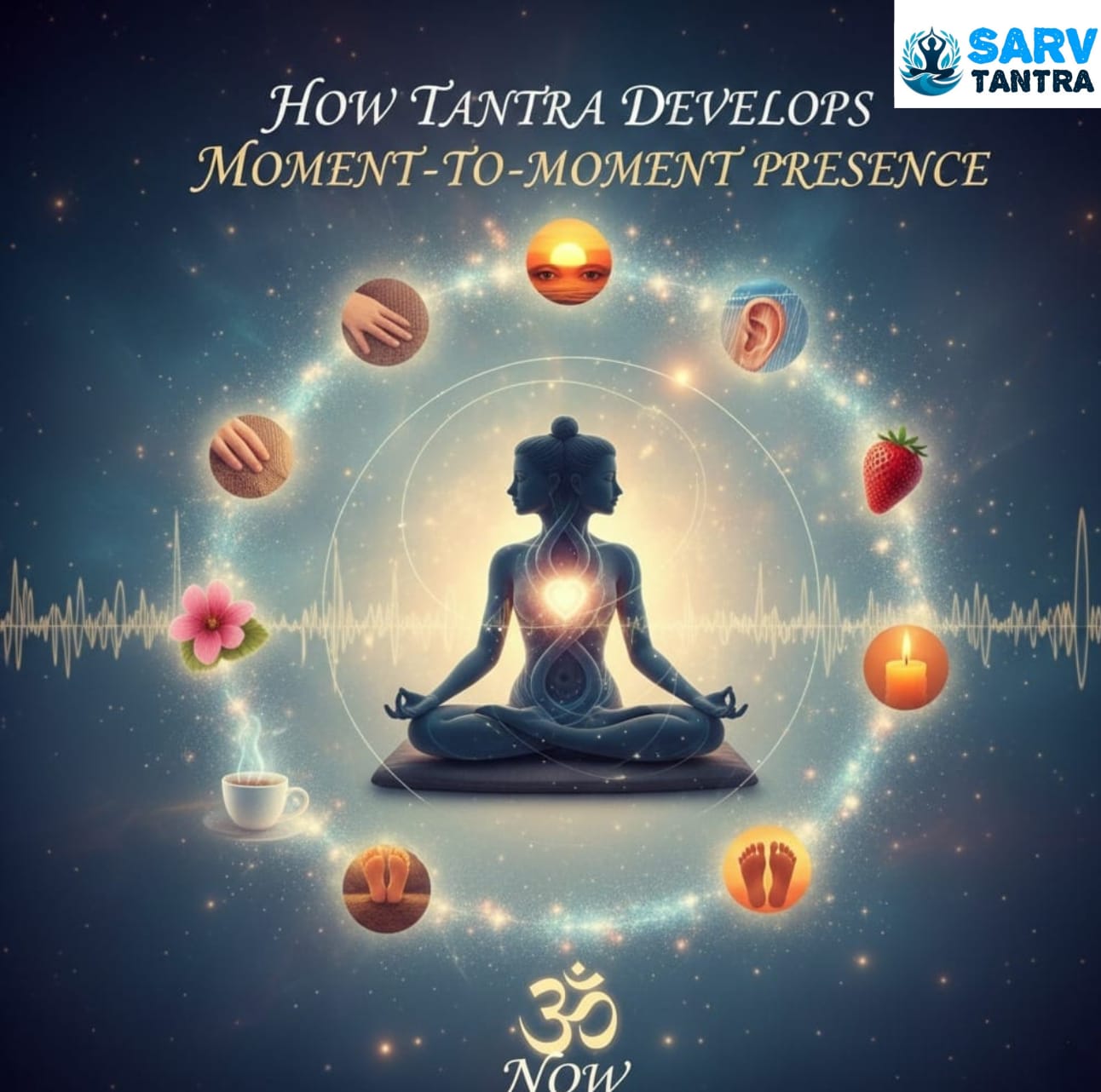
In a world dominated by distraction, speed, and constant mental noise, the ability to stay present has become one of the most valuable inner skills. Many people attempt to cultivate presence through meditation, mindfulness, or concentration techniques, yet often struggle to sustain awareness beyond short periods. The mind drifts. The body feels distant. Life continues to feel fragmented.
Tantra offers a radically different approach to presence. Rather than training the mind to control attention, Tantra teaches you to enter the present moment through the body, sensation, breath, and energy. Presence in Tantra is not a forced mental state—it is a natural outcome of deep embodied awareness.
This article explores how Tantra develops moment-to-moment presence, why this approach works at a nervous-system level, and how you can begin integrating Tantric principles into daily life for effortless awareness.
Understanding Moment-to-Moment Presence
Moment-to-moment presence means:
- Being aware of what is happening right now
- Feeling sensations as they arise
- Noticing thoughts without becoming lost in them
- Staying connected to your body and environment
Presence is not about suppressing thinking. It is about anchoring awareness in lived experience rather than mental commentary.
Most people live primarily in anticipation of the future or replay of the past. This habitual time-traveling of the mind disconnects awareness from the present moment, creating anxiety, tension, and dissatisfaction.
Tantra recognizes this pattern and addresses it at its root—not through willpower, but through embodied awakening.
Tantra’s View of Presence
In Tantra, presence is not something you create. It is your natural state.
Distraction arises when awareness becomes contracted into thinking. Tantra gently expands awareness back into the body, breath, senses, and subtle energy.
Rather than labeling experiences as distractions, Tantra treats everything—thoughts, emotions, sensations, sounds, and even discomfort—as doorways into presence.
Nothing needs to be excluded.
Nothing needs to be perfected.
Everything becomes part of awareness.
This inclusive attitude is one of Tantra’s greatest strengths.
Why Presence Is Difficult for Most People
Several conditioning patterns make presence challenging:
- Chronic stress
- Nervous system dysregulation
- Trauma stored in the body
- Over-identification with thinking
- Habitual multitasking
When the nervous system is in survival mode, attention naturally scans for threats or escapes into mental activity. Presence feels unsafe.
Tantra works directly with these layers rather than trying to bypass them.
Tantra Works Through the Body First
Unlike many purely cognitive mindfulness approaches, Tantra begins with somatic awareness.
The body always exists in the present moment.
By placing attention on bodily sensation—breath, temperature, pressure, movement—you automatically step out of abstract thinking and into immediate experience.
Over time, this trains the nervous system to associate presence with safety.
Presence becomes familiar.
Presence becomes comfortable.
Presence becomes home.
Sensation as the Gateway to Presence
Tantra emphasizes feeling rather than analyzing.
Sensation anchors awareness in reality.
When you feel:
- The rise and fall of breath
- The weight of your body
- The pulse of energy
- Subtle tingling or warmth
Your attention is naturally stabilized.
You are here.
Sensation-based awareness does not require effortful concentration. It arises organically.
This is why Tantra presence feels soft rather than strained.
Breath Awareness in Tantra
Breath is one of Tantra’s primary tools for developing presence.
Not controlling the breath.
Not forcing patterns.
Simply feeling the breath move.
Breath awareness:
- Grounds attention
- Regulates the nervous system
- Bridges conscious and unconscious processes
As you feel each inhale and exhale, awareness naturally returns to the moment.
Over time, breath becomes an anchor you can access anywhere.
Slowing Down Perception
One of Tantra’s most powerful contributions is teaching people to slow down their internal experience.
Modern life conditions fast perception:
- Quick reactions
- Rapid judgments
- Instant interpretation
Tantra invites you to feel experiences more slowly.
When perception slows:
- Sensations become clearer
- Subtle details emerge
- Awareness deepens
Slowness is not laziness. It is precision.
Slower awareness naturally stabilizes presence.
Including Thoughts Instead of Fighting Them
Many people believe presence requires stopping thoughts.
Tantra disagrees.
Trying to eliminate thoughts often creates more tension.
Instead, Tantra teaches:
- Notice thoughts
- Feel their energetic quality
- Let them pass
Thoughts become objects of awareness rather than identities.
You are not your thoughts.
You are the awareness that notices them.
This shift is central to sustained presence.
Developing Witness Consciousness
Witness consciousness is the capacity to observe experience without being consumed by it.
Tantra cultivates this by continuously inviting awareness back to:
- Sensation
- Breath
- Energy
- Space
The witness grows naturally.
No forcing.
No strain.
With time, you begin to sense a stable awareness behind all experiences.
This witnessing presence remains even when emotions arise.
How Tantra Trains the Nervous System
Presence is not only a mental skill. It is a physiological state.
Tantric practices activate the parasympathetic nervous system—the rest-and-digest response.
Effects include:
- Lower cortisol
- Slower heart rate
- Relaxed muscles
- Improved digestion
When the nervous system feels safe, awareness naturally settles into the present.
This is why Tantra emphasizes safety, softness, and gradual opening.
Micro-Presence Throughout the Day
Tantra is not limited to formal practice sessions.
Small moments of presence accumulate.
Examples:
- Feeling water while washing hands
- Sensing footsteps while walking
- Noticing breath while waiting
- Feeling the texture of food
These micro-moments retrain attention.
Presence becomes continuous rather than occasional.
Tantra and Sensory Awakening
Tantra sharpens the senses.
Colors appear richer.
Sounds feel fuller.
Touch becomes more vivid.
Sensory richness naturally holds attention in the present.
The world becomes more alive.
Presence becomes pleasurable.
Pleasure as an Anchor to Presence
Tantra recognizes pleasure as a powerful doorway to awareness.
When something feels good and you allow yourself to fully feel it, attention naturally stabilizes.
Pleasure does not mean excess or indulgence.
It means simple embodied enjoyment:
- Warm sunlight
- Gentle stretch
- Deep breath
- Soft touch
Pleasure teaches the nervous system that being present is rewarding.
Emotional Presence
Tantra encourages feeling emotions directly rather than suppressing or dramatizing them.
You learn to sense emotions as energy in the body.
This transforms emotional experience from story into sensation.
Feeling emotions in this way keeps you present even during intensity.
Presence becomes resilient.
From Practice to Lifestyle
In Tantra, presence is not confined to meditation cushions.
It extends into:
- Conversations
- Work
- Creativity
- Relationships
You learn to feel yourself while speaking.
To sense your body while listening.
To stay aware while moving.
Life itself becomes meditation.
Common Obstacles
Restlessness
Tantra meets restlessness with curiosity rather than judgment.
Feel the restlessness.
Notice its texture.
Presence grows through inclusion.
Numbness
Gentle sensation practices gradually reawaken feeling.
No forcing.
Sleepiness
Light breath awareness and subtle movement can refresh attention.
Signs Presence Is Deepening
- Less mental chatter
- Faster recovery from stress
- Increased body awareness
- More enjoyment of simple experiences
- Greater emotional stability
These changes often appear gradually.
Subtle but profound.
A Simple Tantric Presence Practice
- Sit or lie comfortably.
- Place attention on breath sensations.
- Feel the body from inside.
- Notice sensations without labeling.
- When thoughts arise, gently return to feeling.
- Continue for 5–15 minutes.
Consistency matters more than duration.
Long-Term Transformation
As moment-to-moment presence stabilizes:
- Anxiety decreases
- Decision-making improves
- Relationships deepen
- Self-trust grows
Life feels more spacious.
You begin to live from awareness rather than toward imagined outcomes.
Tantra vs Traditional Mindfulness
While both cultivate awareness:
- Mindfulness often emphasizes observation
- Tantra emphasizes embodied participation
Tantra engages the whole organism.
Mind, body, emotions, and energy move together.
This integrated approach creates stable, lived presence.
Presence as Spiritual Maturity
In Tantra, enlightenment is not escape from life.
It is intimacy with life.
Presence is spiritual maturity.
Fully here.
Fully alive.
Conclusion
Tantra develops moment-to-moment presence by gently reuniting awareness with the body, breath, senses, and energy. Instead of controlling the mind, Tantra softens the nervous system and invites embodied awareness to emerge naturally.
Through sensation, slowness, breath, pleasure, and emotional inclusion, presence becomes effortless and sustainable.
Presence is not something to achieve.
It is what you already are—remembered.