

How Tantra Helps You Feel Safe in Your Body Again


Many people today live disconnected from their bodies without realizing it. Chronic stress, emotional overwhelm, unresolved experiences, and constant mental stimulation can slowly erode the natural sense of safety we are meant to feel within ourselves. When the body no longer feels like a safe place, symptoms may arise—anxiety, fatigue, numbness, overthinking, emotional reactivity, or a constant feeling of being “on edge.”
Tantra offers a powerful yet gentle path back home to the body. Unlike practices that aim to control, suppress, or transcend bodily experience, Tantra begins with a radical premise: the body is not the problem—it is the gateway to healing, presence, and wholeness.
This article explores how Tantra helps restore bodily safety, why this sense of safety is essential for well-being, and how Tantric awareness works at a deep nervous-system level to rebuild trust between the mind and the body.
Understanding What It Means to Feel Safe in the Body
Feeling safe in the body does not mean constant comfort or pleasure. It means:
-
Being able to feel sensations without panic or avoidance
-
Remaining present with emotions as they arise
-
Trusting bodily signals rather than fearing them
-
Experiencing rest without guilt or vigilance
When safety is present, the body naturally regulates itself. Breath deepens, muscles soften, digestion improves, sleep becomes restorative, and emotions flow without overwhelming the system.
When safety is absent, the body stays in survival mode—fight, flight, freeze, or shutdown—even in moments that appear calm.
Why Modern Life Disconnects Us from Bodily Safety
Modern culture subtly trains people to override bodily signals:
-
Productivity is valued over rest
-
Emotional suppression is mistaken for strength
-
Overthinking is rewarded more than felt awareness
-
Speed replaces attunement
Over time, this creates a split between mind and body. The mind becomes dominant, while the body is treated as something to manage, fix, or ignore.
Tantra addresses this imbalance not by forcing relaxation, but by re-establishing communication between awareness and sensation.
Tantra’s Core Principle: Safety Comes Before Transformation
One of the most misunderstood aspects of Tantra is its reputation for intensity. In truth, authentic Tantra prioritizes safety, regulation, and presence above all else.
Tantric wisdom recognizes that no lasting transformation happens in a body that feels unsafe. Healing unfolds naturally when the nervous system is supported rather than pushed.
This is why Tantra emphasizes:
-
Slowness over effort
-
Awareness over achievement
-
Inclusion over resistance
How Tantra Works with the Nervous System
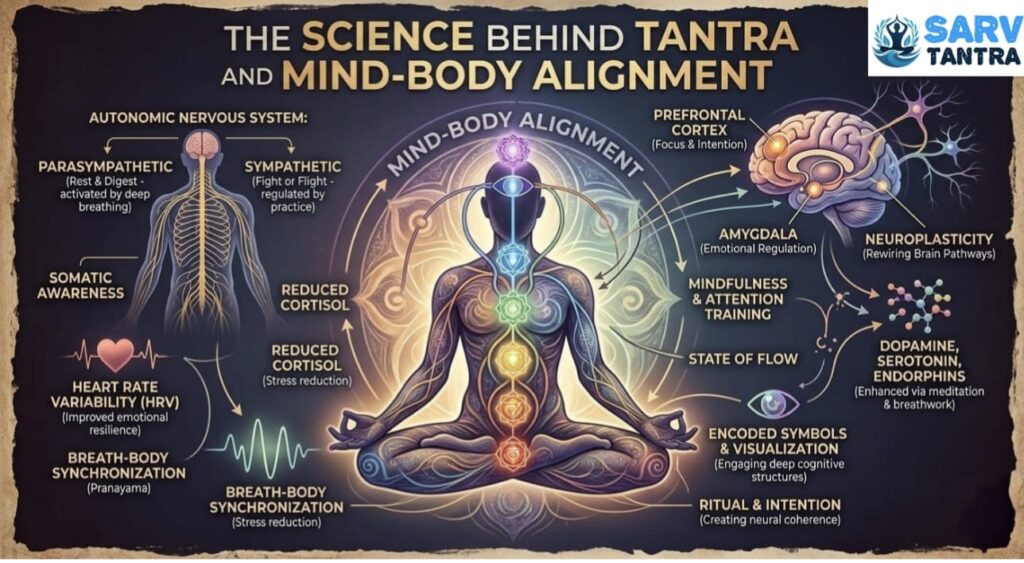
At its foundation, Tantra is a nervous-system-based practice, even though ancient texts did not use modern terminology.
1. From Hypervigilance to Regulation
When the body has learned to stay alert, Tantric practices invite awareness to move slowly through sensation without judgment. This signals the nervous system that it is safe to soften.
Breath, attention, and stillness work together to downshift the system from survival mode into regulation.
2. Building Capacity Instead of Forcing Release
Tantra does not demand emotional release. Instead, it builds the capacity to feel safely.
As capacity grows, tension releases on its own—without retraumatization or overwhelm.
Reclaiming Sensation Without Fear
Many people associate bodily sensation with danger due to past experiences, stress, or emotional overload. Tantra helps change this relationship.
Rather than diving into intense sensations, Tantra begins with neutral or pleasant awareness:
-
The feeling of breath at the nostrils
-
The weight of the body on the ground
-
Subtle warmth or tingling
Over time, the body relearns that sensation is not a threat. This gradual approach rebuilds trust organically.
Tantra and the Healing of Dissociation
Dissociation occurs when awareness disconnects from the body as a protective response. While dissociation once served a purpose, it can persist long after danger has passed.
Tantra gently reverses dissociation by:
-
Anchoring awareness in physical sensation
-
Encouraging choice and agency
-
Avoiding sudden emotional flooding
The emphasis is always on staying present without force.
Breath as a Bridge to Safety
In Tantra, breath is not controlled—it is listened to.
By allowing breath to move naturally while staying aware of its rhythm, the body begins to self-regulate. Shallow or restricted breathing gradually opens without instruction.
This restores a sense of internal safety because breath reflects the state of the nervous system more directly than thought.
Restoring Trust in Bodily Signals
Many people no longer trust their bodies. Hunger, fatigue, emotion, and desire are often overridden.
Tantra restores this trust by teaching practitioners to:
-
Listen before acting
-
Feel before deciding
-
Respond rather than react
As bodily signals are honored, the body learns it is no longer ignored or betrayed.
The Role of Stillness in Feeling Safe
Stillness can feel threatening to a dysregulated system. Tantra approaches stillness gradually.
Moments of quiet awareness—without expectation—allow the body to experience rest without collapse or fear.
Over time, stillness becomes nourishing rather than unsettling.
Tantra and Emotional Safety
Emotions are sensations moving through the body. When emotions were previously overwhelming, the body learned to suppress or avoid them.
Tantra reframes emotions as temporary movements of energy rather than problems to fix.
This perspective:
-
Reduces fear around emotional experience
-
Allows feelings to arise and pass naturally
-
Builds emotional resilience
Releasing Shame Stored in the Body
Shame often lives in posture, breath restriction, and muscle tension. Tantra addresses shame not through affirmation, but through embodied acceptance.
By meeting the body exactly as it is—with awareness rather than judgment—shame gradually dissolves.
Feeling safe in the body includes feeling worthy of occupying space.
Why Tantra Avoids Aggressive Techniques
Some practices emphasize catharsis or dramatic release. Tantra takes a different approach.
Sudden intensity can overwhelm the nervous system, reinforcing unsafety. Tantra instead supports slow integration, ensuring changes are sustainable.
This makes Tantra especially effective for people who feel fragile, exhausted, or overwhelmed.
Safety Through Choice and Consent
A core Tantric principle is choice. Nothing is forced. Awareness is invited, not imposed.
This restores agency—an essential component of bodily safety.
When the body experiences choice, it relaxes naturally.
Daily Tantric Practices That Support Bodily Safety
Body Scanning Without Fixing
Simply noticing sensation without changing it teaches the body it does not need to defend itself.
Grounded Breathing
Allowing breath to find its own depth while staying present.
Sensory Anchoring
Feeling textures, temperature, or sound to anchor awareness in the present moment.
Tantra as a Long-Term Relationship with the Body
Feeling safe in the body is not a one-time achievement—it is an ongoing relationship.
Tantra encourages curiosity rather than expectation. Each moment becomes an opportunity to listen and respond.
Signs That Tantra Is Restoring Bodily Safety
-
Increased ability to rest without guilt
-
Reduced emotional reactivity
-
Greater comfort with stillness
-
Improved sleep and digestion
-
A sense of “coming home” to oneself
Tantra Versus Control-Based Healing Approaches
Many healing methods rely on discipline, control, or cognitive reframing. Tantra complements these by addressing what cannot be thought away—the nervous system’s lived experience.
This is why Tantra often succeeds where effort-based approaches fail.
Integrating Tantra into Modern Life
Tantra does not require retreat from daily responsibilities. Its practices integrate seamlessly into ordinary life—walking, breathing, resting, listening.
Safety becomes something lived, not practiced only on a mat.
Conclusion: Coming Home to the Body
Feeling safe in your body again is not about fixing yourself. It is about remembering something that was never truly lost.
Tantra offers a compassionate, embodied path back to safety—one breath, one sensation, one moment of awareness at a time.
When the body feels safe, life unfolds with greater ease, clarity, and depth. And in that safety, genuine transformation becomes possible.