


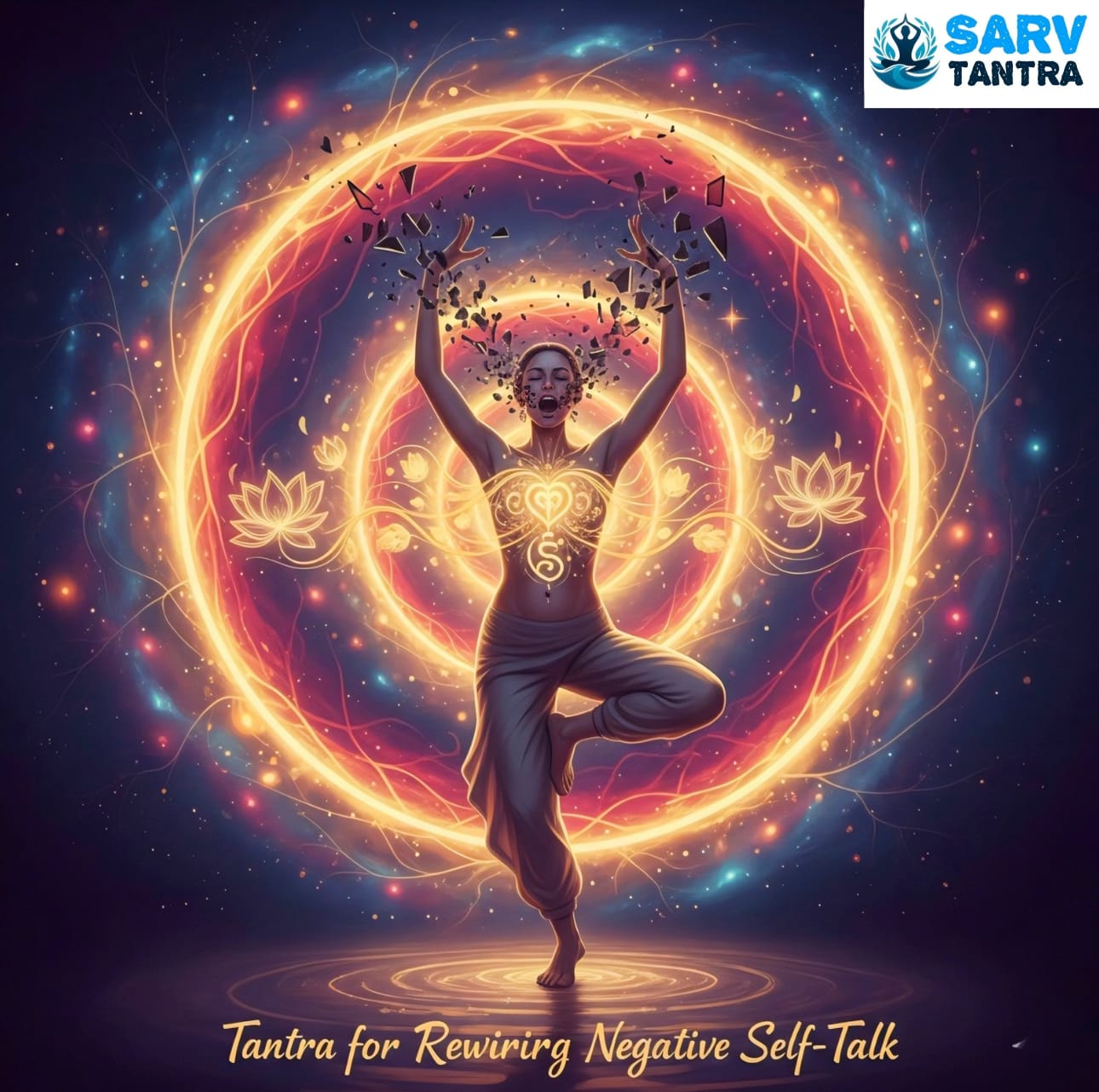
Tantra for Rewiring Negative Self-Talk

Most people live with a constant internal narrator. It comments on decisions, judges mistakes, compares appearances, and predicts failure. Over time, this voice becomes so familiar
that we mistake it for truth. Negative self-talk quietly shapes confidence, relationships, career choices, and even physical health.
Modern psychology recognizes that repetitive thought patterns reshape neural pathways. What we tell ourselves repeatedly becomes the lens through which we experience life. Yet while many approaches attempt to correct thoughts through logic or affirmation, Tantra offers a different path — one that works through the body, breath, sensation, and awareness.
Tantra does not try to silence the mind through force. Instead, it dissolves negative self-talk by changing the relationship between awareness and thought. Through embodied practices, Tantra teaches us to experience ourselves directly rather than through the distorted commentary of the inner critic.
This article explores how Tantra helps rewire negative self-talk, why it works, and how you can apply its principles in daily life.
Understanding Negative Self-Talk: Where It Comes From
Negative self-talk is not random. It develops from conditioning, memory, and survival instincts.
Common roots include:
- Childhood criticism or comparison
- Social pressure and cultural expectations
- Fear of rejection or failure
- Past mistakes internalized as identity
- Chronic stress or trauma stored in the body
Over time, these influences form subconscious narratives like:
- “I’m not good enough.”
- “I always mess things up.”
- “Others are better than me.”
- “I must prove my worth.”
The mind repeats these scripts automatically, believing it is protecting us from future pain. But instead, they create contraction in the body, tension in relationships, and avoidance of growth.
Tantra sees these thoughts not as enemies, but as energetic patterns. They are sensations, breath rhythms, muscle contractions, and emotional imprints stored in the nervous system. Therefore, Tantra addresses negative self-talk through the body rather than through argument.
Why Mental Approaches Alone Often Fail
Many people try to overcome negative self-talk by replacing it with positive affirmations. While helpful, this approach often feels superficial.
If the body remains tense, the breath shallow, and emotions unprocessed, the subconscious continues reinforcing the old pattern.
For example:
A person may repeat “I am confident,” yet their shoulders remain tight, stomach clenched, and breath restricted. The nervous system still signals threat. The affirmation conflicts with embodied reality, so the mind returns to its old story.
Tantra recognizes that belief follows sensation. When the body feels safe, the mind softens. When the breath deepens, the inner voice changes tone naturally. Therefore, Tantra rewires self-talk from the inside out.
The Tantric View of the Inner Critic
In Tantra, thoughts are considered movements of energy, not fixed truths. The inner critic is not an enemy but a contracted expression of life force.
Instead of fighting it, Tantra invites us to:
- Notice the sensation behind the thought
- Feel the emotion without resisting it
- Breathe into the contracted area
- Allow energy to move and release
As awareness increases, the thought loses its emotional charge. Without energy feeding it, the pattern dissolves.
This process transforms the relationship to self-talk from conflict to curiosity.
How Tantra Rewires the Brain Through the Body
Tantric practices affect self-talk through several mechanisms:
1. Regulating the Nervous System
Negative self-talk thrives in a stressed nervous system. When the body feels unsafe, the mind scans for problems and self-blame.
Tantric breathing practices activate the parasympathetic nervous system, which signals safety. As the body relaxes, the brain reduces defensive thinking.
2. Releasing Stored Emotional Energy
Tantra uses movement, sound, and sensation awareness to release emotions stored in muscles and fascia. When these energies move, the thoughts attached to them often fade.
3. Expanding Awareness Beyond Thought
Tantra trains attention to include breath, sensation, space, and presence. When awareness expands, thoughts lose their dominance. They become just one element of experience rather than the authority.
4. Replacing Judgment with Direct Experience
Negative self-talk lives in abstraction. Tantra brings awareness into direct sensation — warmth, movement, vibration, touch. Direct experience interrupts mental narratives and reconnects us with reality.
Core Tantric Practices for Rewiring Negative Self-Talk
1. The Practice of Witnessing
This foundational Tantric method trains awareness to observe thoughts without merging with them.
How to practice:
- Sit comfortably with relaxed posture
- Notice your breath moving naturally
- Observe thoughts as passing clouds
- Do not suppress or analyze them
- Simply notice: “A thought is happening”
Over time, you begin to experience that you are not the voice in your head — you are the awareness observing it.
This realization alone reduces the power of negative self-talk dramatically.
2. Breath Expansion Practice
Negative self-talk often correlates with shallow breathing. Expanding the breath expands emotional capacity.
Steps:
- Inhale slowly through the nose into the belly
- Let the chest expand gently
- Exhale longer than the inhale
- Relax the jaw and throat
As the breath deepens, many people notice that the inner critic softens or becomes quieter.
This is not coincidence — it is nervous system regulation in action.
3. Feeling the Thought in the Body
Instead of analyzing a negative thought, Tantra invites you to locate its sensation.
For example, if the thought is “I am not good enough,” ask:
- Where do I feel this in my body?
- Is it tightness, heat, heaviness, or pressure?
- Can I breathe into that area?
Stay with sensation rather than the story.
This shifts attention from mental narrative to embodied presence, where healing actually occurs.
4. Sound Release Practice
Tantra uses sound to move emotional energy.
When negative self-talk arises:
- Exhale with a soft “ahhhh” sound
- Let the sound vibrate through the chest or throat
- Repeat until tension reduces
Sound engages the vagus nerve, calming the nervous system and dissolving emotional charge attached to thoughts.
5. Compassionate Touch Awareness
Self-touch practices help rewire the inner relationship.
Place one hand on the heart or belly and breathe slowly. Feel warmth and contact. Imagine offering kindness to the part of you that feels inadequate or judged.
This simple act sends signals of safety and belonging to the brain, gradually replacing criticism with care.
How Tantra Changes Your Relationship with Yourself
As these practices deepen, several shifts occur:
You Stop Believing Every Thought
You begin to see thoughts as temporary weather patterns rather than identity.
You Feel Safer in Your Body
When the body relaxes, the mind no longer needs constant self-evaluation.
You Develop Inner Compassion
Instead of fighting your inner critic, you learn to understand its fears and unmet needs.
You Experience More Silence Between Thoughts
Tantra does not eliminate thinking. It expands the space around thoughts so they no longer dominate.
Tantra and Self-Trust
Negative self-talk often reflects a lack of trust in oneself. Tantra rebuilds trust through direct experience.
When you repeatedly feel:
- Your breath calming you
- Your awareness holding emotions
- Your body releasing tension
You begin to trust your capacity to handle life.
Self-trust replaces self-criticism naturally.
Tantra in Everyday Moments
The beauty of Tantra is that it works in ordinary life.
You can practice rewiring self-talk:
- While walking, by feeling each step
- While speaking, by noticing your breath
- While working, by relaxing your jaw and shoulders
- While resting, by sensing your body from inside
Each moment of embodied awareness interrupts habitual mental patterns and strengthens new ones.
Long-Term Transformation
Over time, Tantric practice does not merely reduce negative self-talk — it transforms the entire inner atmosphere.
People often notice:
- Increased emotional stability
- Greater self-acceptance
- More authentic communication
- Less comparison with others
- Increased creativity and confidence
The inner voice shifts from critic to guide, from judge to companion.
Conclusion: Returning to Inner Friendship
Negative self-talk is not a personal flaw. It is a learned survival pattern that once tried to protect you.
Tantra offers a compassionate path for rewiring this pattern, not through force, but through awareness, breath, and embodied presence.
When you learn to feel yourself rather than judge yourself, the inner dialogue softens. When you inhabit your body fully, the mind stops fighting for control. And when awareness expands, you discover that beneath all thoughts lies a steady presence that has always been whole.
Tantra does not replace your inner voice — it transforms it into an ally.