

Tantra for Inner Safety and Self-Trust


In today’s fast-paced, uncertain world, many people live with a quiet sense of unease. Even when life appears stable externally, internally there may be anxiety, self-doubt, hypervigilance, or a constant need for reassurance. We look for safety in relationships, achievements, spiritual practices, or external validation—yet still feel ungrounded.
Inner safety is the felt sense that “I am okay in myself.”
Self-trust is the confidence that “I can meet my experience without abandoning myself.”
Tantra offers a profound yet practical path to cultivate both.
Unlike systems that focus on escaping discomfort or fixing the self, Tantra teaches us how to rest within experience, reclaim bodily intelligence, and rebuild trust in our awareness. Tantra does not promise a life without challenges; it offers the capacity to feel safe within life as it is.
This article explores how Tantra for inner safety and self-trust works at a deep level—and how its principles can be applied in everyday life.
Understanding Inner Safety from a Tantric Perspective
In Tantra, safety is not created by control, avoidance, or perfection. It arises from inclusion.
Tantric philosophy recognizes that fear, desire, sadness, joy, confusion, and stillness all arise within the same field of consciousness. When parts of our experience are rejected, inner fragmentation occurs. This fragmentation is felt as insecurity or lack of trust.
Inner Safety in Tantra Means:
-
Feeling at home in the body
-
Allowing emotions without being overwhelmed
-
Trusting awareness to hold all experiences
-
Knowing you do not need to escape yourself
Rather than asking, “How do I get rid of fear?” Tantra asks,
“Can awareness stay present even with fear?”
When the answer becomes yes, safety is restored from within.
Why Self-Trust Is Often Broken
Self-trust is not lost suddenly. It is eroded over time.
Common causes include:
-
Repeated invalidation of emotions
-
Trauma or overwhelming experiences
-
Cultural conditioning that values thinking over feeling
-
Spiritual teachings that shame desire, anger, or vulnerability
-
Living disconnected from bodily wisdom
When we stop listening to our sensations, intuition, and inner signals, we begin outsourcing trust—to authority figures, belief systems, or constant reassurance.
Tantra reverses this process by re-establishing intimacy with direct experience.
Tantra’s Core Teaching: Awareness Is Safe
One of Tantra’s most radical insights is this:
Awareness itself is never harmed by experience.
Thoughts change. Emotions surge and fade. Sensations arise and dissolve. But the awareness that knows them remains intact.
When this is not just understood intellectually but felt somatically, something profound shifts. The nervous system begins to relax. Hypervigilance softens. Trust grows.
Inner safety in Tantra is rooted not in what happens—but in what is aware of what happens.
The Body as the Foundation of Inner Safety
Tantra is deeply embodied. It recognizes the body not as an obstacle, but as a gateway to presence.
Many people feel unsafe because they live mostly in the mind. The body, when ignored, becomes a source of tension or fear. Tantra gently restores the body as a place of refuge.
How Tantra Rebuilds Safety Through the Body:
-
Slow awareness of breath without control
-
Sensing weight, gravity, and contact
-
Allowing sensations without naming or judging
-
Releasing the need to “do” something with experience
When the body is felt from within, it sends signals of safety to the nervous system. This is not a technique—it is a relationship with sensation.
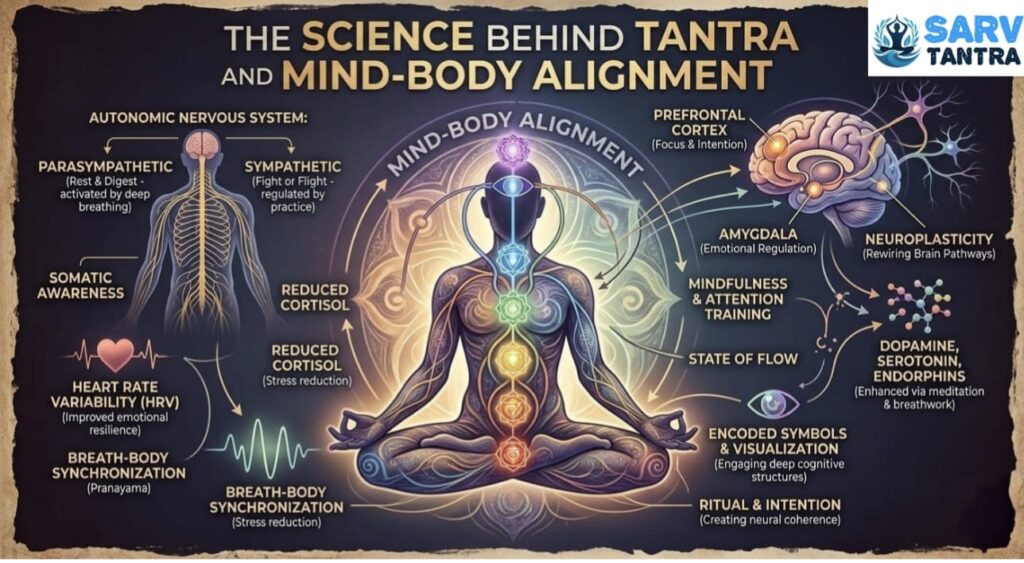
Nervous System Regulation Through Tantric Awareness
Modern psychology now confirms what Tantra has known for centuries: safety is a felt state, not a mental belief.
Tantra supports nervous system regulation by:
-
Encouraging present-moment contact
-
Reducing resistance to sensations
-
Allowing slow, natural breathing
-
Creating space around intense emotions
Unlike forceful practices, Tantra works with the nervous system, not against it. There is no pushing toward catharsis or transcendence.
Safety emerges through permission and patience.
Self-Trust Through Direct Experience
Self-trust grows when we repeatedly witness this truth:
“I can stay with my experience without being destroyed by it.”
Tantric practice is less about achieving special states and more about staying present with ordinary moments.
Each time you:
-
Feel an emotion without suppressing it
-
Notice a boundary and honor it
-
Rest in stillness without distraction
-
Trust your pace rather than forcing progress
…self-trust strengthens.
Tantra teaches that wisdom is not imported from outside—it arises from listening deeply to what is already happening.
Tantra and Emotional Safety
Many spiritual paths prioritize transcendence over emotional integration. Tantra does the opposite.
In Tantra:
-
Emotions are expressions of energy (Śakti)
-
No emotion is considered impure or wrong
-
Suppression is seen as the cause of suffering
When emotions are allowed to move through awareness, they naturally transform.
This creates emotional safety—the knowing that:
-
You don’t need to numb or dramatize emotions
-
Feelings can arise and pass
-
Awareness remains spacious
Emotional safety is a cornerstone of self-trust.
The Role of Acceptance (Not Resignation)
Tantric acceptance is often misunderstood as passivity. In truth, it is radical intimacy with reality.
Acceptance means:
-
Feeling what is present without manipulation
-
Allowing discomfort without collapse
-
Not abandoning yourself when things are difficult
From this ground, clear action arises naturally.
Inner safety deepens when we stop fighting experience and start meeting it with curiosity.
Inner Safety vs External Security
External safety—money, relationships, routines—is important. But it is fragile.
Tantra distinguishes between:
-
Outer security, which can change
-
Inner safety, which is always accessible
When inner safety is present:
-
Change feels less threatening
-
Boundaries become clearer
-
Dependence on external validation decreases
This does not make life emotionless—it makes it resilient.
Tantra for Healing Trauma (A Gentle Perspective)
Tantra is not a replacement for trauma therapy, but its principles are deeply compatible with trauma-informed healing.
Key Tantric insights helpful for trauma recovery:
-
Safety precedes transformation
-
Awareness must move at the body’s pace
-
Nothing needs to be forced or re-experienced
-
Choice and agency are central
Tantra honors the intelligence of the nervous system. It restores trust by letting the body lead.
Daily Tantric Practices for Inner Safety and Self-Trust
Here are simple, non-ritualistic ways to live Tantra daily:
1. Sensory Grounding
Pause and feel:
-
The weight of your body
-
Contact with the floor or chair
-
Natural breath moving
No analysis. Just sensation.
2. Emotional Permission
When an emotion arises, silently acknowledge:
“This is allowed.”
Notice what happens when resistance softens.
3. Boundary Awareness
Sense when something feels like a “no” in the body. Trust it—without justification.
4. Spacious Attention
Notice not just objects of experience, but the space around them. Space is inherently safe.
5. Slowing Down
Tantra values less intensity, not more. Slowness allows safety to emerge.
Tantra vs Techniques That Promise Control
Many self-help approaches promise confidence by teaching control over thoughts or emotions. Tantra offers something deeper:
-
Not control, but capacity
-
Not suppression, but integration
-
Not performance, but presence
Self-trust grows when you realize you do not need to manage life perfectly to be okay.
Living Tantra: Trusting Life Without Losing Yourself
True self-trust is not blind positivity. It is grounded realism infused with compassion.
Tantra teaches us:
-
To trust awareness, not outcomes
-
To feel fear without being ruled by it
-
To meet uncertainty without collapsing
Inner safety becomes a quiet background hum—subtle, steady, and reliable.
Common Misconceptions About Tantra and Safety
Myth: Tantra is only about intensity or breaking limits
Truth: Authentic Tantra prioritizes stability, containment, and care
Myth: You must confront everything head-on
Truth: Tantra respects pacing and readiness
Myth: Inner safety means never feeling fear
Truth: Inner safety means fear can arise without overwhelming you
The Deeper Gift of Tantra for Inner Safety
Over time, Tantra reveals something profound:
You are not safe because life is predictable.
You are safe because awareness is vast enough to hold unpredictability.
This realization is not dramatic. It is deeply quiet.
And from that quietness, trust naturally unfolds.
Conclusion: Coming Home to Yourself
Tantra for inner safety and self-trust is not about becoming someone new. It is about remembering what has always been present beneath the noise.
Through embodiment, awareness, and inclusion, Tantra gently dissolves the inner split between “what I feel” and “what I allow.”
When that split heals:
-
Safety is no longer something you chase
-
Trust is no longer something you earn
-
You begin to live from a place of grounded wholeness
This is Tantra—not as philosophy, but as lived truth.