

Tantra’s Approach to Inner Wholeness: Returning to Your Original State of Being


Almost every human being carries a subtle, persistent feeling that something inside is incomplete. Even when life appears successful on the surface, there may be an underlying sense of disconnection — from the body, from emotions, from purpose, or from a deeper self.
Modern culture often explains this feeling as a lack of achievement, status, relationships, or productivity. As a result, people spend years trying to add something to themselves: more knowledge, more discipline, more self-improvement techniques, more external validation.
Tantra offers a radically different understanding.
According to Tantra, the problem is not that you are broken.
The problem is that you have learned to experience yourself in fragments.
Tantra’s approach to inner wholeness is not about fixing a defective self. It is about remembering your original state of completeness.
This article explores:
-
What inner wholeness means in Tantra
-
Why fragmentation happens
-
How Tantra restores integration
-
The role of awareness, body, breath, and energy
-
Practical ways to cultivate wholeness in daily life
What Inner Wholeness Means in Tantra
In Tantra, wholeness is not a future achievement.
It is your natural condition.
Before labels, roles, identities, and conditioning formed, you existed as a seamless field of:
-
Awareness
-
Sensation
-
Energy
-
Presence
There was no internal division between:
-
Body and mind
-
Sacred and ordinary
-
Spiritual and physical
-
Good and bad
Tantra calls this state purnata — fullness or completeness.
Wholeness does not mean perfection.
Wholeness means nothing inside you is excluded.
Every sensation, emotion, thought, and impulse is allowed to exist within awareness.
When everything is allowed, everything belongs.
When everything belongs, you are whole.
Fragmentation: How Humans Lose the Sense of Wholeness
From early childhood, we receive subtle and overt messages about which parts of us are acceptable and which are not.
Examples:
-
“Don’t cry.”
-
“Don’t be angry.”
-
“Be quiet.”
-
“Be strong.”
-
“Good children behave this way.”
Over time, we learn to:
-
Suppress certain emotions
-
Hide certain desires
-
Contract around certain sensations
This creates internal compartments.
One part of you wants to express.
Another part is afraid of consequences.
Another part judges both.
This internal splitting becomes normal.
Eventually, many people identify only with a narrow slice of themselves — usually the thinking mind — while large areas of emotional and bodily experience remain unconscious.
Tantra describes this as loss of inner continuity.
You still exist as a whole being, but you no longer feel whole.
Why Self-Improvement Alone Cannot Create Wholeness
Most self-improvement systems operate on an unconscious assumption:
“I am not enough, and I must become better.”
While growth can be valuable, this mindset subtly reinforces fragmentation.
It divides you into:
-
The flawed self
-
The ideal self
The flawed self is rejected.
The ideal self is chased.
Tantra sees this dynamic as another layer of separation.
Wholeness cannot emerge from fighting yourself.
Wholeness emerges from ending the inner war.
When you stop trying to replace who you are with who you think you should be, something softens.
That softening is the doorway to integration.
Tantra’s Core Principle: Inclusion Instead of Exclusion
At the heart of Tantra’s approach to inner wholeness is a simple but profound principle:
Nothing is outside the path.
Your fear is not an obstacle.
Your anger is not a mistake.
Your desire is not sinful.
Your sadness is not weakness.
Everything is a movement of life.
Tantra does not ask you to get rid of inner experiences.
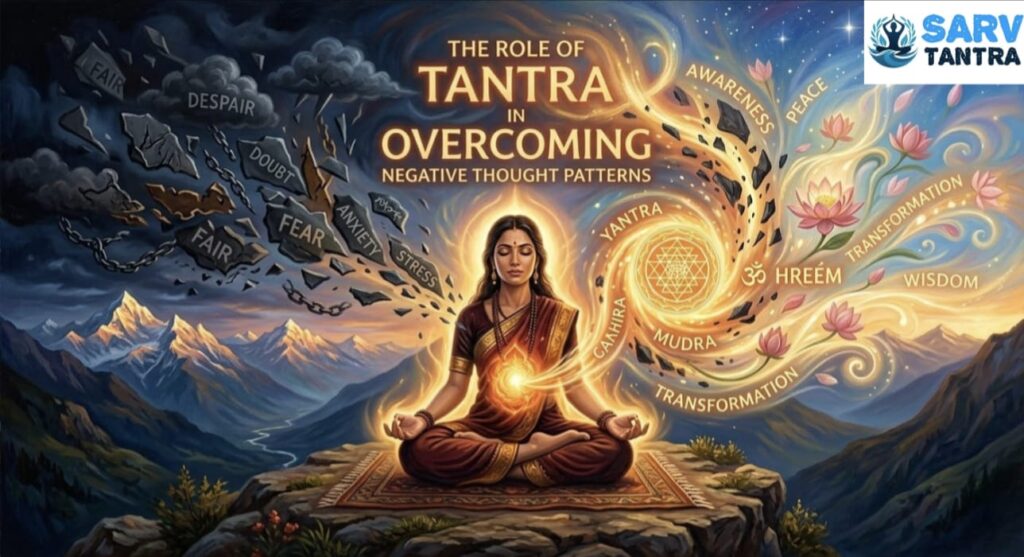
Tantra asks you to meet them with awareness.
When awareness meets experience without judgment, experience naturally integrates.
Integration does not require force.
It requires presence.
Awareness as the Great Integrator
Awareness is the space in which all experiences appear.
Thoughts appear.
Sensations appear.
Emotions appear.
They disappear.
Awareness remains.
Tantra teaches that awareness itself is whole.
When you rest as awareness, you are already whole.
Fragmentation exists only at the level of identification — identifying with one part of experience instead of the totality.
As awareness deepens:
-
You notice sensations without labeling
-
You notice emotions without suppressing
-
You notice thoughts without believing
This witnessing creates inner spaciousness.
In spaciousness, parts of you that were previously exiled begin to return.
Wholeness is not constructed.
It is revealed.
The Body as the Gateway to Wholeness
Many spiritual traditions historically emphasized transcending the body.
Tantra takes the opposite approach.
The body is not an obstacle.
The body is a doorway.
Your body contains vast intelligence:
-
Emotional memory
-
Energetic patterns
-
Instinctive wisdom
When you live mostly in your head, large areas of experience remain unfelt.
Tantric practice gently brings awareness back into:
-
Muscles
-
Skin
-
Organs
-
Breath
-
Subtle sensations
As sensation becomes conscious, numb areas begin to awaken.
This awakening restores inner continuity.
You start to feel yourself as one field, not a collection of disconnected parts.
Breath as a Bridge Between Worlds
Breath occupies a unique position.
It is both voluntary and involuntary.
It connects conscious and unconscious processes.
Tantra uses breath not to control the body, but to listen to the body.
Slow, relaxed breathing:
-
Signals safety to the nervous system
-
Softens internal contractions
-
Expands sensory awareness
As breath becomes smooth, attention naturally sinks from the head into the body.
This descent is essential for wholeness.
Many people try to become whole by thinking about themselves.
Tantra invites you to feel yourself.
Feeling integrates faster than thinking.
Emotions as Energy, Not Problems
In Tantra, emotions are not psychological defects.
They are energy in motion.
Anger is a surge of power.
Fear is heightened sensitivity.
Sadness is contraction of life force.
Joy is expansion.
Problems arise not from emotions themselves, but from resistance to them.
When you resist emotion:
-
Energy freezes
-
Tension accumulates
-
Patterns solidify
When you allow emotion:
-
Energy moves
-
Waves rise and fall
-
Space returns
Allowing does not mean acting out.
Allowing means feeling without suppression or indulgence.
As emotional energy moves freely, it naturally reintegrates into the whole.
The Tantric View of Shadow
“Shadow” refers to aspects of self that have been rejected or hidden.
Tantra does not treat shadow as darkness to be eliminated.
Shadow is unmet life.
Parts of you that once adapted for survival.
Perhaps you learned:
-
To hide vulnerability
-
To suppress anger
-
To disconnect from desire
These adaptations were intelligent responses to environment.
Tantra meets shadow with respect.
Instead of:
“Why am I like this?”
The Tantric attitude is:
“Can I be present with this?”
Presence dissolves shame.
When shame dissolves, shadow transforms into usable energy.
Wholeness expands.
Desire and Wholeness
Many spiritual paths view desire as the root of suffering.
Tantra views desire as movement toward experience.
Desire itself is not the problem.
Unconscious grasping is.
When desire is repressed, it distorts.
When desire is indulged compulsively, it enslaves.
Tantra proposes a third way:
Conscious desire.
You feel desire fully, without suppression and without losing awareness.
In this state:
-
Desire becomes a wave of energy
-
The wave rises
-
The wave falls
No identity is built around it.
Desire becomes integrated into the whole instead of dominating it.
Sexual Energy as Creative Intelligence
Tantra recognizes sexual energy as one of the strongest expressions of life force.
But it is not limited to physical sexuality.
It is creative intelligence.
The same energy:
-
Moves plants to grow
-
Moves artists to create
-
Moves humans toward intimacy
When sexual energy is suppressed, fragmentation increases.
When sexual energy is obsessively discharged, fragmentation remains.
Tantric practice teaches how to circulate this energy through awareness and breath.
Circulation transforms raw drive into:
-
Vitality
-
Clarity
-
Presence
-
Heart openness
Sexual energy becomes integrated with the whole being, not isolated in the genitals.
This integration supports inner wholeness.
The Nervous System and Wholeness
A dysregulated nervous system makes wholeness difficult.
When the body is in survival mode:
-
Attention narrows
-
Awareness contracts
-
Integration decreases
Tantric practices naturally regulate the nervous system through:
-
Slow breathing
-
Gentle movement
-
Sensory awareness
-
Non-judgmental presence
As regulation improves:
-
Safety increases
-
Muscles soften
-
Energy flows
Wholeness becomes more accessible.
You cannot force yourself into wholeness.
You relax into wholeness.
Meditation in Tantra: Not Escaping, But Entering
Many people use meditation as an escape from experience.
Tantra uses meditation as entry into experience.
Instead of rising above life, Tantra moves into life.
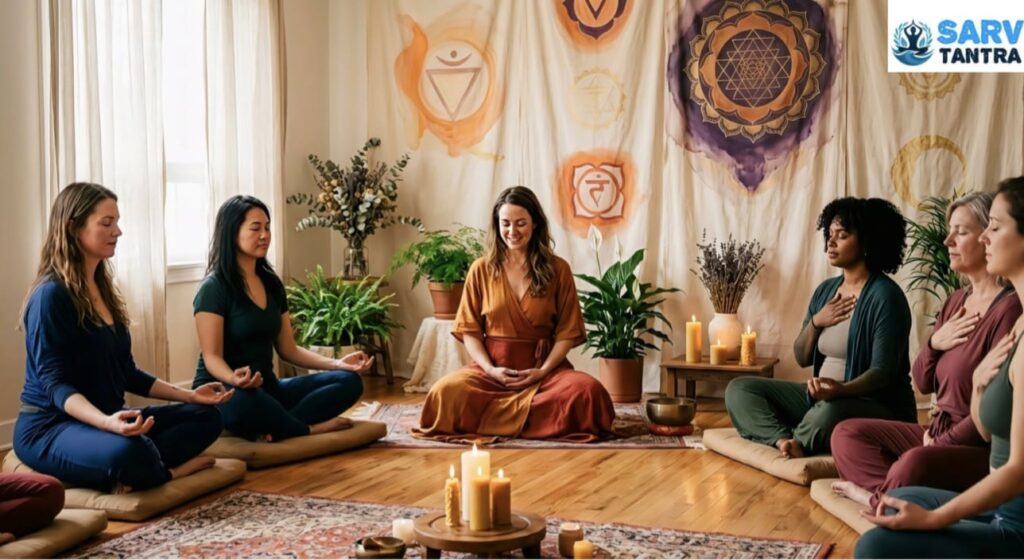
A simple Tantric meditation:
Sit comfortably.
Feel your breath.
Feel your body.
Notice sensations.
Allow everything.
No mantra.
No visualization.
No goal.
This simplicity is radical.
You are practicing being with what is.
Being with what is dissolves inner division.
Relationship as a Mirror of Wholeness
Tantra sees relationship not merely as companionship, but as field of awakening.
Relationships expose:
-
Attachment patterns
-
Fear patterns
-
Control patterns
-
Love patterns
Instead of blaming partners, Tantra invites inquiry:
“What is arising in me?”
When relationships are used as mirrors:
-
Projection decreases
-
Ownership increases
-
Integration deepens
You stop outsourcing parts of yourself to others.
Wholeness grows.
Everyday Life as Practice
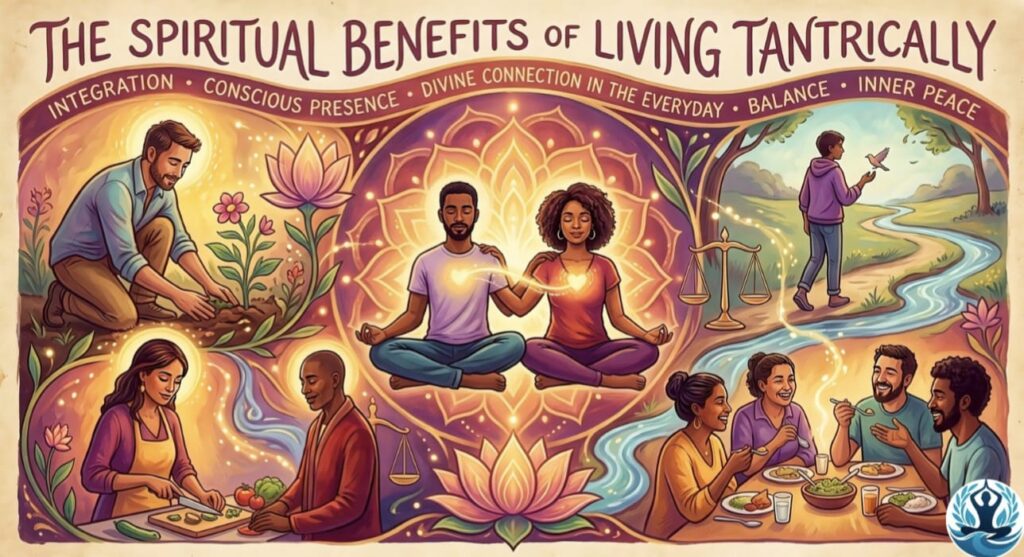
In Tantra, there is no separation between spiritual practice and daily activity.
Washing dishes can be practice.
Walking can be practice.
Working can be practice.
The key is presence.
You feel your hands.
You feel your feet.
You feel your breath.
Life becomes a continuous meditation.
This continuity dissolves fragmentation between:
-
Sacred time
-
Ordinary time
Everything belongs.
You belong.
Signs of Growing Inner Wholeness
Wholeness does not look dramatic.
It looks simple.
Common signs:
-
Feeling at home in your body
-
Less inner conflict
-
Reduced self-judgment
-
Greater emotional range
-
Increased sensitivity
-
Natural compassion
-
Ease with uncertainty
You still experience emotions.
You still face challenges.
But you no longer experience yourself as broken.
You experience yourself as alive.
Common Misunderstandings About Wholeness
Wholeness does not mean:
-
Constant happiness
-
Absence of pain
-
Perfect behavior
-
Enlightened persona
Wholeness means:
-
Capacity to include experience
-
Ability to stay present
-
Willingness to feel
It is a mature, grounded state.
Why Wholeness Is the Foundation of Real Healing
Many healing modalities focus on fixing symptoms.
Tantra addresses the root:
Disconnection from self.
When connection is restored:
-
Symptoms often soften
-
Patterns lose grip
-
Clarity increases
Healing becomes a side-effect of integration.
A Simple Daily Tantric Practice for Wholeness
Spend 10 minutes daily:
-
Sit or lie down
-
Place one hand on chest, one on belly
-
Breathe slowly
-
Feel sensations
-
If emotion arises, allow it
-
If thought arises, notice it
-
Return to sensation
No analysis.
Just presence.
Over time, this practice rebuilds inner continuity.
The Deeper Promise of Tantra’s Approach to Inner Wholeness
Tantra does not promise a perfected personality.
Tantra offers something more profound:
A return to your original nature.
A state where:
-
You are not at war with yourself
-
Nothing essential is rejected
-
Life is allowed to move
This is inner wholeness.
Not something you become.
Something you remember.
SEO Tags (comma separated):
Tantra’s approach to inner wholeness, tantra and self integration, tantric healing, tantra philosophy, embodiment practices, awareness meditation, nervous system regulation, shadow integration tantra, holistic spirituality, inner completeness, mind body integration, conscious awareness, energy healing tantra, spiritual wholeness, tantra meditation practice