

The Role of Breath in Tantric Transformation


In Tantra, breath is not merely a biological function—it is the primary bridge between body, mind, and energy. While many spiritual paths focus on controlling thoughts or disciplining behavior, Tantra begins at a more fundamental level: how life moves within us. That movement is breath.
Breath is the first act of life and the last act of the body. Between these two moments, every emotional state, mental pattern, and energetic shift is mirrored in the way we breathe. Tantra recognizes this intimate relationship and uses breath as a direct tool for transformation, not by force or manipulation, but through conscious participation.
Unlike mechanical breathing techniques aimed at performance or achievement, Tantric breathwork is about awareness, sensitivity, and alignment. When breath changes, energy changes. When energy changes, perception changes. When perception changes, transformation naturally unfolds.
This article explores the role of breath in Tantric transformation, how it works on physical, emotional, mental, and energetic levels, and why breath awareness is considered one of the most powerful Tantric practices.
Tantra’s View of Breath: More Than Oxygen
In modern science, breath is understood primarily as oxygen exchange. In Tantra, breath is understood as Prana—the vital life force that animates the body and mind.
Breath as Prana Shakti
Tantra sees breath as the carrier of Shakti, the dynamic energy of life. Every inhale draws in vitality; every exhale releases stagnation. When breath flows freely, energy flows freely. When breath is restricted, energy becomes blocked.
This is why emotional suppression, chronic stress, trauma, and mental overactivity all reflect immediately in breathing patterns. Shallow breath, held breath, or erratic breathing signal deeper energetic imbalance.
Tantric practice does not try to “fix” breath first. Instead, it listens to breath—because breath reveals the truth of the inner state more honestly than thoughts.
Breath as the Gateway Between Conscious and Unconscious
One of the most unique aspects of breath is that it exists at the threshold between voluntary and involuntary action. You can control it, but it also happens without your effort.
Tantra uses this quality of breath as a doorway into deeper awareness.
Why This Matters for Transformation
-
Thoughts are often too fast and conditioned
-
Emotions can be overwhelming or suppressed
-
Breath is always present and accessible
By becoming aware of breath, you step into a neutral observation point. From here, unconscious patterns begin to surface naturally—without analysis or judgment.
In Tantra, transformation does not happen by fighting habits but by bringing light to them through awareness, and breath is the safest and most direct light source.
How Breath Regulates the Nervous System in Tantra
Tantric transformation is impossible without nervous system regulation. A dysregulated nervous system keeps the body in survival mode, making deep awareness inaccessible.
Breath and the Parasympathetic Response
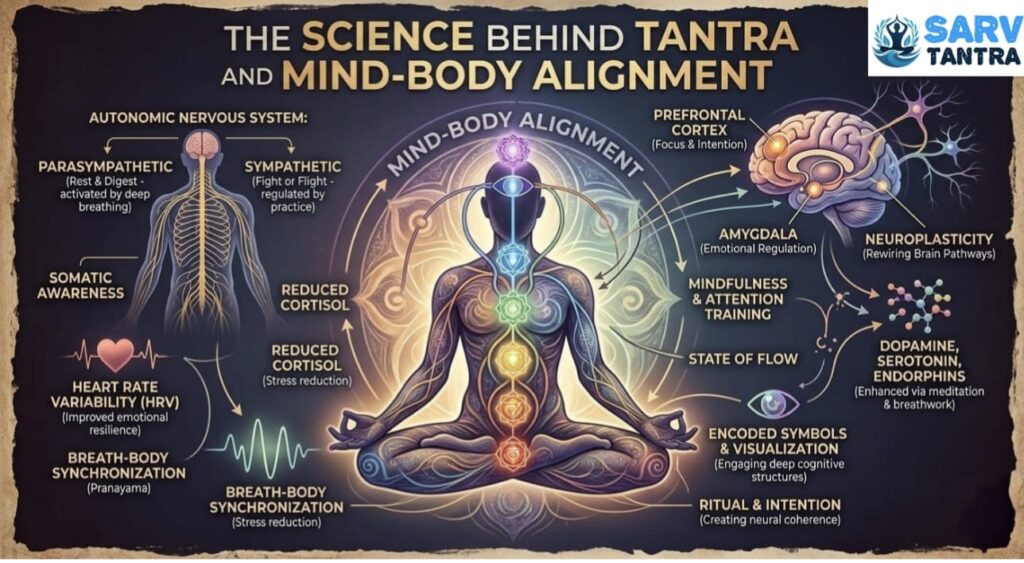
Slow, conscious breathing activates the parasympathetic nervous system, signaling safety to the body. Tantra works with this mechanism intuitively, long before modern neuroscience confirmed it.
When the nervous system settles:
-
Mental chatter reduces
-
Emotional reactivity softens
-
Energy begins to circulate naturally
Tantra does not force relaxation. Instead, breath invites relaxation, allowing the body to feel safe enough to release long-held tensions.
Breath and Energy Channels (Nadis)
Tantric texts describe subtle energy channels known as Nadis, through which prana flows. The three primary Nadis are:
-
Ida (cooling, lunar, receptive)
-
Pingala (warming, solar, active)
-
Sushumna (central channel of balance)
Breath as the Key to Opening Sushumna
When breath is uneven or unconscious, energy moves primarily through Ida or Pingala, creating imbalance. When breath becomes steady, aware, and natural, energy begins to align with the central channel.
This alignment is not forced. Tantra emphasizes effortless breath awareness, allowing balance to arise organically.
As Sushumna becomes active:
-
Inner clarity increases
-
Emotional extremes soften
-
A sense of inner stability emerges
This is a core aspect of Tantric transformation.
Breath as a Tool for Emotional Healing
Emotions live in the body before they appear as thoughts. Breath is the language emotions understand best.
How Emotions Affect Breath
-
Fear shortens breath
-
Anger sharpens breath
-
Sadness weakens breath
-
Suppression freezes breath
Tantra teaches that instead of analyzing emotions, one should breathe with them. Not to amplify them, not to suppress them—but to allow them space to move.
Breathing Through Emotional Blocks
When breath is brought gently into areas of tension:
-
Emotions begin to dissolve naturally
-
Stored energy releases safely
-
The body regains fluidity
This is why Tantric breath practices are often described as soft, receptive, and non-aggressive. Healing happens through permission, not pressure.
Breath and the Mind: From Control to Clarity
Most people try to change the mind directly. Tantra works differently—it changes the energetic environment in which thoughts arise.
Breath as the Anchor of Awareness
When breath becomes the focal point:
-
Thoughts lose dominance
-
Awareness stabilizes
-
Inner silence becomes accessible
Tantric meditation often begins with simply observing the breath, without altering it. This observation alone gradually transforms mental patterns.
As breath becomes subtle, the mind follows.
Tantric Breath vs. Mechanical Breathing Techniques
Many modern breathing techniques emphasize:
-
Counting
-
Retention
-
Forceful inhalation or exhalation
-
Achievement-based goals
Tantric breathwork differs fundamentally.
Key Differences
| Mechanical Breathing | Tantric Breathing |
|---|---|
| Technique-focused | Awareness-focused |
| Goal-oriented | Process-oriented |
| Forceful | Gentle |
| Mind-led | Body-led |
| External structure | Internal intelligence |
Tantra trusts the innate wisdom of the body. Breath is allowed to find its own rhythm when awareness is present.
The Role of Breath in Awakening Sensitivity
One of Tantra’s primary goals is not transcendence, but sensitivity—the ability to feel life directly.
Breath awareness:
-
Sharpens bodily perception
-
Refines emotional intelligence
-
Enhances intuitive insight
As sensitivity increases, transformation becomes self-guided. You no longer need rigid practices; life itself becomes the practice.
Breath and the Present Moment
Tantra is deeply rooted in the here and now. Breath anchors awareness in the present moment more effectively than any concept.
You cannot breathe yesterday.
You cannot breathe tomorrow.
You can only breathe now.
By resting attention on breath:
-
Regret loosens
-
Anxiety softens
-
Presence deepens
This presence is not passive—it is alive, alert, and embodied.
Breath as a Spiritual Equalizer
One of the most radical aspects of Tantra is that it does not privilege belief, background, or philosophy. Breath is universal.
You do not need:
-
Prior spiritual knowledge
-
Religious identity
-
Special initiation
If you breathe, you can practice Tantra.
This makes breath-based Tantric practices accessible, inclusive, and deeply human.
Daily Life as Tantric Practice Through Breath
Tantric transformation does not happen only on meditation cushions. Breath brings Tantra into daily life.
Examples of Breath Awareness in Daily Activities
-
Conscious breathing while walking
-
Soft breath during difficult conversations
-
Grounded breathing during stress
-
Deep breathing before sleep
These micro-practices slowly rewire the nervous system and reshape habitual reactions.
Common Misunderstandings About Tantric Breath
1. Breath Must Be Controlled
Tantra teaches relationship with breath, not domination.
2. Breathwork Is Only for Meditation
In Tantra, breath is woven into every activity.
3. Strong Breath Equals Strong Results
Tantra values subtlety over intensity.
Signs of Transformation Through Breath Practice
As breath awareness deepens, practitioners often experience:
-
Greater emotional stability
-
Improved energy levels
-
Reduced mental noise
-
Increased bodily comfort
-
A sense of inner alignment
These changes are gradual but lasting, because they arise from internal reorganization, not external pressure.
Why Breath Is Considered the Heart of Tantra
Tantra does not aim to escape the body or transcend life. It seeks to inhabit life fully, and breath is the doorway.
Through breath:
-
Energy awakens
-
Awareness stabilizes
-
Healing unfolds
-
Transformation becomes natural
Breath teaches us how to live without force, effort, or fragmentation.
Conclusion: Transformation Begins With the Next Breath
In Tantra, transformation is not something you achieve—it is something you allow. Breath is the simplest, most profound way to begin.
By meeting each breath with awareness, you begin to meet yourself as you are—whole, alive, and connected. Over time, this meeting reshapes everything: how you feel, how you think, how you relate, and how you live.
Tantric transformation does not demand change.
It invites presence.
And presence begins with breath.