

Tantra for Reclaiming Your Attention From Mental Clutter: A Complete Guide to Mindful Living

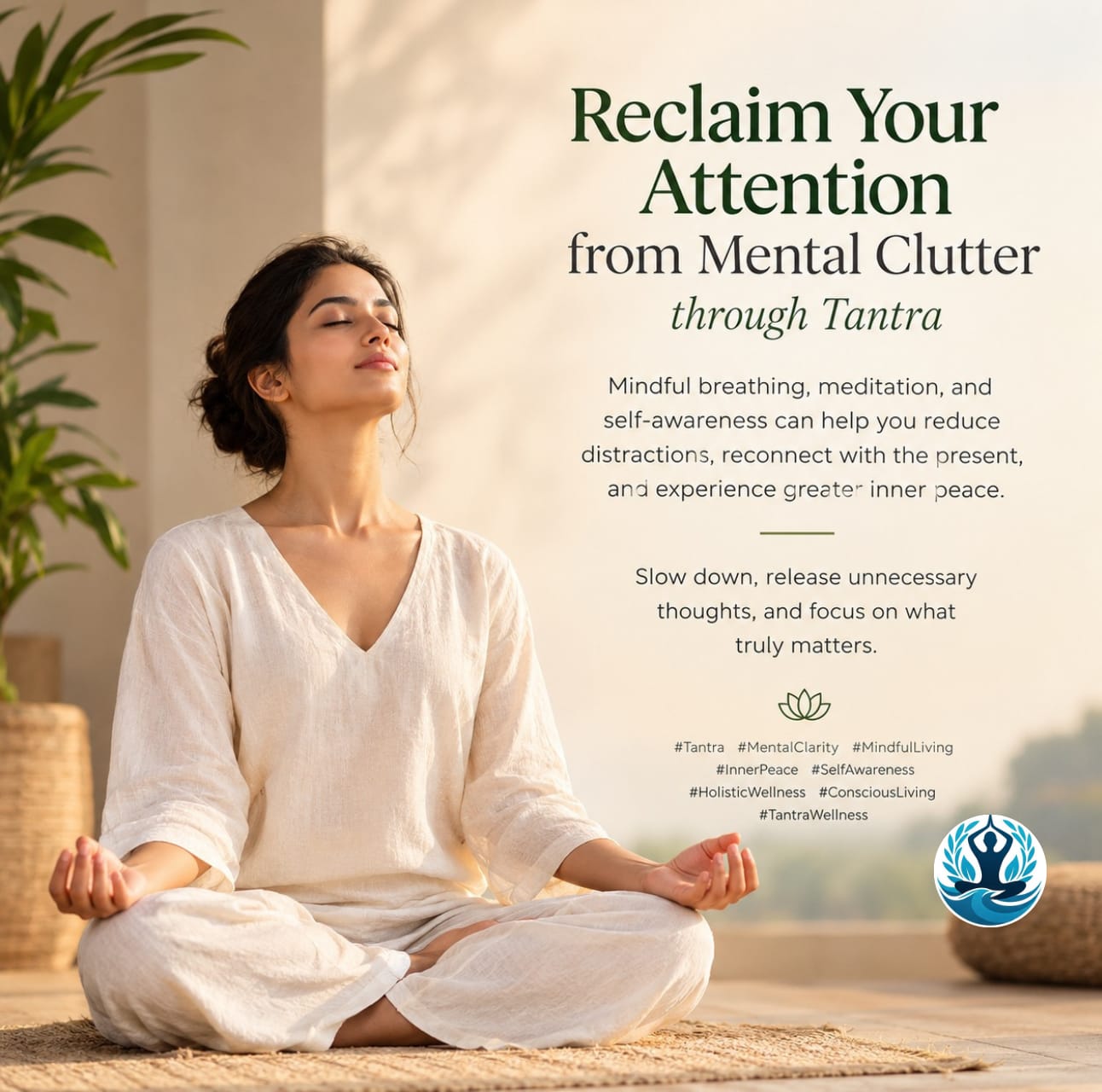
Modern life constantly demands our attention. From work responsibilities and personal commitments to social media notifications and endless thoughts, our minds rarely experience genuine rest. Even when we sit quietly, our thoughts may continue moving from one concern to another. We think about yesterday’s mistakes, today’s responsibilities, and tomorrow’s uncertainties, leaving little space to experience the present moment.
This continuous mental activity can make us feel distracted, overwhelmed, emotionally tired, and disconnected from ourselves. We may spend hours completing tasks without feeling focused or struggle to enjoy simple experiences because our attention is occupied elsewhere.
Tantra for reclaiming your attention from mental clutter offers a mindful approach to understanding this experience. Rather than treating every thought as a problem that must be eliminated, Tantric awareness encourages us to observe our thoughts, reconnect with our bodies, and become more conscious of where we direct our attention.
Tantra is a diverse spiritual tradition with philosophical and contemplative practices. Depending on the tradition, it may involve meditation, breath awareness, mantra, ritual, and embodied awareness. In a modern wellness context, selected awareness practices inspired by Tantra can complement everyday habits that support concentration, emotional understanding, and a deeper connection with the present.
The goal is not to create a completely empty mind. It is to develop a healthier relationship with your thoughts so that they do not automatically control your attention, decisions, and experiences.
By learning to pause, notice distractions, and return to what matters, you can gradually create more mental space for clarity, creativity, and meaningful living.
1. What Is Mental Clutter?
Mental clutter refers to the accumulation of thoughts, worries, unfinished tasks, emotional concerns, memories, and information competing for your attention.
Just as a crowded room can make it difficult to find what you need, a crowded mind can make it harder to concentrate on important things.
Mental clutter may include:
-
Repeatedly thinking about past conversations.
-
Worrying about situations that have not happened.
-
Remembering unfinished responsibilities throughout the day.
-
Comparing your progress with other people’s achievements.
-
Switching constantly between tasks and digital notifications.
-
Replaying mistakes or criticizing yourself.
-
Feeling pressure to respond immediately to every message.
-
Trying to solve several problems simultaneously.
These experiences are common, especially when life becomes demanding. However, when attention is repeatedly pulled in different directions, even ordinary activities may feel exhausting.
For example, you may sit down to complete an important assignment but find yourself checking your phone, remembering an unfinished task, worrying about a conversation, and planning the following day. Although you remain physically present at your desk, your attention keeps moving.
Over time, this pattern can make it difficult to feel fully engaged in work, relationships, rest, or personal interests.
Tantric awareness offers an opportunity to notice these patterns without automatically judging yourself for having them.
2. How Tantra Can Help You Reclaim Your Attention
A central theme in many Tantric contemplative approaches is developing awareness of experience as it unfolds. Instead of living entirely through habitual reactions, you learn to observe sensations, thoughts, emotions, and actions more consciously.
This approach can be useful when dealing with mental clutter because attention is not only about concentrating harder. It also involves understanding what repeatedly captures your mind and why.
For example, you might discover that you check your phone whenever you feel uncomfortable, replay conversations because you fear being misunderstood, or overthink decisions because you want to avoid making mistakes.
These observations help you identify habits that may otherwise remain automatic.
Tantra-inspired awareness practices may support you in several ways:
Greater self-awareness: Notice recurring thought patterns and the situations that trigger distraction.
Present-moment attention: Bring awareness back to your breathing, body sensations, or current activity.
Emotional understanding: Recognize feelings that may contribute to repetitive thinking.
Conscious responses: Create a pause between an impulse and your next action.
More intentional living: Choose where to direct your attention instead of following every distraction.
These practices do not guarantee that mental clutter will disappear, and they are not a replacement for professional care when persistent difficulties significantly affect daily life. Their value lies in helping you develop a more conscious relationship with your inner experience.
3. Understanding Where Your Attention Goes
Before you can reclaim your attention, it helps to understand where it is going.
Many people believe that their main problem is a lack of concentration. However, attention can also be affected by emotional concerns, habitual distractions, fatigue, and the pressure to manage too many responsibilities.
You might be physically engaged in one activity while mentally preparing for another. You may listen to someone speak while thinking about how to respond. You might even take a break while worrying about whether you have done enough work.
Tantric self-awareness encourages you to observe these moments without immediately trying to change them.
Practice: The attention check-in
Pause for two minutes and ask yourself three questions:
-
What has been occupying my mind today?
-
Which thoughts genuinely require my attention right now?
-
What can I allow to wait until later?
There is no need to force an answer. Simply notice what appears.
You may discover that some thoughts concern real responsibilities, while others involve imagined outcomes, old memories, or expectations that do not require immediate action.
This distinction helps you respond more intentionally.
Key takeaway: Reclaiming your attention begins with awareness, not self-criticism. You cannot consciously redirect attention if you never notice where it goes.
4. The Connection Between Mental Clutter and Emotional Overload
Mental clutter is not always caused by having too much information. Sometimes, it develops because emotions remain unacknowledged or difficult to process.
For example, a disagreement with a friend may occupy your thoughts long after the conversation ends. You might repeatedly imagine what you should have said, wonder what the other person thinks, or worry about how the relationship will change.
Similarly, uncertainty about work, family expectations, or personal decisions can create repeated mental conversations that are difficult to interrupt.
In these situations, trying to force yourself to stop thinking may not address the underlying concern.
A more helpful approach is to identify the emotion connected to the thought.
Ask yourself:
-
Am I feeling worried, disappointed, angry, embarrassed, or uncertain?
-
Is there something I need to acknowledge?
-
Can I take a useful action, or is this something I cannot control right now?
Naming an emotion does not automatically resolve it, but it can help you understand your experience more clearly.
Tantric awareness invites you to make room for feelings without allowing every feeling to dictate your next action. You can acknowledge discomfort, breathe gently, and decide what response would be appropriate.
For instance, rather than repeatedly replaying a difficult conversation, you might recognize that you feel hurt. From there, you can decide whether a calm conversation, a personal boundary, or simply some time to reflect would be helpful.
This shifts your attention from endless mental repetition toward understanding and constructive action.
5. Practicing Present-Moment Awareness Through Tantra
One practical way to reclaim attention is to return to the experience happening right now.
The present moment contains information that mental clutter often pushes into the background: the feeling of your feet on the floor, the movement of your breathing, the sounds around you, or the sensation of water on your hands.
You do not need a special environment to practise awareness. Ordinary moments can become opportunities to reconnect with your immediate experience.
Simple present-moment practice

Step 1: Pause
Stop what you are doing for a moment, if it is safe and practical. Let your shoulders soften without forcing your body into a particular position.

Step 2: Notice your body
Feel your hands, feet, posture, or the surface supporting you. Notice sensations without needing to change them.

Step 3: Observe your surroundings
Notice a few sounds, colours, shapes, or details in your environment. Let your attention rest on what is actually present.

Step 4: Return without judgment
If your mind wanders, recognize that it has wandered and gently return to the experience you chose to notice.
Practise for one to three minutes at a time. There is no need to demand perfect concentration.
Every time you notice distraction and return to the present, you have an opportunity to practise directing your attention deliberately.
6. Using Conscious Breathing to Create Mental Space
Breathing is an accessible way to bring attention back to the body. Although breathing alone cannot resolve every source of mental clutter, noticing your natural breath can provide a simple anchor when thoughts become overwhelming.
In some Tantric traditions, breath awareness forms part of broader contemplative practices. For everyday wellness, you can begin with a gentle, uncomplicated approach.
A simple conscious breathing exercise
-
Sit or stand in a comfortable position.
-
Notice the natural movement of your breathing.
-
Feel the air entering and leaving your body.
-
When thoughts appear, acknowledge them without following every detail.
-
Bring your attention back to the next breath.
Continue for two to five minutes, or for less time if that feels more comfortable.
Avoid forcing deep breaths or holding your breath. If focusing on breathing makes you uncomfortable, you can instead notice your feet on the ground or the sounds around you.
The purpose is not to control every thought through breathing. It is to give your attention a simple, present experience to return to.
With regular practice, conscious breathing may help you recognize moments when you are rushing, reacting automatically, or mentally moving ahead of the activity in front of you.
7. Learning to Observe Thoughts Without Following Them
One of the most useful skills for managing mental clutter is learning to distinguish between having a thought and needing to act on it.
The mind naturally produces ideas, memories, predictions, questions, and judgments. Some are helpful. Others are repetitive or irrelevant to the present task.
When a thought appears, we often follow it automatically.
For example:
You begin working on a project. A thought appears: What if I make a mistake? You start imagining negative outcomes, remember a previous failure, and begin questioning your abilities. Soon, you have moved far away from the task you originally intended to complete.
Tantric observation offers a different possibility: notice the thought without immediately building a story around it.
You might silently acknowledge, “I am having a worried thought.”
This does not mean ignoring genuine problems or pretending that negative experiences do not matter. It simply creates a little space between the thought and your response.
Try the following approach:
-
Notice: Recognize the thought that has appeared.
-
Name: Identify it as worry, planning, remembering, or judging.
-
Allow: Let it exist without immediately arguing with it.
-
Choose: Decide whether it requires action now.
-
Return: Bring your attention back to the activity that matters.
This process can help reduce unnecessary engagement with repetitive thoughts. The goal is not to eliminate thinking but to stop treating every thought as an instruction.
8. Reducing Digital Distractions Through Conscious Living
Digital devices are useful, but frequent notifications, messages, short videos, and constant switching between applications can fragment attention.
You may open your phone to check one message and discover that twenty minutes have passed. You might switch between work and social media so frequently that neither activity receives your full attention.
Reclaiming attention therefore involves both inner awareness and practical changes to your environment.
Build healthier digital habits
Turn off unnecessary notifications. Keep alerts for essential communications and silence those that do not require immediate attention.
Create phone-free periods. Set aside short periods for meals, focused work, conversations, or relaxation without checking your device.
Avoid unnecessary multitasking. Complete one manageable task before moving to another whenever possible.
Choose when to check messages. Rather than reacting to every notification, establish reasonable times to review communications.
Notice your reason for reaching for your phone. Ask whether you need information, want connection, feel bored, or are avoiding an uncomfortable task.
This last practice is particularly important. Sometimes, distraction becomes a way to avoid uncertainty, loneliness, frustration, or fatigue.
When you recognize the underlying reason, you can choose a more suitable response. You might take a short walk, speak to someone, rest, or return to your work with a clearer plan.
Conscious living does not require rejecting technology. It means using technology intentionally rather than allowing it to determine every moment of your attention.
9. Tantra and the Practice of Single-Tasking
Single-tasking means giving one activity your attention instead of repeatedly dividing it among competing demands.
Although multitasking may feel productive, frequent task-switching can interrupt concentration and make complex work more difficult.
Tantric awareness can be applied to everyday activities by encouraging you to participate more fully in what you are doing.
Consider eating a meal. You could eat while checking messages, watching videos, and planning tomorrow’s schedule. Alternatively, you could spend part of the meal noticing the taste, texture, smell, and experience of eating.
The second approach offers an opportunity to experience an ordinary activity more consciously.
You can practise single-tasking with:
-
Preparing or eating food.
-
Walking to work.
-
Listening during a conversation.
-
Reading a book.
-
Completing an important assignment.
-
Taking a shower.
-
Spending time in nature.
Start with one activity each day. Put aside unnecessary distractions and notice when your mind moves elsewhere.
You may find that ordinary experiences feel more engaging when you give them your attention.
Single-tasking is not about maintaining perfect focus. It is about noticing when your attention has shifted and choosing to return.
10. Releasing the Pressure to Think About Everything
Mental clutter often grows when we believe that every problem must be solved immediately.
We may feel responsible for predicting every outcome, preparing for every possibility, or finding an answer to every uncertainty. This creates a constant sense of mental urgency.
However, not every thought requires an immediate decision.
Some matters need practical action. Others require more information, time, or acceptance that an outcome remains uncertain.
A useful exercise is to divide your concerns into three categories:
| Category | Helpful response |
|---|---|
| Things you can act on | Identify one practical next step. |
| Things that need time | Decide when you will revisit them. |
| Things outside your control | Acknowledge the uncertainty and redirect your attention where possible. |
For example, if you are worried about an upcoming meeting, you can prepare your notes and decide what you want to communicate. You do not need to rehearse every possible conversation repeatedly throughout the day.
If you are concerned about another person’s opinion, you can communicate honestly and respectfully. You cannot completely control how that person interprets your words.
This distinction allows you to use attention more wisely.
Tantra-inspired self-awareness encourages you to notice when the mind is trying to create certainty where certainty is unavailable. You can take responsibility for your choices without demanding control over every outcome.
11. Creating Emotional Space Instead of Reacting Automatically
When mental clutter builds up, even minor situations may feel frustrating. A delayed message, an unexpected request, or a small mistake can trigger a strong response when your mind is already occupied.
In such moments, creating a pause can help you respond more thoughtfully.
Imagine receiving a message that feels critical. Your first impulse might be to respond immediately, defend yourself, or assume the other person intended to hurt you.
Instead, pause and notice what is happening.
-
What did the message actually say?
-
What meaning am I adding to it?
-
What emotion am I experiencing?
-
Would it help to respond now or wait until I feel calmer?
This practice does not require you to suppress your emotions. It allows you to recognize them before choosing how to act.
Over time, such pauses may support better communication, greater emotional awareness, and fewer impulsive reactions.
Tantra is not simply about achieving a peaceful state. It can also involve becoming more aware of difficult experiences and responding to them with greater consciousness.
12. Reconnecting With Your Body to Reduce Mental Overload
When attention remains focused on thoughts, the body can become something we notice only when it feels tired, uncomfortable, or tense.
You may spend hours sitting at a desk without noticing your posture. You might hold tension in your jaw or shoulders while concentrating. You may continue working even when you need a break.
Body awareness provides another way to reconnect with the present.
Try a gentle body-awareness practice
Sit comfortably and slowly notice different areas of your body.
Start with your feet. Notice their contact with the floor. Move your attention toward your legs, hands, shoulders, and face. Observe any sensations without forcing relaxation.
Ask yourself:
-
Am I holding unnecessary tension?
-
Have I been sitting in one position for too long?
-
Do I need water, movement, food, or rest?
-
Would a brief pause help me return to my activity?
Respond to any practical needs you notice.
This exercise is not intended to diagnose physical problems or promise that body awareness will eliminate mental clutter. Instead, it helps you pay attention to physical signals that can be overlooked during busy periods.
If body-focused attention feels uncomfortable, choose an external anchor such as sounds in the room or an object you can see.
13. Making Peace With Unfinished Thoughts
A common source of mental clutter is the desire to achieve complete certainty before moving forward.
You may keep revisiting a decision because you are unsure whether it was correct. You may continue thinking about a conversation because you want to understand exactly what the other person meant.
Sometimes, reflection is useful. It helps us learn from experiences and make better decisions.
However, repeated thinking does not always produce new information.
One way to recognize unproductive repetition is to ask whether your thinking is helping you understand something or simply repeating the same concern.
If you have already considered the available information, identified your options, and taken any necessary action, further analysis may not be useful at that moment.
You can tell yourself:
“I have considered this for now. I can return to it if new information becomes available.”
Then redirect your attention to the present task.
This is not avoidance. It is a decision to stop spending attention on a question that cannot currently be resolved.
Developing this ability can make it easier to move through daily life without needing every experience to have a perfect explanation.
14. Developing a Daily Tantra-Inspired Attention Practice
Lasting changes in attention often develop through small, repeated actions rather than occasional long sessions.
You do not need to reorganize your entire life or spend hours meditating. Begin with a short routine that fits naturally into your day.
Here is a simple daily practice you can adapt to your needs.
Your daily mental clarity routine
Morning — 5 minutes
Sit quietly and notice your natural breathing. Identify one or two priorities for the day instead of mentally reviewing every responsibility.
During work — 2 minutes
Pause between tasks. Notice your current mental state, set aside unrelated distractions, and choose what deserves your attention next.
Afternoon — 5 minutes
Take a short, mindful walk. Notice your surroundings, physical sensations, and breathing without constantly checking your phone.
Evening — 5 minutes
Reflect on what occupied your attention. Write down unfinished tasks for tomorrow and identify one moment when you felt genuinely present.
This routine takes approximately 17 minutes, which you can shorten or adjust to fit your schedule.
The aim is not to add another demanding task to your day. It is to create small opportunities to notice your attention and use it more intentionally.
15. The Importance of Letting Yourself Rest
Sometimes, mental clutter is intensified by a lack of adequate rest. When you are tired, distracted, or overloaded, concentrating may become more difficult.
You may try to overcome this by working harder, consuming more information, or pushing yourself to finish everything immediately.
However, constantly demanding more from your attention can leave you feeling even more overwhelmed.
Conscious rest offers an opportunity to step away from unnecessary stimulation.
Rest may involve sleeping adequately, spending time outdoors, taking a quiet break, enjoying a hobby, or connecting with people without multitasking.
It also means recognizing that you do not need to turn every free moment into an opportunity for improvement.
You can sit quietly without trying to learn something. You can enjoy a walk without tracking your performance. You can spend time with loved ones without worrying about what you should accomplish next.
From a Tantra-inspired perspective, awareness can include resting and receiving an experience rather than constantly pursuing another goal.
Rest is not a failure of productivity. It is a normal part of maintaining your wellbeing and supporting your ability to engage with life.
If you regularly experience significant fatigue or persistent concentration difficulties, consider whether sleep, stress, medication, or another health concern may be contributing.
16. Reclaiming Attention Through Self-Compassion
One overlooked source of mental clutter is the criticism we direct toward ourselves.
When we become distracted, we may think, “Why can’t I concentrate?” When we forget something, we may call ourselves careless. When our minds wander during meditation, we may conclude that we are doing it incorrectly.
This creates another layer of mental activity: we are no longer only distracted, but also judging ourselves for being distracted.
Self-compassion offers a different approach.
Instead of criticizing yourself for losing focus, recognize that attention naturally fluctuates. Notice the distraction, identify what you need, and return to the task when you are ready.
You might replace self-critical thoughts with more constructive statements:
-
“My mind is busy right now, and I can take this one step at a time.”
-
“I do not have to solve every problem today.”
-
“I can notice this distraction without following it.”
-
“I can make progress without expecting perfection.”
-
“I can begin again whenever I notice that I have wandered.”
These statements are not meant to deny difficulties or provide false reassurance. They help you respond to your experience without adding unnecessary judgment.
Tantric awareness can be practised through this willingness to meet your present experience honestly, including moments when you feel distracted, uncertain, or imperfect.
17. Common Mistakes to Avoid When Practising Tantra for Mental Clarity
When you begin exploring awareness practices, it is helpful to understand what the process does and does not require.
Mistake 1: Trying to stop every thought
The mind naturally generates thoughts. Trying to eliminate them completely can become another source of frustration.
Instead, practise noticing thoughts and returning to the present without needing them to disappear.
Mistake 2: Expecting instant results
A short meditation may help you pause, but it will not necessarily resolve long-standing habits immediately.
Approach the practice with patience. Focus on learning to recognize distractions rather than measuring success by how peaceful you feel.
Mistake 3: Treating every thought as important
Not every thought needs analysis, and not every worry signals an immediate problem.
Consider whether a thought requires action, reflection, or simply acknowledgment.
Mistake 4: Using mindfulness to avoid real problems
Awareness should not become an excuse to ignore responsibilities, difficult conversations, or practical decisions.
If something requires action, use your increased awareness to determine a realistic next step.
Mistake 5: Turning self-improvement into another pressure
You do not need to perform every practice perfectly or follow an inflexible schedule.
Begin with small steps and adapt them to your needs.
Mistake 6: Assuming all mental clutter has the same cause
Distraction can arise from stress, insufficient sleep, environmental interruptions, emotional difficulties, or health-related factors.
Tantra-inspired practices may be helpful for self-awareness, but they cannot address every underlying cause. Seek professional support if persistent mental difficulties interfere with daily functioning.
18. How Reclaiming Your Attention Can Change Everyday Experiences
Reclaiming your attention is not simply about becoming more productive. It can also influence how you experience ordinary life.
When you are less caught up in repetitive thoughts, you may find it easier to listen during conversations, notice your surroundings, enjoy personal interests, and recognize what matters to you.
You may become more aware of when you need a break, when a concern requires action, and when you are spending energy on something beyond your control.
For example, imagine spending an evening with your family while repeatedly thinking about unfinished work. You are physically present, but your attention remains at the office.
By noticing this pattern, you can write down the tasks you need to address tomorrow and deliberately return to the conversation in front of you.
The work has not disappeared, and your responsibilities remain real. However, you have created a boundary between the task you will handle later and the experience you can participate in now.
Similarly, during a walk, you might notice that you are planning the next day instead of enjoying the environment. You can gently return to the sounds, colours, and sensations around you.
These small moments do not need to be dramatic to be meaningful.
Over time, practising conscious attention may help you engage more fully with your choices, relationships, work, and personal experiences.
The deeper benefit is learning that your life is not limited to the thoughts passing through your mind. You can acknowledge those thoughts while also participating in what is happening around you.
19. A Simple 7-Day Plan to Reclaim Your Attention
If you are new to Tantra-inspired awareness, a seven-day plan can help you begin without feeling overwhelmed.
Your weekly checklist
0 of 7 complete
Day 1: Observe your thoughts
Spend five minutes noticing what occupies your mind without judging it.
Day 2: Reconnect with breathing
Practise gentle breath awareness for two to five minutes.
Day 3: Reduce digital distractions
Silence unnecessary notifications and choose a phone-free period.
Day 4: Practise single-tasking
Give one ordinary activity your attention from beginning to end.
Day 5: Understand emotional triggers
Notice which feelings or situations tend to pull your attention away.
Day 6: Make space for rest
Take a quiet break without turning it into another productivity goal.
Day 7: Reflect and choose
Review what you noticed and choose one practice to continue.
At the end of the week, reflect on three questions:
-
Which distractions did I notice most often?
-
Which practice helped me return to the present most comfortably?
-
What small change would make my daily life feel less mentally crowded?
There is no need to achieve a particular result within seven days. Use the experience to discover which habits are useful for you.
Conclusion: Reclaim Your Attention and Reconnect With Yourself
Mental clutter can make everyday life feel more demanding than it needs to be. Repeated thoughts, constant notifications, emotional concerns, and unrealistic expectations can pull your attention away from the experiences that matter most.
Tantra for reclaiming your attention from mental clutter offers a way to approach these challenges through awareness, conscious breathing, body connection, and more intentional choices.
The purpose is not to eliminate every thought or achieve permanent stillness. It is to recognize when your attention has been pulled away and learn to return without unnecessary judgment.
You can begin with a few minutes of mindful breathing, a phone-free meal, a quiet walk, or a deliberate pause before responding to a difficult situation. These simple practices can create opportunities to understand yourself more clearly and engage with the present.
Remember that you do not have to follow every thought, solve every problem immediately, or respond to every demand the moment it appears.
Your attention is a valuable part of your everyday experience. When you learn to direct it more consciously, you create more room for meaningful work, authentic relationships, self-understanding, and moments of genuine enjoyment.
The journey begins with one simple choice: pause, notice what is happening, and gently return to what matters now.