

Tantra and the Practice of Welcoming Uncertainty

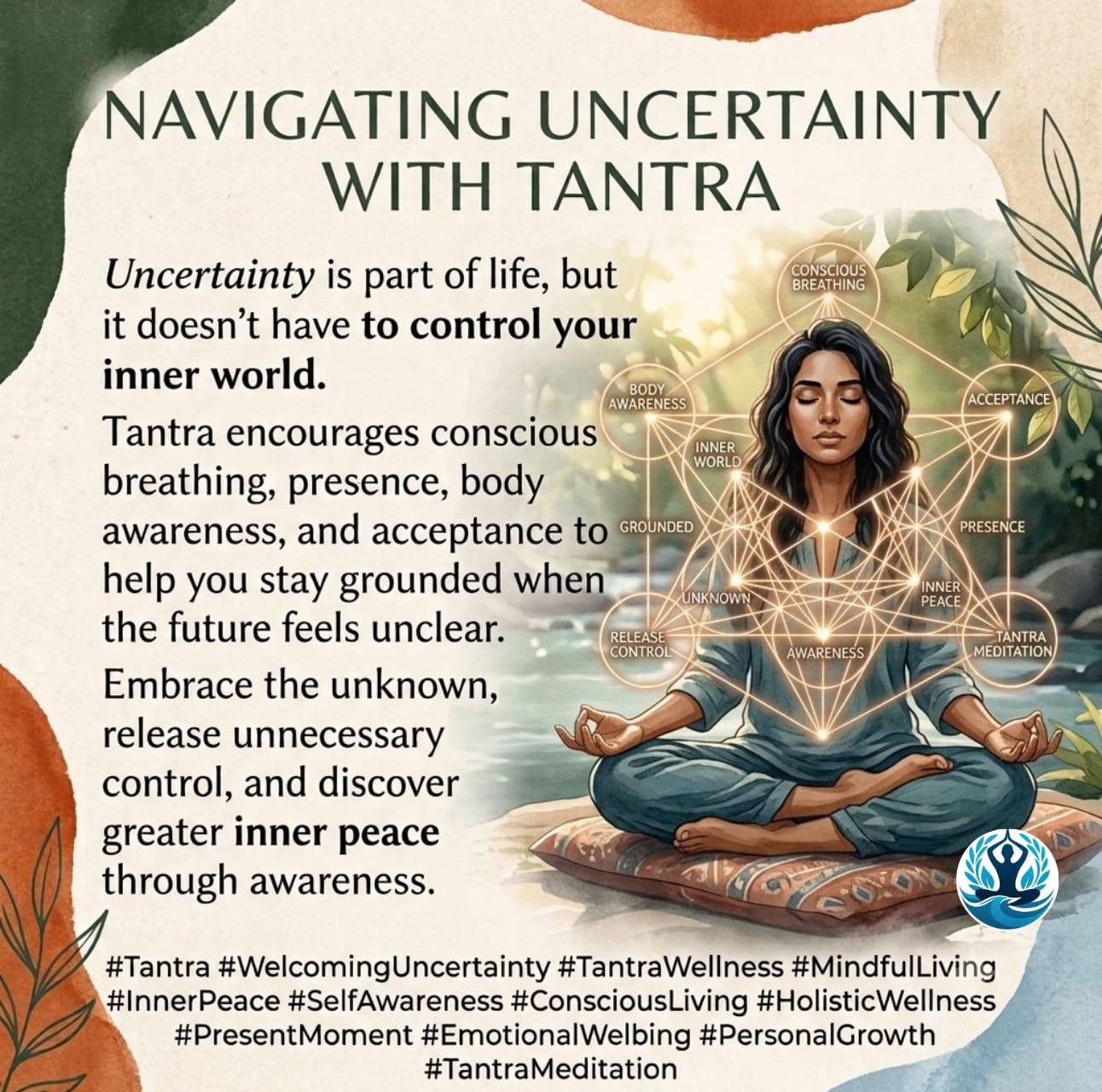
Uncertainty is an unavoidable part of life. We may make plans, set goals, build routines, and imagine how the future should unfold, yet life rarely follows a perfectly predictable path. Relationships change, opportunities appear unexpectedly, circumstances shift, and personal priorities evolve.
For many people, uncertainty creates discomfort because the mind naturally looks for answers. We want to know what will happen, when it will happen, and whether the outcome will be favorable. When answers are unavailable, we may experience overthinking, worry, hesitation, or a strong desire to control circumstances.
Tantra offers a different perspective.
Rather than encouraging us to escape uncertainty, Tantra can invite us to become more conscious of our relationship with the unknown. Through awareness, presence, breath, body consciousness, and observation, uncertainty can become an opportunity to understand ourselves more deeply.
The practice is not about pretending that uncertainty is easy or that every unknown situation will have a positive outcome. Instead, it is about developing the capacity to remain present when certainty is unavailable.
Welcoming uncertainty means learning to live fully without requiring every answer in advance.
Understanding Uncertainty in Everyday Life
Uncertainty can appear in many forms.
It may arise when beginning a new career, entering a relationship, making an important decision, moving to a new place, experiencing personal transformation, or simply wondering what the future will bring.
Sometimes uncertainty is external. We cannot control changing circumstances, other people’s choices, economic conditions, or unexpected events.
At other times, uncertainty comes from within. We may be unsure about what we want, how we feel, where our life is going, or which direction truly feels meaningful.
This internal uncertainty can be especially challenging because many people believe they should always have clear answers.
However, personal growth does not always happen through immediate clarity. Sometimes clarity develops gradually through experience.
Tantra encourages us to become comfortable with this process.
Instead of asking, “How can I make sure everything turns out exactly as I want?” we can begin asking:
- What am I experiencing right now?
- What is my body communicating?
- What emotions are present?
- What am I trying to control?
- Can I remain present without immediately knowing the outcome?
- What can this moment teach me?
These questions shift attention from controlling the future toward understanding the present.
What Does Tantra Teach About Uncertainty?
Tantric traditions are diverse and historically complex, so Tantra cannot be reduced to a single modern wellness technique. However, many contemporary interpretations of Tantra emphasize awareness, embodiment, presence, and a conscious relationship with experience.
From this perspective, uncertainty does not necessarily need to be treated as an obstacle.
Life is constantly changing. Thoughts change. Emotions change. Relationships change. Bodies change. Circumstances change.
Trying to make everything permanent can create tension.
Tantra encourages deeper awareness of change rather than constant resistance to it.
This can create an important inner shift: instead of demanding certainty from life, we develop greater capacity to meet life as it unfolds.
The Connection Between Uncertainty and Control
The desire for certainty is often closely connected with the desire for control.
When something feels uncertain, we may attempt to reduce discomfort by planning excessively, repeatedly analyzing situations, seeking reassurance, imagining every possible outcome, or trying to influence circumstances beyond our control.
Planning can be useful. Preparation can be valuable.
The difficulty begins when control becomes a way of avoiding the emotional experience of not knowing.
Tantric awareness can help us recognize this pattern.
For example, imagine waiting for an important decision. The mind repeatedly creates scenarios:
“What if it doesn’t work?”
“What if something goes wrong?”
“What should I do next?”
“What will people think?”
Instead of immediately following every thought, a conscious practice might involve noticing the thoughts without becoming completely absorbed by them.
You can observe:
“I am experiencing uncertainty.”
“I notice tension in my body.”
“My mind is searching for an answer.”
This simple awareness creates space.
You are no longer completely identified with the uncertainty. You are observing it.
Welcoming Uncertainty Does Not Mean Being Passive
Welcoming uncertainty does not mean abandoning responsibility or refusing to make decisions.
It means recognizing the difference between what you can influence and what you cannot guarantee.
You can prepare for an interview, but you cannot guarantee the result.
You can communicate honestly in a relationship, but you cannot control another person’s response.
You can care for your wellbeing, but you cannot control every future circumstance.
You can make thoughtful decisions, but you cannot eliminate every possible risk.
This distinction can create emotional freedom.
Tantra can support a balanced approach in which awareness guides action while acceptance reduces unnecessary resistance.
The Role of Presence
One of the most valuable practices for working with uncertainty is learning to return to the present moment.
The future exists as possibility, while the present is where experience actually happens.
When uncertainty becomes overwhelming, attention often moves far into imagined futures.
The body may be sitting in one place, while the mind is living through dozens of possible outcomes.
Presence interrupts this cycle.
You can return attention to your breathing.
Notice the sensations in your body.
Feel your feet touching the ground.
Observe sounds around you.
Notice the movement of your breath.
These simple actions do not magically solve uncertainty. Instead, they reconnect attention with immediate experience.
That can make uncertainty feel more manageable.
Tantra and Body Awareness During Uncertain Times
Uncertainty is not experienced only through thoughts.
It can also appear physically.
You might notice:
- Tightness in the shoulders
- Shallow breathing
- Tension in the stomach
- Restlessness
- Jaw tension
- Difficulty relaxing
- A feeling of heaviness
- Increased physical alertness
Body awareness can help you recognize these signals before they become overwhelming.
A simple practice is to pause for a few moments and scan the body.
Ask:
“Where am I holding the experience of uncertainty?”
Do not immediately try to change the sensation.
Simply notice it.
Then take slow, comfortable breaths and allow yourself to experience the sensation without judging it.
This creates a more compassionate relationship with your body.
Breathing Into the Unknown
Conscious breathing can be incorporated into a daily Tantra-inspired practice.
Sit comfortably and allow your breathing to become natural.
Notice the inhale.
Notice the exhale.
Instead of trying to force the breath, observe its rhythm.
With each exhalation, consciously soften areas of unnecessary tension.
You can silently repeat:
“I do not need to know everything right now.”
Then return attention to the breath.
The goal is not to eliminate uncertainty.
The goal is to develop the ability to remain present while uncertainty exists.
Releasing the Demand for Immediate Answers
Modern life often rewards speed.
We expect immediate information, immediate communication, immediate results, and immediate clarity.
This can make waiting uncomfortable.
Yet many important aspects of life require time.
Self-understanding develops gradually.
Relationships evolve gradually.
Healing can be gradual.
Meaning often becomes clearer through experience.
Tantra invites us to respect this unfolding process.
Instead of demanding an immediate answer from ourselves, we can allow questions to remain open.
Sometimes the question itself becomes part of the journey.
Uncertainty as an Opportunity for Self-Discovery
When familiar plans disappear, we may discover aspects of ourselves that were previously hidden.
A career change might reveal new interests.
A period of solitude might reveal neglected needs.
An unexpected challenge might reveal resilience.
A change in relationships might clarify personal boundaries.
Uncertainty can therefore become a mirror.
It can show us where we depend heavily on external validation, where we fear losing control, or where we have built our identity around predictable outcomes.
Tantric awareness encourages observation rather than immediate judgment.
Instead of thinking, “I shouldn’t feel this way,” we can ask:
“What is this experience revealing about me?”
That question transforms uncertainty into an opportunity for awareness.
Moving Beyond the Need to Predict Everything
Prediction can be useful, but constant prediction can become exhausting.
Some people mentally rehearse future conversations, imagine possible problems, or repeatedly analyze decisions because they believe that enough thinking will eventually eliminate uncertainty.
But thinking about the future cannot guarantee the future.
There is a point where additional analysis creates more mental noise rather than more clarity.
A Tantra-inspired approach encourages us to recognize when awareness has turned into repetitive mental activity.
You can ask:
“Am I solving a problem, or am I repeatedly trying to feel certain?”
This distinction can be powerful.
If action is needed, take the appropriate action.
If nothing can currently be done, practice returning to the present.
Accepting That Life Is Always Changing
Change is not an unusual event in life.
It is part of life itself.
Our circumstances change.
Our bodies change.
Our relationships change.
Our beliefs change.
Our priorities change.
Our understanding of ourselves changes.
When we recognize change as natural, uncertainty can become less threatening.
Tantra can encourage us to experience life as dynamic rather than fixed.
This does not mean we should avoid stability. Stability can be deeply valuable.
It means understanding that stability and change can coexist.
We can create routines while remaining open to change.
We can make plans while accepting that plans may evolve.
We can have intentions without demanding guaranteed outcomes.
The Practice of Conscious Surrender
Surrender is often misunderstood.
It does not necessarily mean giving up.
In a conscious context, surrender can mean releasing the struggle against something that cannot currently be controlled.
For example, you may have done everything reasonably possible to prepare for a situation. At some point, continued worrying may no longer improve the outcome.
Surrender allows you to say:
“I have done what I can. I can now allow the situation to unfold.”
This can create a sense of spaciousness.
You remain responsible for your actions without demanding control over everything around you.
Tantra, Desire, and Uncertainty
Tantra also provides a useful framework for exploring desire.
Desire naturally points toward the future.
We want something because we imagine a future in which we experience it.
But when desire becomes rigid, uncertainty can become threatening.
“I must have this outcome.”
“It must happen this way.”
“Things must work according to my plan.”
The stronger the attachment to one specific outcome, the more difficult uncertainty may feel.
Awareness allows desire to exist without completely controlling us.
You can acknowledge what you want while remaining open to how life unfolds.
This creates a healthier relationship with desire.
Creating Inner Stability Without External Certainty
True inner stability does not require every external circumstance to remain stable.
External stability can change quickly.
Inner stability can come from developing a grounded relationship with yourself.
Practices that support this include:
- Conscious breathing
- Meditation
- Body awareness
- Journaling
- Mindful movement
- Nature connection
- Quiet reflection
- Conscious communication
- Regular periods of digital rest
These practices do not remove uncertainty.
They can help you develop a stronger foundation from which to experience it.
A Simple Tantra-Inspired Practice for Welcoming Uncertainty
Try this five-step practice whenever you feel uncomfortable about an unknown situation.
Step 1: Pause
Stop for a moment rather than immediately reacting.
Step 2: Breathe
Take several slow, comfortable breaths and notice the movement of your body.
Step 3: Observe
Identify the thoughts and sensations associated with uncertainty.
Step 4: Separate Action From Worry
Ask yourself:
“Is there something useful I can do right now?”
If yes, take that action.
If no, allow yourself to return to the present.
Step 5: Create Space
Remind yourself:
“I can experience uncertainty without needing to solve everything immediately.”
Repeat the practice whenever necessary.
Bringing the Practice Into Everyday Life
Welcoming uncertainty does not have to be limited to meditation.
You can practice it throughout the day.
When waiting for a message, notice your urge to check your phone repeatedly.
When facing an unfamiliar situation, observe your thoughts before reacting.
When plans change unexpectedly, notice your body’s response.
When you do not know what comes next in life, give yourself permission to remain curious.
Small moments of awareness gradually change your relationship with uncertainty.
The Difference Between Fear and Intuition
Uncertainty can sometimes make it difficult to distinguish genuine inner guidance from fear.
Fear often creates urgency.
It may say:
“Decide immediately.”
“Something will go wrong.”
“You need complete certainty.”
Intuition, by contrast, may feel quieter and less dramatic.
Developing body awareness and mindful observation can help you notice these differences, although no internal sensation should automatically be treated as infallible guidance.
The practice is to slow down enough to observe before acting.
Welcoming Uncertainty in Relationships
Relationships contain uncertainty because another person has their own thoughts, emotions, needs, and choices.
Trying to control another person’s feelings can create tension.
Conscious relationships require communication, boundaries, trust, and respect for individuality.
Tantra-inspired awareness can encourage partners to remain present with each other rather than constantly attempting to predict or control outcomes.
Listening becomes more important.
Presence becomes more important.
Authenticity becomes more important.
The relationship becomes a space for discovery rather than constant reassurance.
Welcoming Uncertainty During Personal Transformation
Personal transformation can be uncomfortable because old identities may no longer feel appropriate while new ones have not yet fully developed.
You may know what you no longer want without knowing what you want next.
This in-between stage can feel confusing.
However, it can also be deeply creative.
You do not always need to immediately replace an old identity with a new one.
Sometimes it is valuable to remain curious.
Ask:
“Who am I becoming?”
rather than demanding:
“Who must I become?”
This shift allows transformation to unfold more naturally.
Creating a Daily Ritual for Uncertainty
A short daily ritual can help strengthen your relationship with the unknown.
Spend five to ten minutes sitting quietly.
Begin with several natural breaths.
Then notice your current emotional state.
Ask yourself:
- What feels uncertain today?
- What am I trying to control?
- What is actually within my influence?
- What can I release for today?
- What deserves my attention right now?
Finish by taking several slow breaths and returning to the present.
The purpose is not to find perfect answers.
It is to develop greater awareness.
The Deeper Lesson of Welcoming Uncertainty
The deeper lesson is not that uncertainty should always feel comfortable.
It probably will not.
There will be moments when the unknown feels frightening, frustrating, or confusing.
The goal is not emotional perfection.
The goal is greater capacity.
You can learn to experience uncertainty without immediately escaping into distraction.
You can make decisions without having complete information.
You can remain open without becoming passive.
You can plan without becoming obsessed with control.
You can desire something while remaining flexible about how life unfolds.
This is where awareness becomes practical.
Conclusion
Tantra and the practice of welcoming uncertainty offer a meaningful approach to one of life’s most unavoidable experiences.
The future cannot always be predicted.
Circumstances cannot always be controlled.
Answers do not always arrive immediately.
Yet we can develop the ability to remain present.
Through conscious breathing, body awareness, observation, meditation, mindful movement, and self-reflection, uncertainty can become less about fighting the unknown and more about learning how to meet it.
Welcoming uncertainty does not mean expecting everything to work out perfectly. It means developing the awareness to remain connected with yourself while life continues to change.
Sometimes the greatest sense of freedom comes not from knowing exactly what happens next, but from trusting your capacity to meet whatever comes next with awareness.
Tantra invites us to stop demanding certainty from every moment and begin experiencing each moment more fully.