

Tantra for Creating Mental Space in a Hyperconnected World

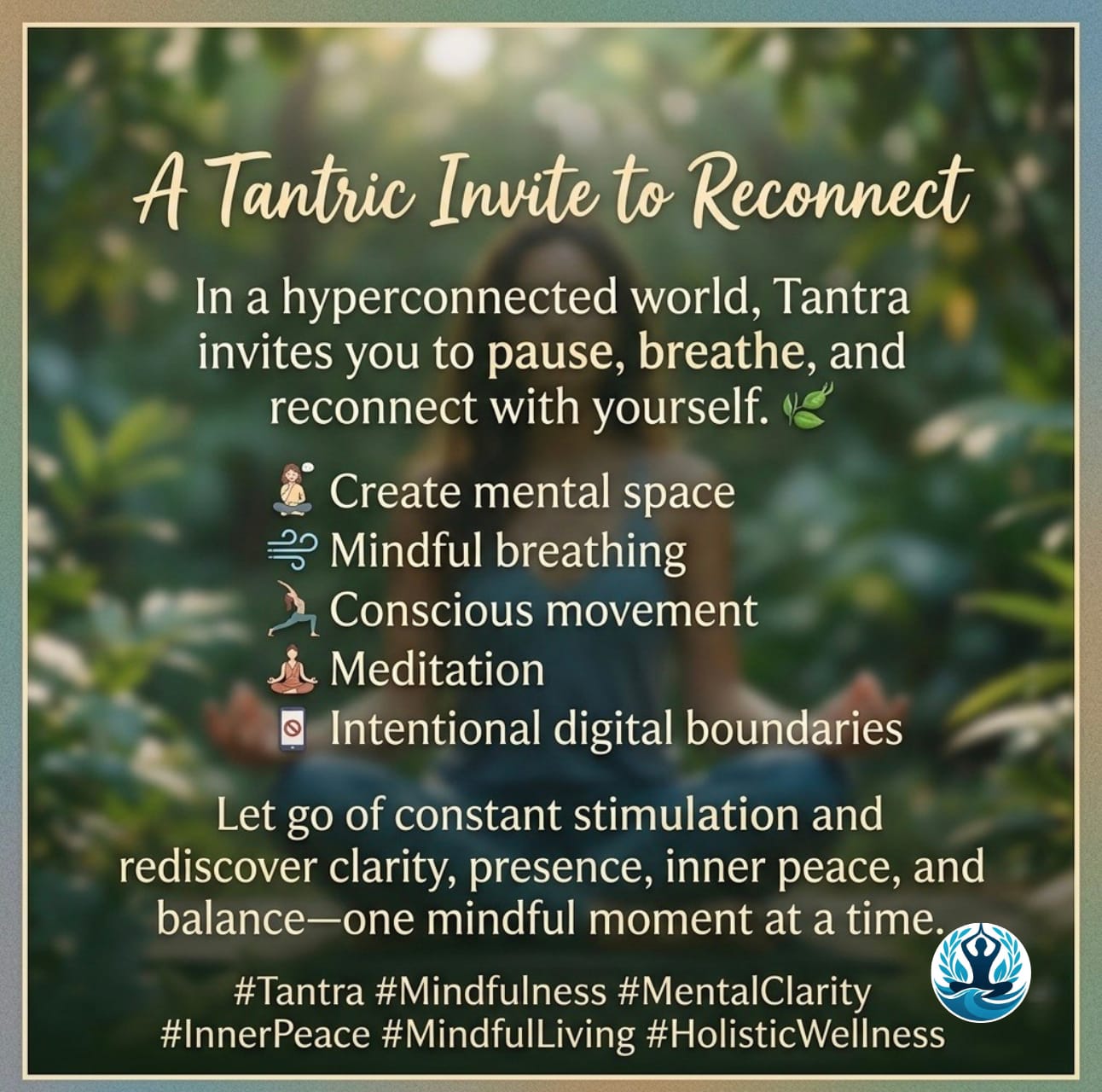
Modern life has made connection easier than ever. We can communicate instantly, access information within seconds, work from almost anywhere, and remain connected to friends, colleagues, communities, and news throughout the day. Yet constant connection does not always create a greater sense of wellbeing.
For many people, the modern digital lifestyle can feel mentally crowded. Notifications compete for attention, social media encourages constant engagement, emails demand responses, and endless streams of information make it difficult to experience genuine quiet. Even when the body is resting, the mind may continue processing conversations, tasks, images, opinions, and future responsibilities.
This is where Tantra for creating mental space can offer a meaningful perspective.
Tantra, understood broadly as a tradition of awareness and conscious living, encourages people to become more present with their experiences rather than automatically reacting to them. Through practices involving awareness, breath, meditation, sensory attention, conscious movement, and observation, Tantra can provide practical ways to create pauses within an otherwise busy day.
Creating mental space does not necessarily mean abandoning technology or disconnecting completely from modern life. Instead, it means developing a healthier relationship with attention.
Mental space allows you to pause before reacting, notice your thoughts without becoming overwhelmed by them, reconnect with your body, and make conscious choices about where your energy and attention go.
In a hyperconnected world, this ability can become an important part of mindful living.
What Does Mental Space Really Mean?
Mental space is the sense of having enough internal room to think, feel, observe, and respond without being immediately overwhelmed.
It is not the absence of thoughts.
A peaceful mind can still contain thoughts, emotions, responsibilities, and plans. The difference is that you are not necessarily controlled by every thought that appears.
Imagine your mind as a room.
When the room is filled with unfinished tasks, notifications, conversations, worries, expectations, and constant stimulation, it becomes difficult to move freely. When unnecessary mental clutter is reduced, there is more room for clarity.
Mental space can involve:
- Greater awareness of your thoughts
- More deliberate responses
- Improved ability to concentrate
- Greater emotional awareness
- A stronger connection with the body
- Reduced mental clutter
- More conscious use of technology
- Greater appreciation for quiet moments
- Improved ability to rest
- A deeper sense of presence
Tantra approaches these experiences through awareness rather than force.
Instead of trying to eliminate every thought, the practice can involve noticing thoughts and allowing them to arise without automatically following each one.
Why Modern Life Can Feel Mentally Overcrowded
Digital technology has created remarkable opportunities, but constant connectivity can also create an environment of continuous stimulation.
A typical day may involve checking a phone immediately after waking, responding to messages, reading emails, scrolling through social media, attending meetings, consuming news, watching videos, and switching between multiple tasks.
The result can be a pattern of continuous attention shifting.
Even short interruptions can make it harder to remain fully engaged with one activity. When this pattern becomes habitual, moments of silence may begin to feel uncomfortable.
Instead of experiencing quiet as restorative, someone may immediately reach for their phone.
This is one reason creating mental space is becoming increasingly relevant to modern wellness.
The goal is not to reject technology.
The goal is to use technology consciously rather than allowing every notification, message, or piece of information to determine where your attention goes.
How Tantra Supports Mental Space
Tantra emphasizes awareness of present experience.
This makes it particularly relevant to the challenge of mental overload.
Rather than constantly trying to escape uncomfortable thoughts, Tantra encourages observation. Instead of treating the body as separate from the mind, many Tantric approaches emphasize embodied awareness.
This can include attention to:
- Breath
- Physical sensations
- Movement
- Emotions
- Thoughts
- Environment
- Sensory experiences
- Patterns of reaction
When attention becomes more intentional, mental space can gradually feel more accessible.
1. Tantra Encourages Conscious Pausing
One of the simplest ways to create mental space is to pause.
Modern life often encourages immediate reactions. A message arrives, and we respond. A notification appears, and we check it. An uncomfortable thought arises, and we immediately distract ourselves.
Tantric awareness introduces another possibility:
Pause. Observe. Then choose.
A conscious pause can be only a few seconds.
Before responding to a difficult message, take one slow breath.
Before opening another application, notice whether you actually need it.
Before reacting emotionally, observe what is happening inside the body.
These small pauses create distance between stimulus and response.
That distance can become valuable mental space.
2. Breath as an Anchor for Attention
Breath is always available.
You do not need special equipment, a particular environment, or a long meditation session to become aware of breathing.
Simply noticing the natural rhythm of inhalation and exhalation can help bring attention away from constant external stimulation and toward present experience.
A simple practice is:
- Sit comfortably.
- Relax your shoulders.
- Notice your natural breathing.
- Feel the movement of the abdomen or chest.
- Follow several breaths without trying to control them.
- When the mind wanders, gently return attention to breathing.
The purpose is not to force the mind to become completely empty.
Instead, the breath becomes an anchor.
With regular practice, this kind of conscious breathing can become a practical transition between digital stimulation and present-moment awareness.
3. Tantra and the Practice of Single-Tasking
Multitasking is often treated as a productivity skill, but constantly switching attention can contribute to a feeling of mental fragmentation.
Tantra offers a different approach: become fully present with what you are doing.
If you are eating, notice the food.
If you are walking, feel your steps.
If you are speaking with someone, listen.
If you are working, give the task your attention.
This is essentially a practice of conscious participation.
You do not have to perform every activity perfectly. The intention is simply to reduce unnecessary division of attention.
Single-tasking can therefore become a modern expression of mindful living.
4. Creating Space Through Sensory Awareness
The senses provide another doorway into the present moment.
When the mind becomes absorbed in digital information, awareness may become heavily concentrated around screens and thoughts.
Tantra encourages greater awareness of direct experience.
Try noticing:
- The temperature of the air
- Sounds around you
- The sensation of your feet touching the ground
- The texture of clothing
- The taste of food
- Natural light in the room
- The movement of your breath
This may seem simple, but sensory awareness can interrupt repetitive mental loops.
Instead of living entirely inside the thinking mind, you reconnect with the physical experience of the present moment.
5. Tantra Can Help You Observe Thoughts
A hyperconnected lifestyle can expose us to thousands of ideas and opinions every day.
Over time, it can become difficult to distinguish between what we genuinely think and what we have simply absorbed.
Tantric meditation can encourage observation of thoughts without immediately identifying with them.
For example, instead of saying:
“I am stressed.”
you might notice:
“Stress is present right now.”
Instead of:
“I cannot stop thinking.”
you might observe:
“There are many thoughts moving through my mind.”
This subtle shift creates psychological distance.
You are observing an experience rather than defining yourself entirely by it.
That can contribute to greater self-awareness.
6. Digital Boundaries as a Form of Conscious Living
Creating mental space requires more than meditation.
Your daily environment matters.
One practical application of Tantra is becoming more conscious about what enters your awareness.
You can experiment with simple boundaries such as:
- Turning off unnecessary notifications
- Keeping your phone away during meals
- Creating screen-free periods
- Avoiding unnecessary scrolling before sleep
- Taking short technology breaks
- Checking messages at intentional times
- Keeping one activity free from digital distractions
These boundaries do not need to be extreme.
The purpose is to reclaim choice.
Instead of technology automatically claiming your attention, you decide when and how to engage with it.
7. Tantra and the Power of Silence
Silence can feel unfamiliar when life is constantly filled with sound.
There may be music, podcasts, television, notifications, conversations, traffic, and digital content throughout the day.
Intentional silence provides a different experience.
Even five or ten minutes of quiet can become an opportunity to notice what is happening internally.
At first, silence may reveal thoughts that were previously hidden beneath stimulation.
This does not mean something is wrong.
It simply means that when external noise decreases, internal activity becomes easier to notice.
Rather than immediately filling the silence, you can practice staying present with it.
Over time, silence may become less uncomfortable and more nourishing.
8. Conscious Movement and Mental Clarity
Mental overload is not always resolved through sitting still.
The body can also become a pathway toward awareness.
Gentle conscious movement can help redirect attention toward physical sensations.
This may include:
- Slow stretching
- Conscious walking
- Gentle yoga-inspired movement
- Breath-coordinated movement
- Body scanning
- Simple mobility practices
The important element is awareness.
Instead of performing movement mechanically, notice how the body feels.
Where is there tension?
Where is there ease?
How does breathing change?
Which movements feel comfortable?
This encourages a stronger mind-body connection.
9. Tantra for Breaking the Habit of Constant Stimulation
One of the deeper challenges of hyperconnectivity is the habit of seeking stimulation whenever there is a quiet moment.
Waiting in line becomes scrolling time.
A short break becomes social media time.
A quiet evening becomes streaming time.
A moment of uncertainty becomes a search for information.
Gradually, the mind can become accustomed to continuous input.
Creating mental space may therefore involve learning to experience moments without immediately filling them.
Try leaving a few ordinary moments intentionally unoccupied.
Look outside.
Walk without headphones.
Drink tea without checking your phone.
Sit quietly for several minutes.
Allow yourself to experience boredom without immediately escaping it.
These small practices can strengthen your ability to remain present without requiring constant stimulation.
10. Tantra and Emotional Space
Mental space is not only about reducing thoughts.
It also involves creating room for emotions.
In a busy lifestyle, difficult emotions are often postponed.
A person may continue working while frustrated, continue scrolling while lonely, or remain productive while emotionally exhausted.
Tantric awareness encourages noticing emotional experiences rather than automatically suppressing or escaping them.
You might ask:
What am I feeling right now?
Where do I feel it in my body?
What happened before this emotion appeared?
Am I reacting automatically?
What do I actually need in this moment?
This kind of self-inquiry can support emotional awareness.
It does not mean every emotion needs immediate action.
Sometimes awareness itself creates space.
A Simple Tantra-Inspired Mental Space Practice
You can create a short daily practice using five stages.
Step 1: Pause
Stop what you are doing for a moment.
Step 2: Breathe
Take several comfortable, unforced breaths.
Step 3: Feel
Notice sensations in your body.
Step 4: Observe
Notice thoughts and emotions without immediately judging them.
Step 5: Choose
Ask yourself:
“What deserves my attention right now?”
This final question is especially useful in a hyperconnected environment.
Not everything deserves your attention.
Not every notification requires an immediate response.
Not every thought requires analysis.
Not every opinion requires engagement.
Conscious living begins with recognizing that attention is limited and valuable.
Tantra for Creating Space Between You and Your Devices
Technology itself is not the enemy.
The challenge is unconscious use.
Before reaching for your phone, consider asking:
Why am I picking this up?
Perhaps you need to answer a message.
Perhaps you are looking for information.
Perhaps you are bored.
Perhaps you are uncomfortable.
Perhaps you simply have developed a habit.
The question creates awareness.
You may still choose to use the device.
The difference is that the action becomes more conscious.
This principle can extend to social media, entertainment, news consumption, and digital communication.
Building a Daily Routine for Mental Space
A simple routine can make these principles easier to integrate.
Morning
Begin the day without immediately checking every notification.
Spend a few minutes breathing, stretching, or sitting quietly.
Ask yourself:
“How do I want to experience today?”
During Work
Focus on one task at a time whenever possible.
Take short awareness pauses.
Notice physical tension before it accumulates.
Afternoon
Use a short breathing or walking practice to reset attention.
Instead of automatically reaching for your phone during every break, experiment with quiet.
Evening
Gradually reduce unnecessary digital stimulation.
Create a transition between work and personal time.
Spend a few minutes reflecting on the day.
Before Sleep
Allow the mind to slow down.
Practice gentle breathing or body awareness.
Let the final moments of the day be less about information and more about presence.
The Difference Between Disconnection and Conscious Connection
Creating mental space does not require rejecting modern society.
Complete digital disconnection may not be realistic for many people.
The deeper goal is conscious connection.
You can be connected to technology without being constantly consumed by it.
You can communicate without constantly checking.
You can consume information without allowing every headline to shape your emotional state.
You can participate in online communities while maintaining awareness of your own inner experience.
This balance is an important aspect of mindful living in the modern world.
Common Mistakes When Practicing Tantra for Mental Space
Trying to Stop All Thoughts
Thoughts are a normal part of mental activity.
The goal is not necessarily to eliminate them.
Instead, practice observing them without automatically following every thought.
Expecting Immediate Results
Mental habits develop over time.
Creating mental space is a gradual process.
Consistency is generally more useful than forcing long practices occasionally.
Turning Mindfulness Into Another Task
If your wellness routine becomes another source of pressure, it may defeat its purpose.
Keep practices simple.
Using Digital Detox as Punishment
Technology can be useful and enjoyable.
The intention is not guilt.
It is conscious choice.
Ignoring the Body
Mental overload often has a physical component.
Pay attention to breathing, posture, muscle tension, fatigue, and other bodily signals.
Long-Term Benefits of Creating Mental Space
Regular practices that encourage awareness and intentional attention may support several aspects of everyday wellbeing.
These can include:
Greater self-awareness
You may become more familiar with your thoughts, emotions, habits, and reactions.
Improved presence
You may find it easier to stay engaged with ordinary experiences.
More intentional technology use
Instead of automatically checking devices, you can make more deliberate choices.
Greater emotional awareness
You can become better at noticing emotions before reacting automatically.
Stronger mind-body connection
Conscious breathing and sensory awareness encourage attention to physical experience.
Greater appreciation for quiet
Silence may gradually become an opportunity for restoration rather than something that must immediately be filled.
More conscious decision-making
Creating a pause between stimulus and response can give you more room to choose how you respond.
Tantra and the Art of Doing Less, But Experiencing More
Modern culture often emphasizes doing more.
More productivity.
More information.
More communication.
More achievement.
More entertainment.
But a meaningful life is not necessarily created by maximizing the number of things we experience.
Sometimes depth comes from giving full attention to fewer things.
A simple meal can become more enjoyable when eaten without distraction.
A conversation can become more meaningful when you genuinely listen.
A walk can become restorative when you notice your surroundings.
A quiet morning can become valuable when you do not immediately fill it with information.
Tantra invites this shift from quantity toward quality of awareness.
Creating Mental Space Is an Ongoing Practice
Mental space is not something you achieve once and permanently maintain.
Life changes.
Responsibilities increase.
Technology evolves.
Relationships change.
Emotions fluctuate.
Some days will feel spacious.
Other days will feel crowded.
The practice is returning to awareness again and again.
Pause.
Breathe.
Notice.
Feel.
Choose.
These simple steps can become a foundation for more conscious living.
Conclusion
In a hyperconnected world, attention has become one of our most valuable resources.
Constant notifications, digital communication, information overload, and continuous stimulation can make it difficult to experience genuine quiet. Creating mental space therefore involves more than simply taking a break from technology. It involves developing a conscious relationship with attention itself.
Tantra for creating mental space offers a holistic approach centered on awareness, presence, breath, sensory experience, conscious movement, meditation, and intentional living.
The purpose is not to escape modern life.
It is to experience modern life with greater awareness.
By practicing conscious pauses, observing thoughts, reconnecting with the body, creating healthy digital boundaries, and allowing moments of silence, you can begin to create more room within your everyday experience.
Mental space does not require an empty mind.
It requires enough awareness to recognize that you do not have to follow every thought, answer every notification immediately, consume every piece of information, or fill every quiet moment.
Sometimes, the most powerful practice is simply to pause.
Breathe.
Come back to yourself.
And choose where your attention belongs.