

Tantra for Finding Wholeness Within Life’s Contradictions

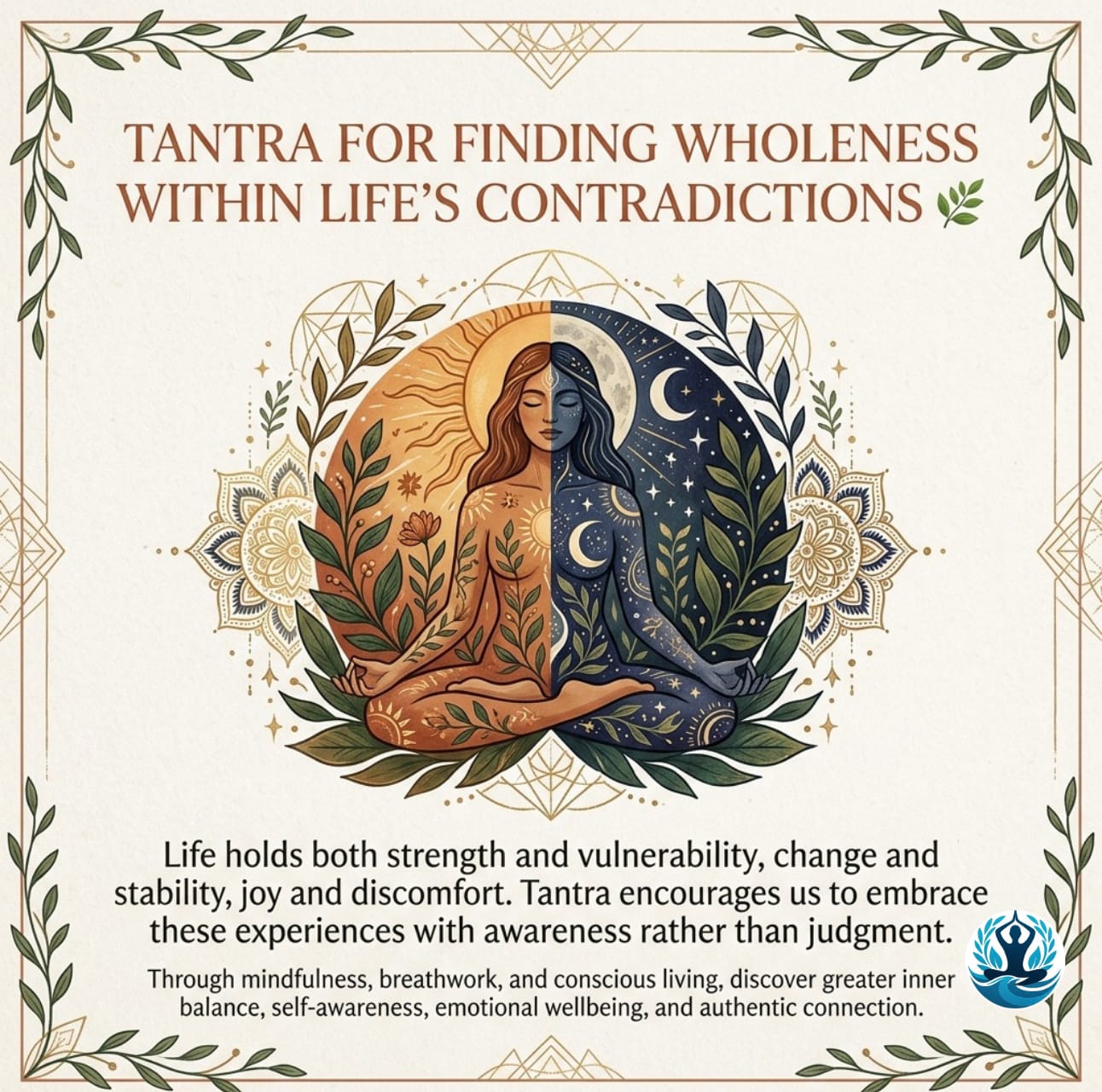
Life is rarely simple. We can feel confident and uncertain at the same time, strong and vulnerable, ambitious and exhausted, connected to others yet deeply in need of solitude. Modern life often encourages us to choose one side: success or rest, strength or softness, independence or connection, productivity or stillness.
Tantra offers a different perspective.
Rather than asking us to eliminate contradictions, Tantra encourages us to become more aware of the different experiences existing within us. From this perspective, inner growth does not necessarily mean becoming a completely different person. It can mean learning how to hold different parts of ourselves with greater awareness, acceptance, and balance.
Tantra for finding wholeness within life’s contradictions is therefore an approach to self-awareness that recognizes the complexity of being human. Instead of rejecting uncomfortable emotions or dividing experiences into “good” and “bad,” mindful Tantric practices can encourage us to observe life more completely.
This does not mean accepting every thought or behavior without question. Instead, it means developing enough awareness to understand ourselves before automatically reacting.
When we stop fighting every contradiction within ourselves, we may discover greater emotional balance, self-understanding, and inner peace.
What Does Wholeness Mean in Tantra?
Wholeness does not mean perfection.
It does not mean being calm all the time, never making mistakes, or having complete certainty about life. Wholeness can be understood as recognizing the different dimensions of our experience without allowing one difficult emotion or circumstance to define our entire identity.
A person can experience fear and courage simultaneously.
Someone can want change while also feeling attached to familiarity.
A person can love being around others and still need solitude.
These experiences are not necessarily signs that something is wrong. They are part of the complexity of human life.
Tantric philosophy has traditionally emphasized awareness, presence, and the recognition of interconnected experience. In a modern wellness context, these principles can inspire practices that help people observe their inner world rather than constantly trying to control it.
Finding wholeness means becoming more comfortable with the full range of human experience.
Understanding Life Through Opposites
Many aspects of life exist through apparent opposites:
- Activity and rest
- Strength and vulnerability
- Giving and receiving
- Independence and connection
- Silence and expression
- Discipline and spontaneity
- Confidence and uncertainty
- Pleasure and discomfort
- Change and stability
- Solitude and community
The problem often begins when we believe only one side is acceptable.
For example, someone may believe they must always be strong. Whenever vulnerability appears, they suppress it. Over time, this can create emotional tension.
Another person may believe productivity determines their value. When they need rest, they feel guilty.
Someone else may prioritize everyone else’s needs and struggle to receive support.
Tantra encourages a more conscious relationship with these opposing experiences.
Instead of asking, “Which side should I choose?” we can sometimes ask:
“What can I learn from both sides?”
This shift can create greater self-awareness.
Tantra and the Acceptance of Human Complexity
One of the most valuable ideas behind mindful Tantra is the willingness to experience life without immediately rejecting parts of it.
Acceptance does not mean resignation.
It means recognizing what is happening before deciding what to do about it.
Suppose you feel anxious about an upcoming change. You might immediately tell yourself, “I should not feel this way.”
A more mindful approach would be:
“I notice uncertainty in my body and thoughts. Something about this change feels uncomfortable. I can observe that experience without allowing it to control my next decision.”
This creates space between experience and reaction.
That space can be extremely valuable.
Instead of fighting an emotion, we become curious about it.
Instead of identifying completely with a thought, we observe it.
Instead of demanding immediate certainty, we allow ourselves to remain present while uncertainty exists.
1. Finding Balance Between Strength and Vulnerability
Strength is often associated with independence, confidence, and resilience. Vulnerability, on the other hand, is sometimes misunderstood as weakness.
But emotional wholeness requires room for both.
You can be capable while asking for help.
You can be confident while admitting uncertainty.
You can be resilient while acknowledging that something hurts.
Tantra-inspired mindfulness encourages greater body and emotional awareness. When we pay attention to sensations, breathing, posture, and emotional responses, we may become more aware of moments when we are protecting ourselves unnecessarily.
A simple practice is to sit quietly and notice the body.
Ask:
- Where am I holding tension?
- Am I trying to appear stronger than I feel?
- What emotion is present?
- Can I acknowledge it without judging myself?
The goal is not to force vulnerability. It is to create greater honesty with yourself.
2. Balancing Doing and Being
Modern culture places enormous emphasis on doing.
Work harder.
Achieve more.
Respond faster.
Stay productive.
Keep improving.
While purposeful action can be valuable, constantly living in “doing mode” can make it difficult to experience the present moment.
Tantra places importance on presence and conscious awareness. This can encourage a healthier relationship between action and stillness.
Being does not mean becoming passive.
It means allowing yourself to experience the moment without always needing to accomplish something.
A short daily pause can help:
Sit comfortably.
Relax your shoulders.
Take several slow, comfortable breaths.
Notice your surroundings.
Feel your body.
For a few minutes, do not attempt to solve anything.
Simply experience the present.
Over time, these small moments can help create a more balanced relationship between productivity and presence.
3. Embracing Pleasure Without Losing Awareness
Pleasure is an important part of human experience, but mindful Tantra does not require compulsive pursuit of pleasure.
Instead, it can encourage conscious experiencing.
Eating a meal, listening to music, spending time in nature, enjoying a conversation, or appreciating a peaceful moment can become opportunities for presence.
Ask yourself:
“Am I actually experiencing this moment, or am I already thinking about what comes next?”
When attention becomes more focused, ordinary experiences can feel richer.
This is not about chasing increasingly intense experiences. It is about becoming more aware of experiences that are already present.
Conscious enjoyment can therefore become a practice of gratitude and presence.
4. Learning From Discomfort
People naturally want to avoid discomfort.
However, some forms of discomfort contain useful information.
Stress may indicate that boundaries need attention.
Frustration may reveal an unmet expectation.
Sadness may point toward something meaningful.
Restlessness may suggest that we have been disconnected from ourselves.
This does not mean every uncomfortable feeling has a hidden message, nor should serious emotional difficulties be ignored. But approaching everyday discomfort with curiosity can sometimes provide useful self-understanding.
Tantra-inspired awareness asks us to pause before immediately distracting ourselves.
Instead of:
“I need to get rid of this feeling.”
Try:
“What is happening right now?”
This simple question can change the relationship we have with difficult emotions.
5. Moving Beyond the Need to Be Perfect
Perfectionism can create an internal contradiction.
We want to grow, but we also want to prove that we are already good enough.
We want improvement, but we fear making mistakes.
We want success, but we become afraid of failure.
Tantra for personal growth can offer a different mindset: growth does not require rejecting who you are today.
You can improve while accepting yourself.
You can have goals without believing you are incomplete.
You can acknowledge weaknesses without reducing your identity to them.
Wholeness begins when personal development becomes an expression of self-awareness rather than self-rejection.
6. Integrating the Mind and Body
Many people live primarily through their thoughts.
They analyze.
Plan.
Compare.
Predict.
Worry.
The body, meanwhile, may communicate through tension, fatigue, shallow breathing, restlessness, or relaxation.
Tantric practices often emphasize awareness of the body as part of conscious experience.
Body awareness can help us notice patterns before they become overwhelming.
For example, you might notice:
- Tight shoulders during stressful conversations
- Jaw tension while overthinking
- A racing heart before difficult decisions
- Shallow breathing during pressure
- Relaxation when you feel safe
- Heaviness when emotionally exhausted
The purpose is not to diagnose yourself from sensations. It is simply to become more attentive.
The body can become an anchor for present-moment awareness.
7. Balancing Independence and Connection
Human beings need both autonomy and connection.
Too much dependence can make it difficult to trust ourselves.
Too much isolation can leave us disconnected.
Finding wholeness means recognizing that independence and connection can coexist.
You can have your own identity while being deeply connected to others.
You can set boundaries while maintaining meaningful relationships.
You can ask for support without surrendering your personal responsibility.
A mindful approach to relationships begins with awareness.
Before reacting, ask:
“What am I feeling?”
“What do I need?”
“What might the other person be experiencing?”
“What response reflects my values?”
These questions can encourage more conscious communication.
8. Turning Inner Conflict Into Self-Understanding
Inner conflict is often uncomfortable.
One part of you wants to move forward.
Another part wants to stay safe.
One part wants to speak.
Another part fears judgment.
One part wants change.
Another part fears uncertainty.
Instead of seeing this conflict as evidence that you are broken, you can view it as information.
Try writing down both sides.
For example:
Part of me wants change because…
Part of me fears change because…
Then ask:
“What does each side need?”
This exercise can help transform internal conflict into self-understanding.
The objective is not always to satisfy every internal desire. Sometimes one decision must be made. But understanding the conflict can help you make that decision more consciously.
9. Tantra and the Practice of Presence
Presence is central to many mindfulness-based practices.
Being present means paying attention to what is happening now rather than constantly living in memories or imagined futures.
A simple Tantric-inspired presence practice can involve the senses.
Notice:
- Five things you can see
- Four things you can physically feel
- Three sounds around you
- Two scents
- One quality of your breathing
There is nothing complicated about this exercise.
Its value comes from redirecting attention toward immediate experience.
Regular moments of sensory awareness can help interrupt habitual mental patterns and bring attention back to the present.
10. Accepting Change and Stability Together
Change is unavoidable.
Yet people often seek stability at the same time.
This creates another apparent contradiction.
We want life to evolve, but we also want security.
Tantra can inspire a deeper understanding of this relationship.
Instead of expecting permanent stability, we can cultivate inner steadiness while external circumstances change.
Your job may change.
Relationships may change.
Your priorities may change.
Your identity may evolve.
The goal is not to prevent change.
It is to develop enough self-awareness to move through change without completely losing your center.
11. Creating a Daily Tantra-Inspired Wholeness Practice
You do not necessarily need a complicated routine.
A simple daily practice may include:
Morning Awareness
Before checking your phone, sit quietly for a few minutes.
Notice your breathing and body.
Ask:
“How do I want to move through today?”
Conscious Movement
Stretch, walk, practice gentle movement, or simply pay attention while moving.
Notice how your body feels rather than treating movement purely as exercise.
Emotional Check-In
During the day, pause and ask:
“What am I feeling right now?”
Name the emotion without judging it.
Conscious Breathing
Take several slow, comfortable breaths during moments of stress.
Allow the breath to become an anchor for attention.
Evening Reflection
Before sleeping, consider:
- What gave me energy today?
- What drained me?
- When was I most present?
- Where did I react automatically?
- What did I learn about myself?
This creates a habit of reflection.
12. Tantra for Emotional Balance
Emotional balance does not mean feeling positive all the time.
It means developing a healthier relationship with the full range of emotions.
Happiness, sadness, frustration, excitement, fear, calmness, disappointment, and gratitude can all be part of human experience.
Trying to eliminate difficult emotions may create additional tension.
Instead, emotional awareness allows us to recognize emotions without automatically becoming controlled by them.
A useful distinction is:
“I am experiencing anger” rather than “I am an angry person.”
The first statement describes an experience.
The second turns a temporary state into an identity.
This small difference can create psychological space.
13. Tantra for Authentic Living
Wholeness is closely connected with authenticity.
When our external behavior constantly contradicts our internal values, we may experience tension.
For example, you may value rest but constantly overwork.
You may value honesty but frequently hide your feelings.
You may value connection but remain emotionally unavailable.
You may value creativity but never create time for it.
Tantra-inspired self-awareness encourages us to examine these contradictions without shame.
Ask:
“Does the way I live reflect what I genuinely value?”
If the answer is no, awareness becomes the starting point for change.
14. The Role of Breath in Finding Wholeness
Breathing is one of the simplest ways to return attention to the present.
During stress, breathing can become rapid or shallow. When we intentionally notice the breath, we create a moment of pause.
A basic practice is to sit comfortably and observe the natural rhythm of breathing.
Do not force it.
Notice the movement of the abdomen or chest.
Feel the air moving in and out.
When the mind wanders, gently return attention to the breath.
The practice is not about achieving a special state.
It is about repeatedly returning to awareness.
15. Wholeness Is Different From Perfection
One of the most important distinctions in this entire topic is the difference between wholeness and perfection.
Perfection says:
“I must remove everything that is uncomfortable.”
Wholeness says:
“I can acknowledge the different parts of my experience and respond to them consciously.”
Perfection demands certainty.
Wholeness allows uncertainty.
Perfection rejects mistakes.
Wholeness learns from them.
Perfection often depends on external standards.
Wholeness begins with self-awareness.
This perspective can make personal growth feel less like a battle against yourself and more like an ongoing process of integration.
16. How Tantra Can Support a More Meaningful Life
When awareness becomes part of everyday life, ordinary moments can become opportunities for growth.
A conversation can teach you about your reactions.
A stressful situation can reveal your patterns.
Rest can teach you about your relationship with productivity.
Silence can reveal thoughts you normally avoid.
Relationships can show you where boundaries are needed.
Change can reveal what truly matters.
In this way, Tantra becomes less about isolated practices and more about conscious living.
The purpose is not to escape life.
It is to experience life more fully.
17. Common Misunderstandings About Tantra
Tantra is often misunderstood because the word is frequently reduced to sexuality or sensationalized ideas.
Traditional Tantra encompasses much broader philosophical and spiritual traditions, with diverse practices and interpretations across historical schools.
Modern wellness approaches may draw inspiration from selected Tantric concepts such as awareness, embodiment, meditation, breath, and conscious presence.
It is therefore important to distinguish between traditional Tantric traditions and modern adaptations.
A responsible approach avoids exaggerated promises and recognizes that mindfulness or wellness practices are not substitutes for professional medical or mental-health care when such care is needed.
18. Practical Questions for Self-Reflection
If you want to explore wholeness through a Tantra-inspired approach, consider these questions:
- Which parts of myself do I find difficult to accept?
- Where am I demanding perfection?
- Do I allow myself to rest without guilt?
- What emotions do I tend to suppress?
- Where do I need stronger boundaries?
- Where could I become more open to receiving?
- What contradictions exist between my values and daily behavior?
- What does my body tell me when I am stressed?
- When do I feel most authentic?
- What would living more consciously look like for me?
There are no perfect answers.
The purpose of reflection is to increase awareness.
19. Building a Life That Can Hold Contradictions
A mature approach to wellbeing does not require every contradiction to disappear.
You can pursue ambition while valuing rest.
You can enjoy solitude while maintaining meaningful relationships.
You can desire change while appreciating stability.
You can experience fear while taking courageous action.
You can acknowledge limitations while continuing to grow.
This is the essence of finding wholeness within life’s contradictions.
Rather than dividing yourself into acceptable and unacceptable parts, you begin to understand the larger picture.
This does not eliminate difficult choices.
It simply allows those choices to emerge from greater awareness.
Conclusion
Tantra for finding wholeness within life’s contradictions offers a powerful perspective on modern wellbeing: you do not have to become perfect to become more whole.
Life will continue to contain opposites.
There will be moments of confidence and doubt, movement and stillness, connection and solitude, pleasure and discomfort, certainty and uncertainty.
The goal is not to eliminate these experiences.
The goal is to meet them consciously.
Through practices such as meditation, breath awareness, conscious movement, sensory awareness, self-reflection, and mindful living, Tantra-inspired wellness can encourage a deeper relationship with the body, emotions, thoughts, and everyday experiences.
Wholeness begins when we stop treating every contradiction as a problem that must immediately be solved.
Sometimes, the contradiction itself is an invitation to become more aware.
When we learn to hold different experiences with curiosity rather than judgment, we create room for greater self-understanding, emotional balance, authenticity, and inner peace.
Ultimately, finding wholeness is not about becoming someone who never struggles.
It is about becoming more present with the person you already are—and consciously choosing how you want to live from there.