

Finding Strength in the Parts of Yourself You Usually Hide: A Tantric Journey Toward Self-Acceptance


Every person has parts of themselves they rarely reveal to the world. These may include feelings of insecurity, fear of failure, emotional sensitivity, uncertainty, past disappointments, or desires that seem difficult to express. Many people learn to hide these aspects because they want to be accepted, respected, and understood by others. Over time, hiding these parts can become a habit that influences relationships, decisions, emotional wellbeing, and personal growth.
But what if the parts of yourself you try to hide are not weaknesses? What if they contain valuable information about your needs, boundaries, experiences, and untapped potential?
Tantra offers a perspective that encourages greater awareness of the whole self rather than rejecting the parts that feel uncomfortable. Through mindful attention, conscious breathing, meditation, and self-observation, you can begin exploring your inner world with greater curiosity and compassion.
Finding strength in the parts of yourself you usually hide does not mean revealing everything to everyone. It means developing the courage to understand yourself honestly, accept your emotional experiences, and make choices that reflect your authentic values.
In this guide, we will explore how Tantric principles can inspire self-acceptance, emotional awareness, personal transformation, and a more meaningful relationship with yourself.
1. Understanding the Parts of Yourself You Usually Hide
People often develop different versions of themselves depending on their environment. You might appear confident at work while privately questioning your abilities. You may support everyone around you while finding it difficult to ask for help. You might smile during difficult moments because expressing sadness feels uncomfortable.
These differences do not necessarily mean you are being dishonest. They may reflect ways you have learned to adapt to social expectations, family influences, professional demands, or past experiences.
However, when you continually suppress important emotions or needs, you may gradually lose touch with what you genuinely feel.
Why do we hide certain aspects of ourselves?
Several factors can contribute to this habit:
- Fear of rejection: You may worry that others will judge you if they see your vulnerabilities.
- Social expectations: You may believe you must always appear strong, successful, agreeable, or emotionally stable.
- Past experiences: Previous criticism or rejection may make emotional openness feel unsafe.
- Perfectionism: You may hide mistakes because you believe your worth depends on doing everything correctly.
- People-pleasing: You may suppress your opinions and preferences to avoid disappointing others.
Recognizing these patterns is the first step toward understanding yourself more deeply.
Instead of asking, “What is wrong with me?” try asking, “What am I afraid would happen if I allowed myself to acknowledge this part of who I am?”
This simple change in perspective can create space for self-understanding rather than self-criticism.
2. How Tantra Encourages Acceptance of the Whole Self
Tantra is a diverse spiritual tradition with different philosophical and practical approaches. In many Tantric traditions, awareness of embodied experience, consciousness, and the interconnectedness of life plays an important role.
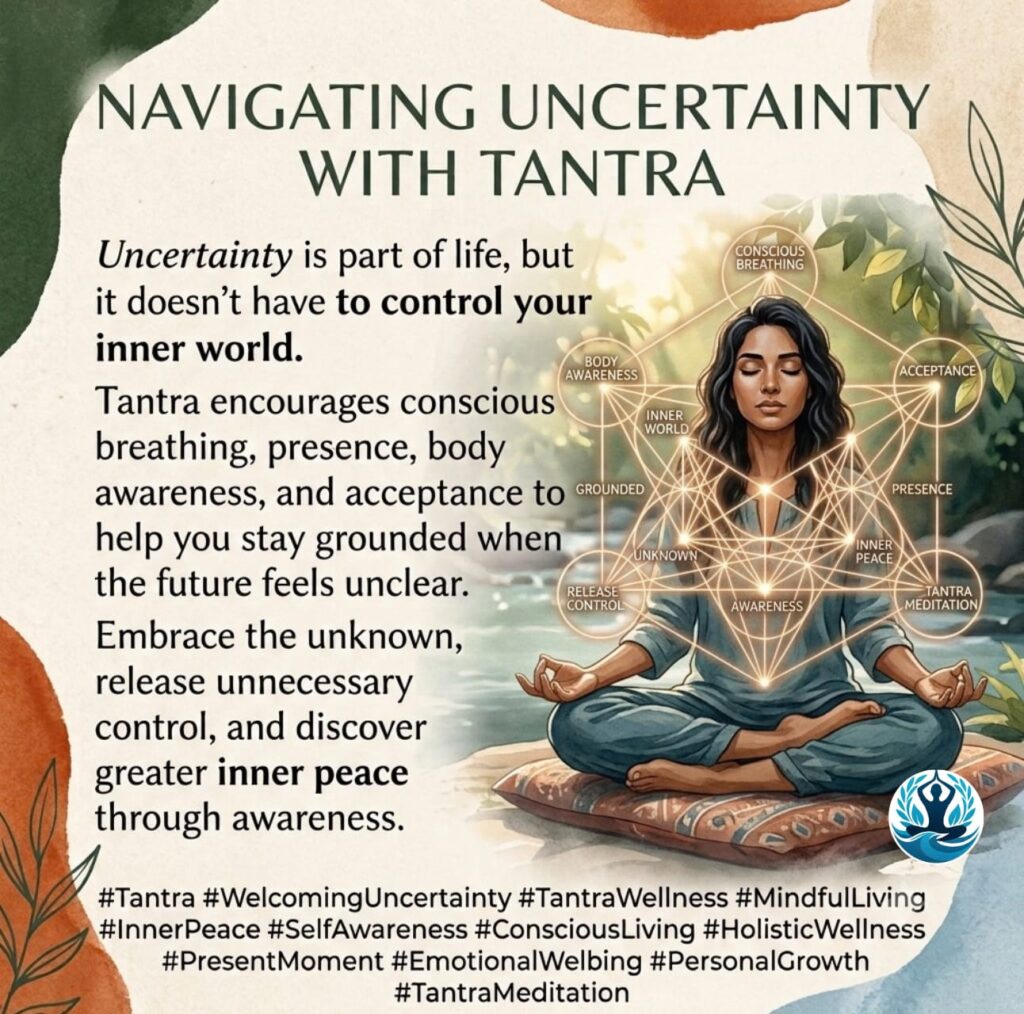
For modern personal development, selected Tantric principles can inspire a more accepting relationship with thoughts, emotions, sensations, and everyday experiences.
Rather than treating every uncomfortable feeling as something that must immediately disappear, a mindful approach encourages you to notice what is happening within you.
For example, if you feel jealous, you can acknowledge the emotion without defining yourself as a jealous person. If you experience fear, you can explore what the fear might be communicating without allowing it to determine every decision.
This distinction is important because an emotion is an experience you have, not the complete definition of who you are.
Acceptance does not mean approving of everything
Self-acceptance does not require you to justify harmful behavior, ignore personal responsibilities, or remain in unhealthy situations.
You can accept that anger is present while choosing not to act aggressively. You can acknowledge insecurity while working to develop confidence. You can recognize a mistake without deciding that you are a failure.
Through conscious awareness, you learn to make room for your experience while remaining responsible for your actions.
This balanced approach can support personal growth without turning self-improvement into another reason to criticize yourself.
3. Discovering the Strength Hidden Within Vulnerability
Many people associate strength with independence, confidence, achievement, and emotional control. Vulnerability, on the other hand, is often misunderstood as weakness.
Yet vulnerability can reveal qualities that are essential for meaningful personal development.
Admitting that you are struggling requires honesty. Asking for support requires courage. Recognizing that you have made a mistake creates an opportunity to learn. Expressing your genuine needs can help you build healthier relationships.
Vulnerability can reveal your real needs
Imagine that you regularly say yes to requests even when you feel exhausted. You might tell yourself that being available to everyone makes you dependable.
However, beneath this behavior, you may fear disappointing people or losing their approval.
Recognizing this fear gives you an opportunity to develop a healthier relationship with your time and energy. You can remain caring without agreeing to every request.
Similarly, acknowledging loneliness may encourage you to seek genuine connection rather than keeping yourself constantly busy.
The strength does not come from eliminating vulnerability. It comes from understanding what it reveals and deciding how to respond.
Practicing vulnerability with wisdom
You do not need to share your deepest feelings with everyone. Emotional openness works best when combined with trust, personal boundaries, and awareness of your circumstances.
Start by being honest with yourself. Then consider sharing appropriate feelings with people who have demonstrated respect and emotional safety.
This allows vulnerability to become a source of connection rather than an obligation to disclose everything.
4. Understanding Your Shadow Without Judging Yourself
The idea of the shadow self is commonly associated with psychologist Carl Jung. It refers broadly to aspects of ourselves that we do not fully acknowledge or prefer to keep outside our conscious self-image.
For example, someone who strongly identifies as generous may struggle to admit that they sometimes feel resentful. A person who values independence may find it difficult to acknowledge their need for support.
These feelings do not automatically make someone a bad person. They may reveal unmet needs, internal conflicts, or areas requiring attention.
Although shadow work is not identical to Tantra, reflective practices inspired by both approaches can encourage deeper self-awareness.
How to explore your hidden patterns
Begin by noticing situations that trigger unusually strong reactions.
Ask yourself:
- What behavior in others causes me to feel especially uncomfortable?
- Which emotions do I find difficult to express?
- What do I criticize myself for experiencing?
- Which parts of my personality do I try hardest to conceal?
- What might these reactions reveal about my expectations or unmet needs?
These questions are invitations to explore, not tools for blaming yourself.
For example, irritation toward someone who confidently expresses their opinions might reveal that you have learned to silence your own voice. Recognizing this possibility can help you practice communicating more honestly.
Not every reaction has a hidden psychological meaning, and self-reflection does not replace professional support when deeper difficulties arise. The goal is simply to become more curious about your inner experiences.
5. Reconnecting With Emotions You Have Learned to Suppress
Emotions provide information about how we experience our circumstances. Sadness may accompany loss. Anger may arise when a boundary feels violated. Fear may signal uncertainty or perceived danger. Joy may reveal what feels meaningful or nourishing.
Problems can arise when we believe certain emotions are unacceptable and repeatedly try to ignore them.
Suppressing emotions does not always make them disappear. Sometimes it makes it harder to recognize our needs or respond constructively.
A mindful approach to emotional awareness
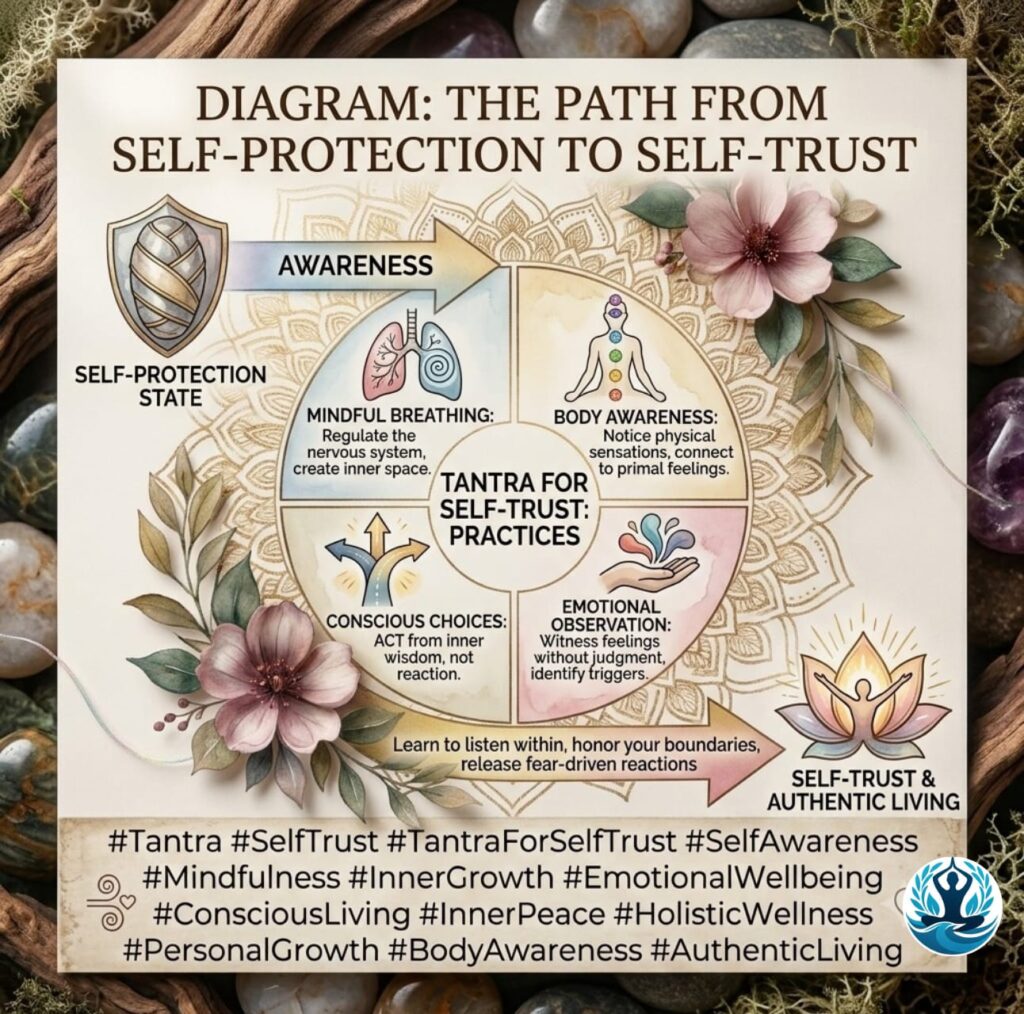
Tantra-inspired mindfulness encourages you to notice your experience before immediately reacting to it.
When a difficult emotion arises, try this process:
- Pause: Give yourself a moment before responding.
- Notice: Identify the emotion as accurately as you can.
- Observe your body: Notice whether you feel tension, warmth, restlessness, or heaviness.
- Name the need: Ask whether you need rest, clarity, reassurance, space, or support.
- Choose a response: Decide what action is appropriate rather than acting automatically.
Suppose a colleague criticizes your work and you immediately feel defensive. Instead of reacting instantly, pause and acknowledge the discomfort.
You might discover that part of your reaction comes from fear of appearing incompetent. With this awareness, you can assess the feedback more objectively and respond professionally.
The purpose is not to control every emotion. It is to develop enough awareness to respond with greater intention.
6. Using Breathwork to Create Space for Self-Understanding
Breathing is an accessible way to bring attention back to the present moment. When your thoughts become overwhelming, observing your natural breath can help you slow down and notice your experience.
In Tantra-inspired practices, breath awareness may be incorporated into meditation, movement, or other contemplative exercises.
For everyday self-awareness, a simple practice is often enough.
A gentle breathing practice
Find a comfortable seated position in a quiet place.
- Allow your shoulders to relax.
- Notice the natural movement of your breathing.
- Observe the air entering and leaving your body.
- When thoughts or emotions arise, acknowledge them without trying to force them away.
- Gently return your attention to the breath.
Continue for two to five minutes, breathing comfortably without straining.
You might notice impatience, sadness, restlessness, or an urge to distract yourself. These experiences are not failures. They are opportunities to observe how your mind responds when you pause.
Breathing exercises affect people differently and are not guaranteed to produce calm. If focusing on your breath feels uncomfortable, keep your eyes open and direct your attention toward your surroundings instead.
Over time, this practice can help you become more familiar with your internal experiences and recognize when you need a break, a boundary, or a thoughtful response.
7. Releasing the Pressure to Appear Perfect
Perfectionism often develops around the belief that mistakes make us less worthy of respect or acceptance.
You may feel pressure to have the right answers, maintain a positive attitude, avoid conflict, or demonstrate success in every area of life.
This pressure can make it difficult to acknowledge uncertainty or ask for help.
However, a life built around maintaining a perfect image can become emotionally exhausting.
Moving from perfection to authenticity
Authenticity involves allowing your actions to reflect your genuine values rather than constantly performing an idealized version of yourself.
It does not mean acting without consideration for others. It means recognizing that you can be responsible and imperfect at the same time.
Consider these practical changes:
- Replace “I must never make mistakes” with “I can learn from mistakes.”
- Replace “I should always be strong” with “I can ask for help when necessary.”
- Replace “Everyone must approve of me” with “I can act according to my values.”
- Replace “I must hide my uncertainty” with “I can take time to understand.”
These shifts may seem small, but they challenge the assumptions that keep hidden parts of yourself locked away.
Through conscious living, you can begin to measure your progress by honesty, learning, and meaningful choices rather than by the appearance of perfection.
8. Setting Boundaries Without Feeling Guilty
One of the hidden parts of yourself may be the part that wants to say no.
You might agree to social plans when you need rest, accept additional responsibilities when your schedule is full, or avoid expressing disagreement because you fear conflict.
Over time, these patterns can create frustration and emotional exhaustion.
Healthy boundaries help you recognize that your needs matter alongside the needs of other people.
Why boundaries are part of self-acceptance
If you consistently ignore your limits, you may unintentionally communicate to yourself that your time, energy, and preferences are unimportant.
Setting boundaries offers a different message: you can care about others without abandoning yourself.
You can begin with simple statements such as:
- “I need some time to consider that.”
- “I am unable to take on another responsibility right now.”
- “I understand your perspective, but I see this differently.”
- “I need some quiet time before continuing this conversation.”
You do not need to explain every decision in excessive detail. A respectful and clear response is often sufficient.
Tantric awareness can complement this process by helping you notice bodily tension, emotional discomfort, and habitual reactions. These signals may help you recognize when a boundary deserves attention.
However, boundaries are not always easy or safe to communicate in every relationship. Consider your circumstances and seek appropriate support when necessary.
9. Understanding the Fear of Being Truly Seen
For some people, hiding certain aspects of themselves is less about embarrassment and more about protection.
They may fear that if others discover their insecurities, needs, or past mistakes, they will be rejected.
This fear can encourage emotional distance, constant people-pleasing, or the habit of presenting only acceptable parts of oneself.
Yet genuine connection often requires some degree of honesty.
Building trust gradually
You do not need to become completely open overnight. Instead, develop a greater sense of safety through small, intentional steps.
You might share a genuine opinion during a conversation, acknowledge when you do not know something, or tell a trusted person that you have been feeling overwhelmed.
Observe how the other person responds. Healthy relationships generally allow room for differences, respectful communication, and mutual boundaries.
Remember that another person’s reaction does not determine your entire worth.
Some people may not understand your experiences, and not everyone deserves access to your private thoughts. Self-acceptance includes recognizing when to open up and when to protect your privacy.
The aim is not to gain universal approval. It is to build a life in which you do not need to hide from yourself to feel worthy of belonging.
10. Tantra and the Practice of Being Present With Yourself
Modern life encourages constant activity. We move between messages, deadlines, responsibilities, and entertainment, often leaving little time to notice our internal experiences.
When every quiet moment is filled with distraction, it can become difficult to recognize what we feel or need.
Present-moment awareness offers an opportunity to reconnect with everyday experience.
Returning to the present through ordinary activities
You can practice awareness without setting aside an entire hour for meditation.
While drinking tea, notice its warmth and aroma. During a walk, observe the movement of your feet and the sounds around you. While eating, pay attention to taste and texture.
When you feel emotionally unsettled, take a moment to recognize what is happening before moving to the next task.
These activities are simple, but they can interrupt the habit of living entirely through automatic responses.
A conscious approach to Tantra emphasizes the value of paying attention to experience rather than treating every moment as something to rush through or improve.
The purpose is not to eliminate thoughts or remain perfectly present all day. It is to return to awareness whenever you notice that you have become disconnected from yourself.
11. Transforming Self-Criticism Into Self-Compassion
The inner voice that criticizes you may seem helpful at first. It may promise that if you judge yourself harshly enough, you will avoid future mistakes.
However, constant self-criticism can make it difficult to learn from experience. Instead of examining a mistake objectively, you may become preoccupied with shame or the fear of failing again.
Self-compassion provides a more constructive alternative.
It involves recognizing your difficulties without exaggerating them, acknowledging that imperfection is part of human life, and responding to yourself with the same basic consideration you would offer someone you care about.
A practical self-compassion exercise
When you notice a harsh internal judgment, pause and write down the thought.
For example:
“I am weak because I cannot manage everything.”
Then consider a more balanced statement:
“I am dealing with several responsibilities, and I may need rest or support. Recognizing my limits can help me make better decisions.”
The revised statement does not deny the challenge. It removes the unnecessary attack on your identity.
This practice can be particularly helpful when exploring emotions or personality traits you usually hide.
Instead of demanding immediate change, give yourself permission to understand the pattern first. Lasting personal growth often becomes easier when reflection is guided by curiosity rather than punishment.
12. Discovering the Values Beneath Your Hidden Desires
Sometimes the aspects of ourselves we hide are connected to needs or aspirations we have learned to dismiss.
You might want a slower lifestyle but feel pressured to pursue constant achievement. You might value creative expression but worry that it is impractical. You may desire deeper relationships while spending most of your time meeting external expectations.
These conflicts can create a sense of disconnection.
Asking what truly matters to you
Take time to reflect on the following questions:
- What activities make me feel genuinely engaged?
- What do I continue doing mainly to gain approval?
- Which responsibilities reflect my values, and which arise from fear?
- What kind of relationships help me feel respected and understood?
- If I stopped comparing myself with others, what might I choose differently?
Your answers may reveal differences between the life you are living and the life you want to build.
You do not need to change everything immediately. Start with one practical decision that better reflects your priorities.
For example, you might protect time for a meaningful hobby, have an honest conversation, or reconsider a commitment that no longer fits your circumstances.
Finding strength in your hidden self means learning to take your inner needs seriously while balancing them with real-world responsibilities.
13. Creating a Daily Tantra-Inspired Self-Awareness Routine
Self-understanding develops through repeated attention rather than a single dramatic experience.
A short daily routine can help you observe patterns, recognize emotions, and respond more consciously.
The following practice is suitable for beginners and can be adapted to your preferences.
Morning: Begin with awareness
Spend three to five minutes sitting comfortably and noticing your natural breath.
Ask yourself:
“What am I bringing into this day emotionally?”
There is no need to force a positive answer. Simply recognize whether you feel rested, anxious, hopeful, distracted, or uncertain.
Choose one intention, such as being honest about your needs or responding thoughtfully during difficult conversations.
During the day: Notice automatic reactions
When you experience discomfort, pause briefly before responding.
Ask yourself whether you are acting from a genuine preference, fear of judgment, or an old habit.
You do not need to analyse every situation. One moment of awareness can be enough to help you make a more deliberate choice.
Evening: Reflect without judgment
Before bed, write a few sentences about your day.
Consider these prompts:
- When did I feel most like myself today?
- When did I hide what I genuinely felt?
- What did I learn about my needs or boundaries?
- What is one thing I can approach differently tomorrow?
Finish by acknowledging one thing you handled well, even if it was a small decision.
This routine is not a test of discipline or spiritual progress. If you miss a day, simply begin again when you are ready.
14. How Self-Acceptance Can Improve Relationships
When you understand your own emotions and needs more clearly, you may find it easier to communicate with others.
For example, recognizing that you fear rejection can help you distinguish between an actual relationship problem and an assumption based on insecurity.
Understanding your tendency to please others can help you express preferences rather than expecting people to guess what you need.
Acknowledging anger can encourage you to discuss a concern before resentment builds.
These changes do not guarantee conflict-free relationships. Disagreements remain a normal part of human connection.
However, greater self-awareness can help you approach disagreements with more honesty and responsibility.
Accept yourself without abandoning accountability
Self-acceptance does not mean expecting others to tolerate every behavior.
If you hurt someone, you can acknowledge the impact, apologize, and work toward changing the behavior. If you repeatedly encounter a difficult pattern, you can seek help or develop new skills.
You can respect yourself while recognizing that you still have room to grow.
This balance is essential: you do not need to hate yourself to become a better version of yourself.
15. Common Misconceptions About Hidden Parts of the Self
Exploring your inner world can be meaningful, but it is helpful to avoid several misunderstandings.
Misconception 1: Every hidden emotion must be expressed.
Not every feeling needs to be shared publicly. You can acknowledge an emotion privately and choose an appropriate response.
Misconception 2: Self-acceptance means never changing.
Acceptance allows you to see your current situation clearly. From that understanding, you can decide what needs to change.
Misconception 3: Vulnerability means telling everyone everything.
Vulnerability can be selective. Trust, context, privacy, and safety matter.
Misconception 4: Difficult emotions mean you are failing spiritually.
Feeling anger, sadness, fear, or confusion does not make you less worthy. Spiritual and personal practices are not measures of emotional perfection.
Misconception 5: Tantra promises instant transformation.
Self-awareness and personal growth take time. Individual experiences vary, and no single practice guarantees a particular emotional outcome.
A realistic approach to Tantra respects the complexity of human experience and avoids treating ordinary emotions as problems that must always be eliminated.
16. When Professional Support May Be Helpful
Self-reflection can support personal development, but it is not a substitute for professional mental health care when emotional difficulties become persistent or overwhelming.
If exploring hidden feelings brings up intense distress, traumatic memories, or difficulties that interfere with everyday functioning, consider speaking with a qualified mental health professional.
A trained professional can help you understand emotional patterns, develop coping strategies, and work through difficult experiences at a manageable pace.
You do not need to explore every painful experience alone. Seeking support is compatible with self-acceptance and can be an important expression of self-respect.
Conclusion: Your Hidden Self Can Become a Source of Strength
Finding strength in the parts of yourself you usually hide begins with a simple but meaningful decision: to approach your inner world with curiosity instead of judgment.
The insecurities you conceal, the emotions you struggle to express, and the needs you repeatedly ignore do not have to define your limitations. They can become opportunities to understand yourself more clearly and make choices that support your wellbeing.
Through Tantra-inspired awareness, conscious breathing, meditation, and honest reflection, you can learn to notice your experiences without immediately rejecting them. You can recognize vulnerability without losing confidence, set boundaries without abandoning compassion, and pursue personal growth without demanding perfection.
You do not need to reveal every part of yourself to the world. You do not need to become someone entirely different to deserve respect. And you do not need to eliminate every uncomfortable emotion before you can experience a meaningful life.
Start by listening to yourself. Notice what you feel, acknowledge what you need, and allow yourself the freedom to grow at your own pace.
True inner strength is not about hiding every weakness. It is about understanding yourself honestly, accepting your humanity, and choosing how you want to live.
Through conscious living and deeper self-awareness, the parts of yourself you once tried to hide may become valuable sources of wisdom, resilience, and authentic personal growth.