

Tantra for Breaking the Habit of Mentally Rehearsing the Future: A Guide to Mindful Living


Have you ever spent hours thinking about a conversation that has not happened yet, imagining how a meeting might go, or worrying about situations that may never occur? You might mentally prepare answers, predict other people’s reactions, or repeatedly imagine different outcomes. Although this habit may feel like preparation, it can sometimes leave you feeling exhausted, distracted, and disconnected from the present moment.
Mentally rehearsing the future is a common experience. People often imagine upcoming events because they want to feel prepared, avoid mistakes, or protect themselves from disappointment. However, when these thoughts become repetitive, they can make it difficult to enjoy the present and respond naturally to everyday experiences.
Tantra offers a perspective on developing awareness of the mind, reconnecting with the body, and experiencing life more consciously. Through mindful breathing, meditation, sensory awareness, and self-observation, Tantra-inspired practices can help you notice repetitive thought patterns without automatically following them.
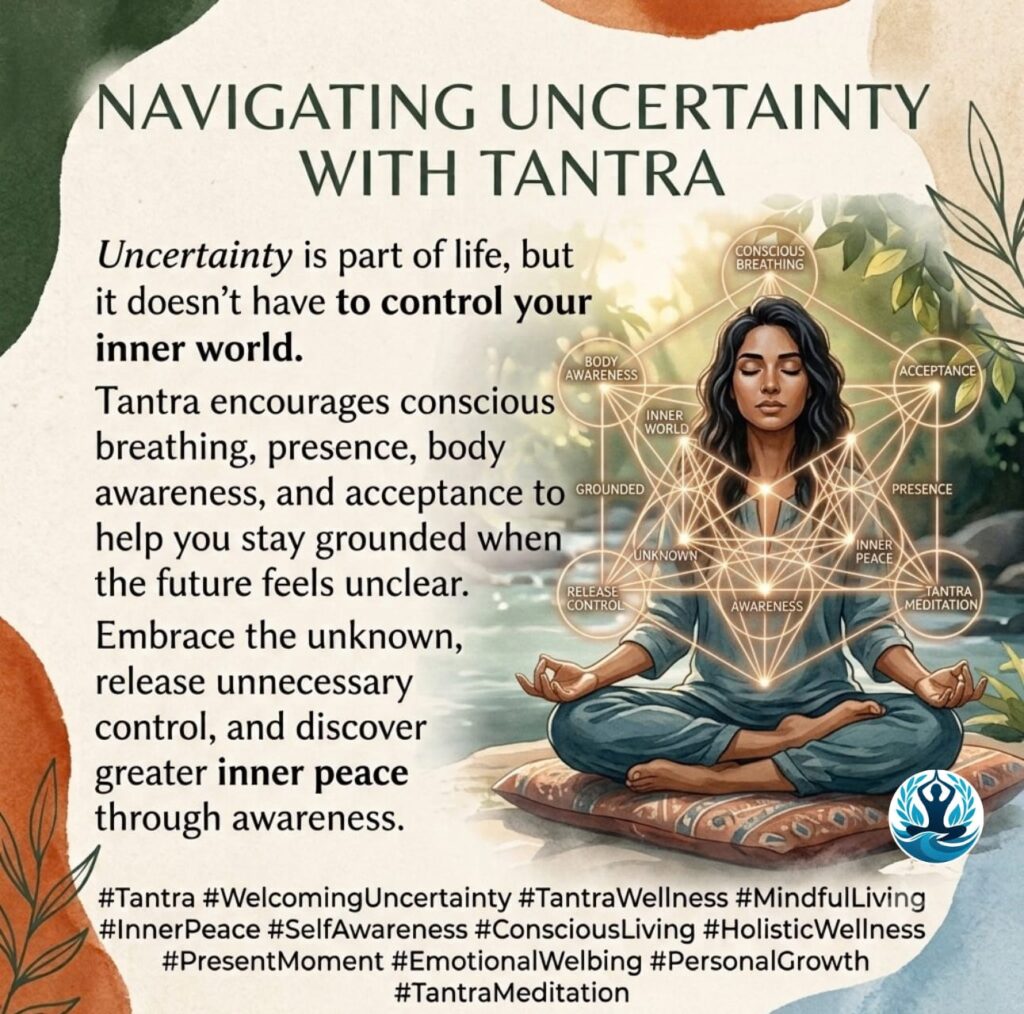
Rather than trying to control every possible outcome, you can learn to distinguish between useful preparation and unnecessary mental repetition. This shift can support a more balanced relationship with uncertainty, allowing you to approach the future thoughtfully while remaining connected to the present.
In this guide, we explore how Tantra can help you understand the habit of mentally rehearsing the future, why it develops, and which practical techniques may help you cultivate greater awareness, inner steadiness, and mindful living.
Understanding the Habit of Mentally Rehearsing the Future
Mentally rehearsing the future involves repeatedly imagining situations before they happen. It can include planning conversations, anticipating problems, predicting reactions, or creating detailed mental stories about possible outcomes.
For example, before attending a meeting, you might imagine what everyone will say, prepare responses to questions, and worry about making a mistake. After planning the important details, your mind may continue replaying the same possibilities even when no additional preparation is necessary.
This habit can appear in many areas of life, including relationships, work, personal decisions, finances, and social situations.
There is nothing inherently wrong with thinking ahead. Planning helps us organize responsibilities, identify challenges, and make informed decisions. The difficulty arises when planning becomes repetitive and creates more worry than clarity.
A useful distinction is the difference between constructive preparation and repetitive mental rehearsal.
Constructive preparation usually leads to a practical action. You identify a concern, consider realistic options, and decide what to do next.
Repetitive mental rehearsal often returns you to the same questions without producing new information or a clear decision.
Tantra-inspired self-awareness encourages you to notice this difference. Instead of judging yourself for thinking about the future, you can become curious about what your mind is doing and whether those thoughts are helping you in the present.
Why Do We Keep Mentally Rehearsing the Future?
Understanding why this habit develops can help you respond to it with greater patience.
1. The Desire for Control
Uncertainty can feel uncomfortable. When you do not know how a situation will unfold, your mind may attempt to create a sense of control by imagining different possibilities.
You might rehearse a difficult conversation because you want to avoid conflict or repeatedly plan a decision because you fear making the wrong choice.
Although preparation can be helpful, no amount of mental rehearsal can guarantee a particular outcome. Other people have their own perspectives, unexpected circumstances arise, and life rarely follows an entirely predictable path.
Tantra-inspired awareness invites you to recognize the limits of control. You can prepare for what is within your influence while learning to remain present with what you cannot determine in advance.
2. Fear of Making Mistakes
Some people repeatedly imagine future situations because they are afraid of being judged, misunderstood, or unsuccessful.
They may believe that if they think through every possibility, they can prevent embarrassment or disappointment. This can create a cycle in which every new possibility generates another question.
Instead of preparing for one realistic challenge, the mind begins searching for every potential problem.
Developing self-awareness can help you recognize when preparation has become driven by fear rather than practical necessity. You can then focus on taking reasonable steps instead of demanding perfection from yourself.
3. Past Experiences and Emotional Memories
Previous experiences can influence how you approach future situations. If a past conversation ended badly, you might spend considerable time preparing for similar conversations.
If a previous decision led to disappointment, you might become more cautious about making another one.
Your mind may be attempting to protect you from repeating an uncomfortable experience. However, the future situation may be different from the past one.
Through mindful observation, you can acknowledge what happened previously without assuming that the same outcome must occur again.
4. Difficulty Being Present
Modern life frequently encourages people to think about what comes next. Work deadlines, messages, appointments, responsibilities, and personal goals can make the mind feel as though it must remain several steps ahead.
When attention is constantly directed toward the next task, the present can begin to feel like something to get through rather than something to experience.
Tantra places importance on conscious awareness of experience. Paying attention to your breath, physical sensations, surroundings, and current activity can help you reconnect with what is happening now.
5. The Belief That Worry Means Responsibility
You may believe that thinking about a problem repeatedly demonstrates that you care about it.
For example, you might keep worrying about an important presentation because you want to perform well. You may continue mentally rehearsing a family conversation because the relationship matters to you.
However, caring about something does not require constant worry.
Responsible preparation involves taking appropriate action. Beyond that point, repeated thinking may not improve the outcome.
Learning this distinction can help you remain committed to your responsibilities without allowing them to occupy your attention throughout the day.
How Tantra Can Help You Change Your Relationship With Future Thoughts
Tantra is a diverse family of spiritual and philosophical traditions with different teachings and practices. It should not be reduced to a single relaxation technique or a modern wellness method.
For this article, Tantra-inspired practices refer primarily to awareness, meditation, conscious breathing, sensory attention, and a more accepting relationship with present experience.
These practices are not about forcing the mind to become completely empty. They are about noticing thoughts without automatically treating every thought as an instruction that requires attention.
1. Observe Thoughts Without Immediately Following Them
When you mentally rehearse the future, your attention can become absorbed in imagined situations.
You might begin by thinking about an upcoming conversation and eventually find yourself imagining several possible arguments, reactions, and explanations.
The first step is to recognize what is happening.
Instead of saying, “I must stop thinking about this,” gently acknowledge, “I am imagining a future conversation.”
This small change creates a distinction between you and the content of your thoughts. You are noticing a mental activity rather than automatically participating in it.
You do not need to criticize yourself or force the thought away. Simply recognize it and decide whether it requires practical attention.
Over time, this approach may help you respond to repetitive thinking with greater awareness.
2. Use Conscious Breathing to Return to the Present
Breathing is an accessible way to bring attention back to immediate experience.
When you notice yourself imagining future situations, pause briefly and observe your natural breathing pattern. Notice the movement of your abdomen or chest, the sensation of air entering your nostrils, and the gentle transition between inhalation and exhalation.
Try this simple exercise:
- Sit comfortably and allow your shoulders to relax.
- Notice your natural breathing without changing it immediately.
- Pay attention to three to five comfortable breaths.
- When thoughts about the future arise, acknowledge them without judgment.
- Gently return your attention to breathing.
You do not need to achieve a special state or eliminate every thought.
The purpose is to practise returning your attention to something that is happening now.
If comfortable, you can allow your exhalation to become slightly slower without straining. Stop or return to normal breathing if you feel dizzy or uncomfortable.
Practised regularly, conscious breathing may support relaxation and help you recognize when your attention has moved away from the present.
3. Reconnect With Your Body
Future-oriented thinking can make you less aware of your immediate physical experience.
You might be sitting at your desk while mentally imagining a difficult meeting. You may not notice that your shoulders are raised, your jaw is tight, or your hands are clenched.
Body awareness can help you recognize these signals.
Pause and ask yourself:
- Are my shoulders relaxed or tense?
- Am I holding my breath?
- What sensations can I notice in my hands and feet?
- Am I physically here while my attention is focused on an imagined situation?
You do not need to change every sensation. Begin by noticing what is present.
Then gently relax any area that feels unnecessarily tense, if comfortable.
Tantra-inspired body awareness encourages a more conscious relationship with physical experience. It can help you recognize when your mind is occupied with imagined events while your body is responding to the present moment.
4. Accept Uncertainty Instead of Trying to Eliminate It
One reason people rehearse the future is that they want certainty before taking action.
They may want to know exactly how a person will respond, whether a decision will succeed, or whether a situation will unfold as expected.
Unfortunately, certainty is not always available.
You can prepare thoughtfully and still encounter unexpected circumstances. Accepting this reality does not mean becoming careless or giving up on your goals.
It means recognizing that preparation and control are different things.
Try asking yourself, “What can I reasonably do now, and what must remain uncertain?”
This question helps separate practical responsibilities from imagined possibilities.
For example, if you have an upcoming interview, you can research the organization, practise answering common questions, and prepare your documents. You cannot know every question the interviewer will ask or guarantee the final decision.
Once you have completed reasonable preparation, you can redirect your attention toward the rest of your life.
5. Practise Witness Consciousness
Witness consciousness is an important concept in some Indian contemplative and philosophical traditions, including certain Tantric traditions.
In practical terms, it can be approached as the ability to notice thoughts, emotions, and sensations without immediately identifying with or reacting to them.
Imagine watching clouds move across the sky. You can observe their changing shapes without needing to hold on to each cloud or make it disappear.
Thoughts can be approached in a similar way.
When you notice yourself rehearsing the future, observe the thought as an event in the mind. You might recognize that you are imagining a negative outcome, seeking reassurance, or trying to predict another person’s response.
You do not have to treat every imagined possibility as a fact.
This practice can help create a pause between thinking and acting. It may also make it easier to examine whether a thought is useful, realistic, or simply repetitive.
Witness consciousness is not about suppressing emotions or becoming detached from life. It is about developing enough awareness to respond more deliberately.
Practical Tantra-Inspired Exercises for Everyday Life
Understanding awareness is useful, but practising it during ordinary activities can make the approach more relevant to daily life.
The following exercises can be adapted to your routine.
Exercise 1: The Present-Moment Pause
Use this practice whenever you notice yourself repeatedly imagining what might happen next.
Step 1: Stop briefly. Pause your current activity if it is safe and appropriate to do so.
Step 2: Notice your surroundings. Look around and identify a few things you can see or hear.
Step 3: Feel your body. Notice your feet touching the floor or your hands resting on a surface.
Step 4: Observe your thoughts. Acknowledge that your mind is imagining the future.
Step 5: Choose your next action. Decide whether you need to prepare something practical or return to the task in front of you.
This exercise can take less than a minute. Its purpose is not to solve every concern but to restore awareness of your immediate experience.
Exercise 2: The Preparation Check
When you find yourself rehearsing the same situation repeatedly, ask yourself three questions:
- What exactly am I preparing for?
- Is there a practical action I can take now?
- Have I already done what is reasonably necessary?
If you identify a useful action, take it or schedule it.
If you have already prepared sufficiently, acknowledge that additional thinking may not provide additional benefit.
For example, if you have prepared your presentation and checked your materials, you might decide to stop practising for the evening and rest.
This method helps you distinguish between productive planning and repetitive thinking.
Exercise 3: A Five-Minute Awareness Meditation
Choose a quiet place where you can sit comfortably.
For the first minute, notice your posture and breathing.
During the next two minutes, allow thoughts to arise naturally. Whenever you notice a future-oriented thought, acknowledge it without judging yourself.
During the following minute, bring attention to physical sensations, such as your feet touching the floor or your hands resting in your lap.
For the final minute, notice your surroundings and choose one activity to approach with greater attention.
You may find that thoughts continue throughout the meditation. That is normal. Success does not depend on achieving a completely silent mind.
The practice is in noticing when attention wanders and gently returning it.
Exercise 4: Complete One Activity With Full Attention
Choose an ordinary activity such as drinking tea, walking, washing dishes, or preparing a meal.
Instead of mentally planning your next five tasks, pay attention to the activity itself.
Notice the temperature of the cup, the movement of your hands, the sounds around you, or the sensation of your feet touching the ground.
When your mind moves toward the future, gently return to what you are doing.
This exercise demonstrates that mindful awareness does not always require a separate meditation session. It can be practised during ordinary daily activities.
Exercise 5: Create a Clear Stopping Point for Planning
Some people find that future-oriented thinking continues because they have not established a boundary around preparation.
You can experiment with setting aside a specific period for planning.
During that time, write down upcoming responsibilities, identify likely challenges, and decide on practical next steps.
When the planning period ends, put the list aside and return to your other activities.
If another concern appears later, ask whether it needs immediate attention or can be added to your next planning session.
This approach can help contain planning rather than allowing it to spread throughout the day.
How Mentally Rehearsing the Future Can Affect Everyday Wellbeing
Repeated future-oriented thinking can influence several aspects of everyday experience, although its effects vary from person to person.
Increased Mental Fatigue
Repeatedly evaluating possibilities can feel tiring, especially when the same questions return without resolution.
You may finish the day feeling mentally exhausted even if you have not completed a particularly demanding task.
Learning to identify repetitive thought patterns may help you spend your attention more intentionally.
Difficulty Concentrating
When your mind is occupied with an imagined conversation or future problem, it can be harder to focus on your current responsibilities.
You might read the same paragraph repeatedly, overlook details, or struggle to remain engaged in a conversation.
Present-moment awareness can help you notice when attention has wandered and redirect it toward the task at hand.
Reduced Enjoyment of Ordinary Experiences
Constantly thinking about what comes next can make everyday experiences feel less satisfying.
You may finish one task only to begin worrying about the next. Even enjoyable moments can become opportunities to plan, evaluate, or anticipate.
Practising sensory awareness can help you recognize experiences as they happen rather than only evaluating them afterward.
Increased Tension and Worry
For some people, repetitive future-focused thinking is associated with worry, anxiety, or physical tension.
Imagining a threatening outcome can produce emotional and bodily responses even when the event has not occurred.
Grounding exercises and conscious breathing may support relaxation, but they are not a substitute for professional care when anxiety is persistent or significantly affects daily functioning.
Building a More Mindful Relationship With the Future
The goal is not to stop thinking about the future altogether. Planning is necessary for meaningful work, healthy relationships, and personal development.
The goal is to make future-oriented thinking more intentional.
Plan, Act, and Return
When a concern appears, use a simple three-part approach.
Plan: Identify the situation and consider what preparation is genuinely useful.
Act: Complete a practical step, make a decision, or schedule the task.
Return: Bring your attention back to the present once the necessary action has been taken.
For example, if you are worried about an upcoming conversation with a colleague, write down the main points you want to communicate. Practise once if necessary. Then return to your current responsibilities instead of repeatedly imagining every possible response.
This method supports preparation without requiring you to predict every outcome.
Allow Room for Imperfection
Sometimes, repeated rehearsal comes from the belief that every conversation, decision, or performance must go perfectly.
This expectation can create unnecessary pressure.
Human interactions are unpredictable, and mistakes are part of learning. You can prepare carefully without needing to produce a flawless result.
Remind yourself that you can respond to new information when it becomes available. You do not need to solve every possible difficulty before it occurs.
Develop Trust in Your Ability to Respond
Confidence does not always come from knowing exactly what will happen.
It can also come from recognizing that you can respond to challenges as they arise.
You may not know how a conversation will unfold, but you can listen, ask questions, communicate honestly, and adjust your response.
This perspective shifts attention away from controlling every detail and toward developing the skills needed to handle real situations.
A Simple Daily Routine for Tantra-Inspired Awareness
Consistency can be more helpful than trying to practise for long periods occasionally.
Here is a simple routine you can adapt to your schedule.
Morning: Five minutes of conscious breathing
Before beginning your day, sit comfortably and observe your breathing. Set an intention to notice when you begin mentally rushing ahead.
During work: Short awareness pauses
Between tasks, take a moment to notice your posture, breathing, and surroundings. Ask whether your attention is focused on something useful or caught in repetitive thinking.
Afternoon: A planning check
Review upcoming responsibilities and identify the next practical steps. Avoid repeatedly reviewing tasks that are already organized unless new information requires a change.
Evening: Reflect without overanalysing
Spend a few minutes reflecting on the day. Consider what went well, what you learned, and what requires attention tomorrow. Write down important tasks so you do not need to keep rehearsing them mentally.
Then allow yourself to return to the present activity, whether that means having dinner, reading, spending time with loved ones, or resting.
The routine does not need to be perfect. Adjust it according to your needs and notice which practices help you feel more aware and grounded.
Common Mistakes to Avoid When Practising Mindfulness
Trying to Stop Every Thought
Attempting to eliminate every future-oriented thought can create another struggle with the mind.
Thoughts arise naturally. Rather than demanding silence, practise recognizing them and returning to the present.
Treating Every Thought as a Warning
An imagined negative outcome is not necessarily a prediction.
You can take a concern seriously without assuming it will happen. Examine the available evidence and decide whether a practical response is needed.
Using Awareness to Avoid Responsibility
Mindfulness does not mean ignoring deadlines, difficult conversations, or important decisions.
If a situation requires action, use your awareness to approach it thoughtfully. The aim is to reduce unnecessary repetition, not avoid real responsibilities.
Expecting Immediate Transformation
Changing a long-standing thinking habit takes practice. Some days, you may notice repetitive thinking quickly. On other days, you may become absorbed in it before recognizing what is happening.
Both experiences can provide opportunities to learn.
Measure progress by your growing ability to notice and respond to thoughts, rather than by how rarely you experience them.
When to Seek Additional Support
Occasional future-oriented thinking is a normal part of life. However, if worry becomes persistent, disrupts sleep, interferes with work or relationships, or makes everyday activities difficult, additional support may be helpful.
A qualified mental health professional can help you understand persistent worry and explore evidence-based approaches, including cognitive behavioural therapy when appropriate.
Tantra-inspired meditation and body-awareness practices may complement other forms of support, but they should not be presented as guaranteed treatments for anxiety or other mental health conditions.
If meditation or inward-focused practices increase distress, shorten the practice, shift attention toward your external surroundings, or discontinue it and seek appropriate guidance.
Conclusion: Return to the Present Without Abandoning the Future
Mentally rehearsing the future often begins with a reasonable desire to prepare, protect yourself, or make good decisions. However, when the same situations are repeatedly imagined without producing useful action, the habit can take attention away from the life unfolding in front of you.
Tantra-inspired practices offer a way to develop greater awareness of this pattern. Through conscious breathing, body awareness, meditation, and the practice of observing thoughts, you can learn to recognize when your mind has moved into an imagined future.
You do not need to control every thought or predict every outcome. Instead, you can prepare for what matters, take practical action, and allow some uncertainty to remain.
Begin with one small pause today. Notice your breathing, feel your body, and recognize what is happening around you. When you find yourself mentally rehearsing an event that has not yet occurred, gently ask whether there is something useful to do now.
If there is, take the next reasonable step. If there is not, allow your attention to return to the present.
The essence of mindful living is not to stop caring about tomorrow, but to stop sacrificing every moment of today to it.
Through regular practice, you can work toward a more balanced relationship with your thoughts, greater awareness of everyday experiences, and a more intentional approach to life.