

Yantra Meditation vs Mantra Meditation:

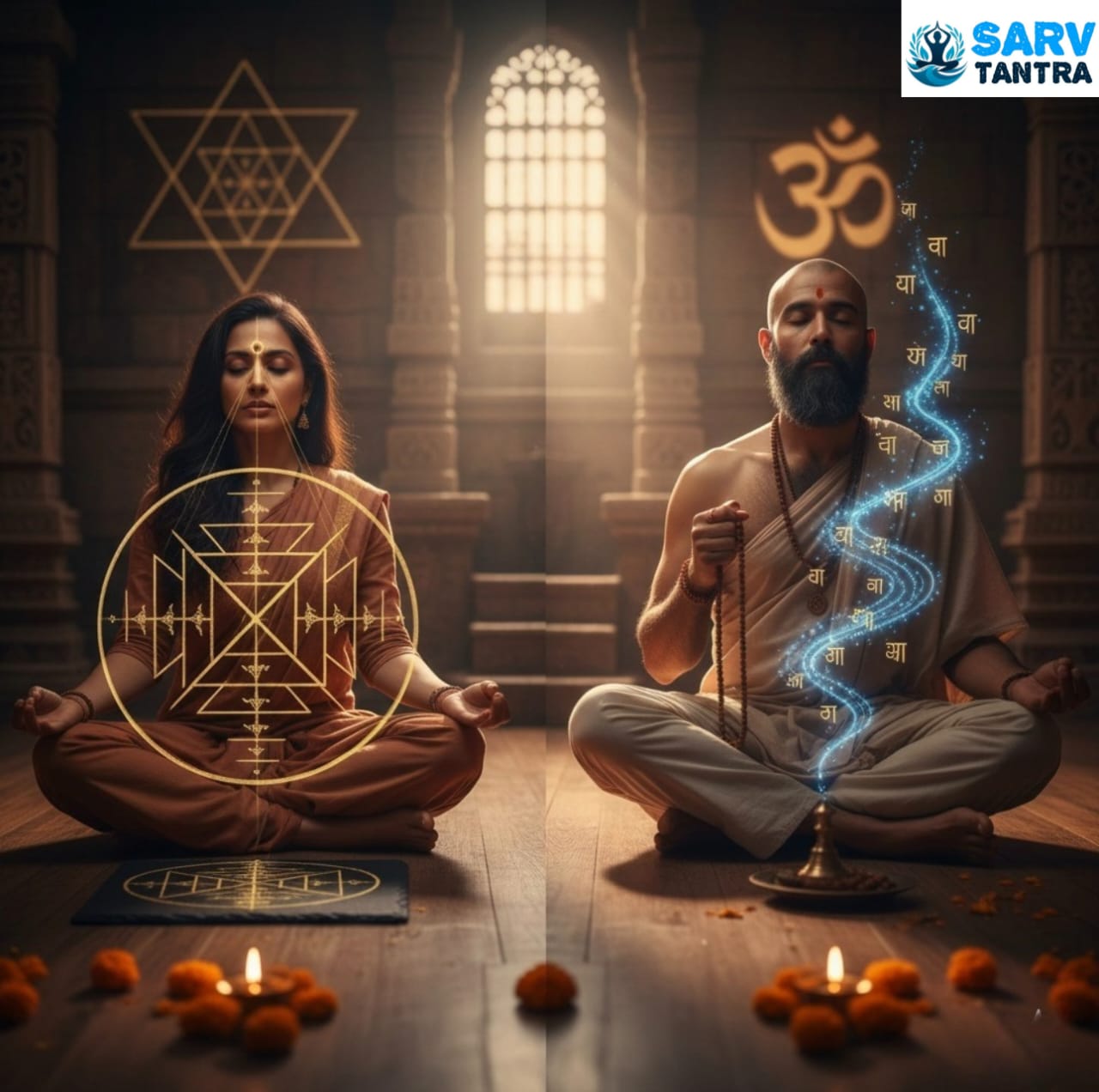
Meditation has been practiced for thousands of years as a powerful tool for self-realization, mental clarity, and spiritual growth. Among the many meditation techniques rooted in ancient Indian traditions, Yantra Meditation and Mantra Meditation stand out as two deeply symbolic and transformative practices. While both aim to focus the mind and elevate consciousness, they use very different methods—one visual and geometric, the other auditory and vibrational.
In this in-depth SEO-optimized guide, we explore Yantra Meditation vs Mantra Meditation, comparing their meanings, origins, techniques, benefits, differences, and suitability for modern practitioners. Whether you are a beginner exploring meditation or an advanced seeker refining your spiritual practice, this article will help you decide which path aligns best with your goals.
What Is Yantra Meditation?
Meaning of Yantra
The word Yantra comes from the Sanskrit root “yam”, meaning to sustain or hold. A Yantra is a sacred geometric diagram used as a visual focus for meditation. Unlike ordinary images, yantras are energetic maps of the universe, designed to guide consciousness inward.
Common yantras include:
- Sri Yantra (Shree Yantra) – symbol of cosmic creation and abundance
- Kali Yantra – represents transformation and protection
- Ganesha Yantra – associated with removing obstacles
Each yantra is composed of precise shapes such as triangles, circles, lotus petals, and bindu (central point), each holding symbolic meaning.
Origins of Yantra Meditation
Yantra meditation originates from Tantric traditions of Hinduism and Buddhism. These traditions view the universe as structured energy, and yantras serve as visual representations of divine consciousness.
Historically, yantras were engraved on metal, drawn on paper, or carved in temples. Practitioners used them not only for meditation but also for rituals, healing, and spiritual protection.
How Yantra Meditation Works
Yantra meditation involves steady visual concentration (Trataka) on a yantra. The practitioner gazes at the diagram and gradually internalizes its form, allowing the mind to merge with its energy.
Basic steps:
- Sit comfortably in a quiet space
- Place the yantra at eye level
- Gaze softly at the center (bindu)
- Allow thoughts to dissolve into the visual form
- Eventually close the eyes and visualize the yantra internally
What Is Mantra Meditation?
Meaning of Mantra
The word Mantra comes from “man” (mind) and “tra” (tool or instrument). A mantra is a sacred sound, word, or phrase repeated during meditation to focus the mind and raise awareness.
Popular mantras include:
- Om (AUM) – the primordial sound of the universe
- So Hum – “I am That”
- Om Namah Shivaya – mantra of transformation
- Gayatri Mantra – invocation of divine wisdom
Origins of Mantra Meditation
Mantra meditation has its roots in the Vedas, the oldest sacred texts of India. It later became central to Hinduism, Buddhism, Jainism, and Sikhism.
For thousands of years, sages believed that sound vibrations directly influence consciousness. Mantras were traditionally passed from teacher to disciple to preserve their purity and potency.
How Mantra Meditation Works
Mantra meditation uses sound repetition—spoken aloud, whispered, or mentally repeated—to anchor attention and transcend ordinary thought.
Basic steps:
- Sit in a relaxed posture
- Choose a mantra
- Repeat it rhythmically
- Gently return to the mantra when the mind wanders
- Enter a state of deep inner silence
Yantra Meditation vs Mantra Meditation: Key Differences
| Aspect | Yantra Meditation | Mantra Meditation |
|---|---|---|
| Focus | Visual (geometry, symbols) | Auditory (sound, vibration) |
| Primary Sense | Sight | Hearing / Mind |
| Main Tool | Sacred diagram | Sacred sound or phrase |
| Best For | Visual learners | Auditory or verbal learners |
| Tradition | Tantra, Shakta paths | Vedic, Bhakti, Yoga paths |
| Technique | Gazing and visualization | Repetition and listening |
Benefits of Yantra Meditation
1. Enhanced Concentration
The complex geometry of yantras trains the mind to focus deeply, improving attention span and mental discipline.
2. Activation of Subtle Energies
Yantras are believed to resonate with specific energy centers (chakras), promoting energetic balance and harmony.
3. Reduced Mental Distractions
Visual meditation helps quiet excessive thinking by giving the mind a single point of focus.
4. Spiritual Awakening
Advanced practitioners report heightened intuition, inner vision, and a sense of unity with cosmic intelligence.
5. Aesthetic and Symbolic Depth
Yantras combine art, mathematics, and spirituality, appealing to intellectually and visually inclined meditators.
Benefits of Mantra Meditation
1. Stress and Anxiety Reduction
The rhythmic repetition of mantras calms the nervous system and induces relaxation.
2. Emotional Healing
Mantras generate positive vibrations that can help release emotional blockages.
3. Accessibility for Beginners
Mantra meditation is easy to learn and does not require visual tools or diagrams.
4. Improved Memory and Focus
Regular mantra practice enhances mental clarity and cognitive performance.
5. Devotional Connection
Mantras often invoke divine qualities, fostering love, surrender, and faith.
Yantra vs Mantra Meditation: Which Is Better?
There is no universal answer to which meditation is better—it depends on your personality, goals, and preferences.
Choose Yantra Meditation If:
- You are visually oriented
- You enjoy symbolism and sacred geometry
- You seek deep concentration and inner visualization
- You are drawn to tantric practices
Choose Mantra Meditation If:
- You are sensitive to sound and rhythm
- You want a simple, portable technique
- You experience anxiety or mental restlessness
- You feel connected to devotional or yogic paths
Can Yantra and Mantra Meditation Be Combined?
Yes. In many traditional practices, yantra and mantra are used together. Each yantra is often associated with a specific mantra. Chanting the mantra while gazing at the yantra amplifies the meditative effect, engaging both sight and sound.
This integrated approach is considered especially powerful in tantric sadhana, as it harmonizes multiple sensory pathways.
Scientific Perspective on Yantra and Mantra Meditation
Modern neuroscience has begun to validate the effects of meditation practices:
- Visual focus (yantra) enhances activity in attention-related brain regions
- Mantra repetition regulates breathing and activates the parasympathetic nervous system
- Both practices reduce cortisol levels and improve emotional regulation
Although research is ongoing, evidence supports the mental health benefits of both techniques.
Yantra Meditation vs Mantra Meditation for Beginners
For beginners, mantra meditation is often easier due to its simplicity. However, those who struggle with mental chatter may find yantra meditation more grounding because it occupies the visual mind.
Trying both methods for a few weeks is the best way to discover which resonates more strongly with you.
Common Myths About Yantra and Mantra Meditation
- Myth: Yantras are magical objects
- Truth: Yantras are symbolic tools for focus and awareness
- Myth: Mantras require religious belief
- Truth: Mantras can be practiced secularly for mental health
- Myth: One method is superior
- Truth: Both serve different temperaments and purposes
Practical Tips for Success
- Practice daily, even if briefly
- Maintain a calm and clean meditation space
- Be patient—progress is subtle and gradual
- Avoid forcing concentration
- Stay consistent rather than intense
Final Thoughts: Yantra Meditation vs Mantra Meditation
Both Yantra Meditation and Mantra Meditation are profound paths toward inner stillness and self-awareness. Yantra meditation refines perception through sacred visuals, while mantra meditation transforms consciousness through sound and vibration.
Rather than choosing one as superior, consider them complementary tools on the same journey inward. By aligning your practice with your natural inclinations, you can unlock deeper peace, clarity, and spiritual insight.