

The Science of Breath: How Tantra Improves Oxygen Efficiency

Breathing is the most natural function of the human body—yet it is also one of the most misunderstood and underutilized tools for health, clarity, and vitality. Most people breathe unconsciously, often shallowly, limiting the amount of oxygen their bodies absorb. Over time, this inefficient breathing pattern can contribute to fatigue, stress, poor concentration, and reduced physical performance.
Tantra, an ancient holistic system, places immense emphasis on conscious breathing. Unlike casual breathing exercises, Tantra approaches breath as a powerful bridge between body, mind, and energy. Modern science increasingly supports what Tantra has long taught: the way you breathe directly impacts how efficiently your body uses oxygen.
This blog explores the science behind breathing and oxygen efficiency, and how Tantra techniques can transform your respiratory function, energy levels, and overall well-being.
Understanding Oxygen Efficiency
Oxygen efficiency refers to how effectively your body:
- Inhales oxygen
- Transfers it into the bloodstream
- Delivers it to cells
- Uses it for energy production
This process is essential for survival because oxygen fuels cellular respiration—the mechanism through which your body produces energy (ATP).
However, inefficient breathing can disrupt this process. Common issues include:
- Shallow chest breathing
- Rapid breathing due to stress
- Poor posture limiting lung expansion
- Weak diaphragm engagement
When oxygen intake is compromised, the body compensates by increasing breathing rate rather than improving quality—leading to fatigue and stress.
The Physiology of Breath
To understand how Tantra improves oxygen efficiency, it’s important to grasp how breathing works:
1. The Role of the Lungs
The lungs contain millions of tiny air sacs called alveoli. These sacs are responsible for exchanging oxygen and carbon dioxide between air and blood.
Shallow breathing:
- Uses only a small portion of the lungs
- Limits oxygen exchange
Deep breathing:
- Activates more alveoli
- Increases oxygen absorption
2. The Diaphragm Connection
The diaphragm is a dome-shaped muscle below the lungs. It plays a key role in breathing.
Efficient breathing:
- Engages the diaphragm fully
- Expands the lungs downward
Inefficient breathing:
- Relies on chest and shoulder muscles
- Restricts airflow
3. Oxygen and Carbon Dioxide Balance
A surprising fact: breathing is not just about oxygen—it’s also about carbon dioxide (CO₂).
Proper CO₂ levels:
- Help oxygen release from hemoglobin
- Improve cellular oxygen usage
Over-breathing (common in stress):
- Reduces CO₂ levels
- Limits oxygen delivery to tissues
How Tantra Approaches Breath
Tantra sees breath as more than a physical act—it is a carrier of life force (prana). Every breath influences:
- Nervous system balance
- Emotional state
- Energy flow
- Mental clarity
Tantric breathing focuses on:
- Awareness
- Rhythm
- Depth
- Control
This combination leads to significantly improved oxygen efficiency.
Key Tantra Breathing Techniques for Oxygen Efficiency
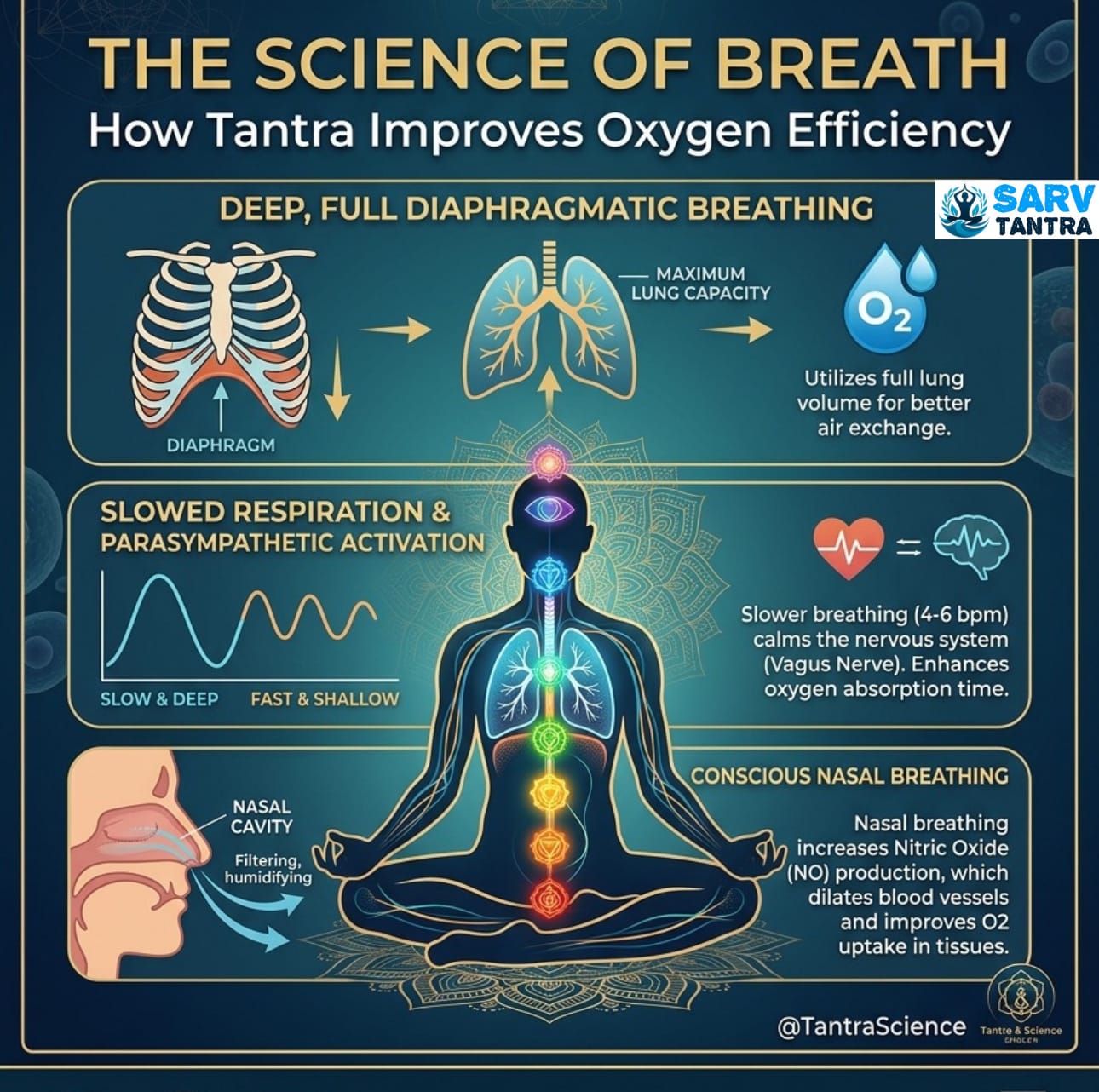
1. Deep Diaphragmatic Breathing
This is the foundation of Tantra breathing.
How it works:
- Inhale deeply through the nose
- Expand the belly, not the chest
- Exhale slowly and completely
Benefits:
- Maximizes lung capacity
- Improves oxygen exchange
- Reduces energy waste
Scientific insight: Deep breathing activates the parasympathetic nervous system, promoting relaxation and efficient oxygen utilization.
2. Slow Rhythmic Breathing
Tantra emphasizes slowing down the breath.
Typical pattern:
- Inhale for 4–6 seconds
- Exhale for 6–8 seconds
Why it works:
- Slower breathing increases oxygen absorption time
- Maintains healthy CO₂ levels
- Improves heart rate variability
3. Breath Retention (Kumbhaka)
A powerful Tantric practice involving holding the breath.
Types:
- After inhale
- After exhale
Benefits:
- Enhances oxygen diffusion into blood
- Increases CO₂ tolerance
- Trains the body to use oxygen more efficiently
Modern research shows breath retention can improve respiratory efficiency and endurance.
4. Alternate Nostril Breathing
This technique balances airflow and energy.
How it works:
- Inhale through one nostril
- Exhale through the other
- Alternate sides
Benefits:
- Improves lung function symmetry
- Enhances oxygen uptake
- Balances brain hemispheres
5. Conscious Breath Awareness
Simply observing the breath can transform its quality.
Practice:
- Sit quietly
- Focus on each inhale and exhale
- Gradually deepen the breath
Effect:
- Reduces unconscious shallow breathing
- Naturally improves oxygen efficiency
The Science Behind Tantra Breathing
Modern science increasingly validates Tantric breathing techniques.
1. Increased Lung Capacity
Deep breathing expands lung volume, allowing more oxygen intake per breath.
2. Improved Oxygen Saturation
Slow, controlled breathing enhances oxygen saturation in the blood.
3. Better CO₂ Regulation
Balanced breathing prevents over-breathing and maintains optimal CO₂ levels, which improves oxygen delivery to tissues.
4. Enhanced Cellular Energy Production
More efficient oxygen use leads to:
- Higher ATP production
- Better stamina
- Reduced fatigue
5. Nervous System Optimization
Tantric breathing shifts the body from:
- Stress mode (sympathetic)
to - Relaxation mode (parasympathetic)
This state supports efficient breathing and oxygen utilization.
Benefits of Improved Oxygen Efficiency Through Tantra
🌿 Physical Benefits
- Increased stamina and endurance
- Better lung health
- Improved cardiovascular function
- Faster recovery from fatigue
🧠 Mental Benefits
- Sharper focus
- Reduced brain fog
- Improved decision-making
💆 Emotional Benefits
- Reduced anxiety
- Greater emotional stability
- Improved mood regulation
⚡ Energy Benefits
- Sustained energy throughout the day
- Reduced dependency on stimulants
- Enhanced vitality
Tantra vs Normal Breathing Habits
| Aspect | Normal Breathing | Tantra Breathing |
|---|---|---|
| Depth | Shallow | Deep |
| Awareness | Unconscious | Conscious |
| Speed | Fast | Slow |
| Oxygen Use | Inefficient | Optimized |
| Energy Impact | Fatigue | Vitality |
Daily Tantra Breathing Routine
Here’s a simple routine to improve oxygen efficiency:
Morning (5–10 minutes)
- Deep diaphragmatic breathing
- Slow rhythmic breathing
Afternoon Reset (3–5 minutes)
- Conscious breath awareness
- Slow inhale-exhale cycles
Evening (5–10 minutes)
- Alternate nostril breathing
- Gentle breath retention
Consistency is key. Even a few minutes daily can create noticeable changes.
Common Mistakes to Avoid
- Forcing deep breaths aggressively
- Breathing too fast during exercises
- Ignoring posture
- Practicing inconsistently
Tantra emphasizes ease and awareness, not force.
The Connection Between Breath and Modern Lifestyle
Today’s lifestyle encourages poor breathing habits:
- Sitting for long hours
- Screen exposure
- Chronic stress
- Lack of physical activity
These factors reduce oxygen efficiency over time.
Tantra offers a simple, natural solution—bringing awareness back to the breath.
Long-Term Impact of Tantra Breathing
With consistent practice, you may experience:
- Stronger lungs
- Improved metabolism
- Better stress resilience
- Higher energy levels
- Enhanced overall health
Breathing becomes not just automatic—but optimized.
Conclusion
Breathing is more than survival—it is a powerful tool for transformation. Tantra teaches that by mastering the breath, you can influence your body, mind, and energy at the deepest level.
From a scientific perspective, Tantric breathing techniques improve:
- Lung capacity
- Oxygen absorption
- CO₂ balance
- Cellular energy production
In a world where stress and fatigue are common, improving oxygen efficiency through conscious breathing is one of the simplest yet most effective ways to enhance well-being.
The best part? It requires no equipment, no cost—just awareness and consistency.
Start with a single deep breath today, and you begin a journey toward greater energy, clarity, and balance.