

Discovering the Beauty of Being Present Without Needing to Improve Yourself

In today’s fast-paced world, many people feel that they must constantly improve themselves to live a meaningful and successful life. They set goals, learn new skills, compare their progress with others, and look for ways to become more productive, confident, successful, or peaceful. Although personal growth can be valuable, the continuous pressure to improve can sometimes make people feel that their present selves are never good enough.
The search for a better life can become exhausting when every moment turns into an opportunity to correct something about ourselves. We may struggle to enjoy the present because our attention remains focused on who we want to become. Instead of appreciating our current experiences, we judge them according to what we believe they should be.
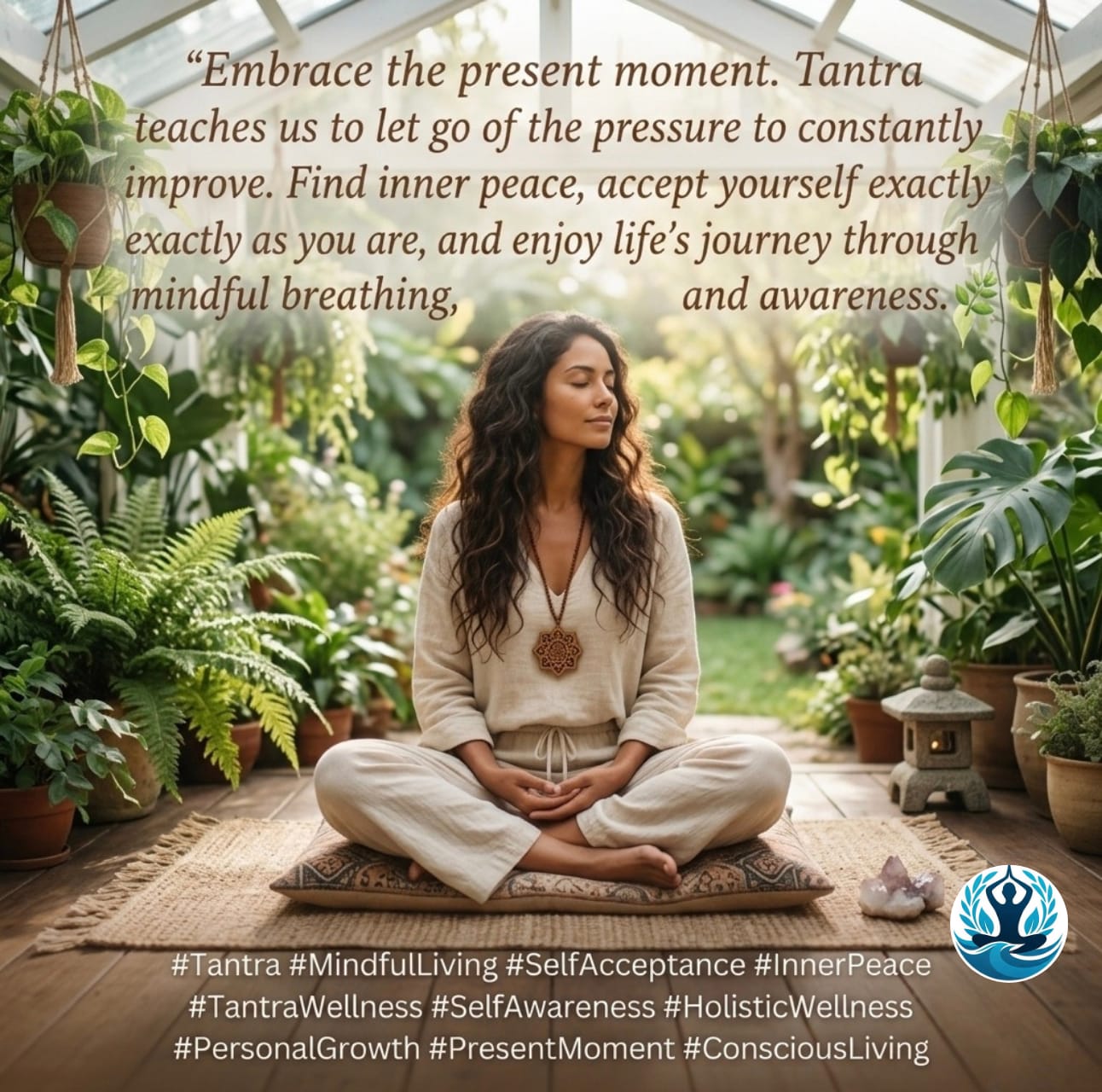
Tantra offers a perspective that encourages awareness of the present moment, acceptance of our experiences, and a deeper connection with ourselves. Rather than treating life as a constant project of self-improvement, a mindful approach invites us to experience life more fully as it unfolds.
Discovering the beauty of being present without needing to improve yourself means learning to appreciate who you are today while remaining open to natural growth. It does not mean abandoning your ambitions or refusing to learn. It means understanding that your worth does not depend on reaching another milestone.
Through conscious breathing, meditation, body awareness, and mindful daily activities, we can gradually develop a more compassionate relationship with ourselves. We begin to recognize that life is not simply a destination to reach. It is an experience to participate in, appreciate, and understand.
1. Understanding the Pressure of Constant Self-Improvement
Personal development has become a major part of modern life. People are encouraged to become more productive, maintain positive habits, improve their appearance, develop emotional intelligence, and achieve professional success. While these goals can support growth, they can also create an unrealistic expectation that every part of life must continually improve.
When self-improvement becomes a permanent demand, relaxation may feel like wasted time. Ordinary experiences may seem unimportant unless they contribute to a larger goal. Even meditation and wellness practices can become another activity to perform perfectly.
For example, someone may begin practicing mindfulness to feel calmer. After a few days, they may become frustrated because their mind continues to wander. Instead of appreciating the moments of awareness they experience, they judge themselves for not meditating correctly.
Similarly, a person who begins a wellness routine may feel disappointed when they miss a day. Rather than returning to the practice gently, they may believe they have failed.
These experiences demonstrate how the desire to improve can turn into self-criticism.
Tantra-inspired mindfulness encourages a different relationship with personal growth. It invites individuals to observe their thoughts, emotions, and bodily sensations without immediately labeling them as good or bad.
This approach helps us understand that we do not need to correct every experience. Sometimes, the most meaningful step is to notice what is happening and allow ourselves to be present with it.
2. What Does It Mean to Be Present?
Being present means giving attention to what is happening right now instead of becoming completely absorbed in memories, worries, expectations, or imagined futures.
Many people spend much of their day thinking about what they have already done or what they still need to accomplish. While planning and reflection are useful, constant mental activity can make it difficult to experience the life unfolding around us.
We may eat a meal while checking messages, speak with loved ones while thinking about work, or spend a quiet evening worrying about tomorrow. Physically, we are present, but mentally, we are somewhere else.
Mindful presence encourages us to reconnect with the immediate experience.
It may involve noticing the movement of the breath, feeling our feet touch the ground, listening carefully to another person, or observing the warmth of sunlight on our skin.
These moments do not need to be extraordinary. Their value comes from experiencing them consciously.
Being present also means allowing ourselves to experience emotions without immediately trying to change them. Happiness, sadness, uncertainty, excitement, and frustration are all part of human life. We can acknowledge these experiences without allowing them to define our entire identity.
Through regular awareness, we begin to understand that we do not have to make every moment productive or meaningful. Some moments can simply be lived.
3. How Tantra Encourages Present-Moment Awareness
Tantra is a diverse spiritual tradition with different teachings and practices across its historical lineages. In contemporary wellness settings, some Tantra-inspired approaches emphasize mindfulness, breath awareness, meditation, embodiment, and a conscious relationship with everyday experiences.
One important idea in these practices is that awareness can be cultivated through direct experience. Instead of constantly analyzing life, we can learn to notice it as it happens.
For example, during conscious breathing, we may observe the natural rhythm of inhalation and exhalation. We do not need to force the breath to become deeper or more peaceful. We simply notice it.
During body-awareness practices, we may observe tension in the shoulders, the movement of the chest, or the sensation of sitting on a chair. These observations can help us reconnect with our physical experience without judging our bodies.
In everyday activities, we can bring attention to simple actions such as walking, preparing food, drinking water, or listening to music.
The goal is not to achieve a perfect state of awareness. It is to return to the present whenever we notice that our attention has wandered.
This perspective can reduce the pressure to perform mindfulness correctly. It reminds us that awareness is a practice of returning, not a competition to become the most peaceful person in the room.
Tantra-inspired mindfulness can therefore help people explore the beauty of ordinary life without turning every experience into a self-improvement project.
4. Learning to Accept Yourself Without Conditions
Self-acceptance means recognizing your current thoughts, feelings, strengths, limitations, and circumstances without making your entire sense of worth depend on them.
It does not require you to approve of every decision you make. It does not prevent you from changing habits, learning from mistakes, or pursuing meaningful goals.
Instead, self-acceptance creates a healthier starting point for growth.
When people believe they must become perfect before they deserve peace, they may spend years postponing happiness. They tell themselves they will relax after achieving a promotion, feel confident after changing their appearance, or appreciate life after reaching a particular milestone.
The problem is that new goals often appear as soon as previous ones are achieved.
Self-acceptance invites a different question: Can I respect and care for myself while I am still learning?
You may be uncertain about your future and still deserve patience. You may make mistakes and still treat yourself with kindness. You may have unfinished goals and still enjoy a peaceful afternoon.
A simple practice is to notice when self-critical thoughts appear. Instead of immediately believing them, pause and ask whether you would speak to a friend in the same way.
If the answer is no, consider choosing a more compassionate response.
Over time, this can help replace harsh self-judgment with understanding. Rather than waiting to become a perfect version of yourself, you can begin appreciating the person who is already here.
5. The Difference Between Personal Growth and Self-Rejection
Personal growth and self-acceptance do not need to compete with each other. The important difference lies in the motivation behind our efforts.
Healthy personal growth often comes from curiosity, care, and a desire to live according to our values. Self-rejection, by contrast, is driven by the belief that we are fundamentally inadequate and must change to become worthy.
Consider two people who want to improve their physical wellbeing.
One person chooses regular movement because they want to feel stronger, enjoy greater mobility, and care for their body. Another exercises because they dislike themselves and believe they must achieve a particular appearance before they can feel acceptable.
The outward behavior may look similar, but the emotional experience can be very different.
The first approach leaves room for flexibility and appreciation. The second may create guilt, anxiety, and endless dissatisfaction.
A similar distinction applies to meditation, career development, relationships, and learning new skills.
Tantra-inspired awareness encourages us to examine the intention behind our actions. Are we making changes because they genuinely support our wellbeing, or are we trying to escape the discomfort of being ourselves?
This question can help us approach change with greater clarity.
We can continue growing without treating our present selves as problems that must be solved. Growth becomes a natural expression of care rather than a punishment for perceived inadequacy.
6. Releasing the Habit of Comparing Yourself With Others
Comparison can make it difficult to appreciate the present moment. We observe other people’s achievements, relationships, appearances, lifestyles, or personal development and begin measuring our lives against theirs.
Social media can intensify this habit by presenting carefully selected images of success and happiness. We may see the visible results of someone else’s journey without understanding their challenges, circumstances, or private experiences.
As a result, we may feel behind even when we are making meaningful progress in our own lives.
Constant comparison also shifts attention away from personal values. Instead of asking what matters to us, we begin pursuing what appears desirable to other people.
A mindful approach invites us to notice comparison without immediately judging ourselves for experiencing it.
When you notice yourself comparing your journey with someone else’s, pause and take a few natural breaths. Ask yourself what the comparison is making you feel. Is it insecurity, motivation, sadness, pressure, or a sense of missing out?
Then gently return your attention to your own circumstances.
You might ask: What is important to me at this stage of life? What do I appreciate about my present situation? What small action would support my wellbeing today?
These questions help bring attention back to your own values and experiences.
You do not need to eliminate every comparative thought. You can simply learn not to let comparison determine how you value yourself.
7. Discovering the Beauty of Ordinary Moments
Many people associate happiness with special events, major achievements, holidays, or exciting changes. Ordinary moments may receive little attention because they seem too familiar to be valuable.
However, daily life contains countless opportunities to experience presence.
A morning cup of tea, a conversation with a friend, the sound of rain, a short walk, or a few minutes of quiet can become meaningful when experienced with attention.
The experience itself may not change. Your relationship with it changes.
When drinking tea, for example, notice its warmth, aroma, taste, and the movement of your hands. Rather than rushing to the next task, allow yourself to experience the activity for a few moments.
When speaking with someone, listen to their words without planning your response immediately. Notice their expressions and the emotional quality of the conversation.
When walking outdoors, observe the surroundings instead of automatically reaching for your phone.
These simple practices can help make everyday life feel less automatic.
They also remind us that we do not need to earn every pleasant experience through achievement. We can appreciate ordinary moments because they are part of being alive.
Present-moment awareness does not guarantee constant happiness. Instead, it creates more opportunities to notice what is already happening, including small experiences of comfort, connection, curiosity, and gratitude.
8. Letting Go of the Need to Be Perfect
Perfectionism often develops from the belief that mistakes are unacceptable or that other people will value us only when we perform well.
This belief can affect many areas of life. We may delay starting a project because we fear doing it imperfectly. We may hide our feelings because we want to appear strong. We may avoid new experiences because we cannot guarantee success.
Perfectionism can also enter wellness practices. People may believe that meditation should always feel peaceful, that mindful living should eliminate negative emotions, or that personal growth should happen in a straight line.
Real life is more complicated.
Some days, concentration comes easily. On other days, the mind feels busy. Sometimes we respond thoughtfully to a difficult situation; at other times, we react before recognizing what is happening.
These variations do not mean that growth has failed.
A more compassionate approach recognizes that learning happens through repeated experience. We can acknowledge mistakes, take responsibility when needed, and make different choices without turning every setback into a judgment of our character.
Try replacing the question, “How can I do everything perfectly?” with “How can I approach this moment with honesty and awareness?”
This change can reduce unnecessary pressure and create space for genuine learning.
Being present means allowing life to be imperfect while still participating in it.
9. Conscious Breathing: Returning to the Present
Breathing is a simple way to reconnect with the present because it is happening continuously, even when we are distracted.
Conscious breathing involves observing the natural breath without forcing it to follow a particular pattern.
To begin, sit comfortably or stand in a relaxed position. Allow your shoulders to soften if that feels comfortable. Notice the sensation of breathing in and breathing out.
You may feel the breath around your nostrils, the movement of your chest, or the gentle expansion of your abdomen.
Your mind will probably wander. You may begin thinking about work, relationships, unfinished tasks, or something that happened earlier.
When this occurs, there is no need to criticize yourself. Recognize that attention has wandered and gently return to the next breath.
You can practice for one to three minutes, gradually extending the time if it feels helpful.
The purpose is not to empty your mind or force yourself into a special state. It is to become more familiar with the experience of noticing and returning.
If focusing on the breath feels uncomfortable, you can instead pay attention to the sounds around you or the sensation of your feet touching the floor.
With regular practice, conscious breathing may help some people develop greater awareness of their stress responses and daily habits. It is a supportive wellness practice, not a guaranteed treatment for anxiety or other health conditions.
10. Body Awareness and the Experience of Being Alive
Modern lifestyles often encourage us to spend long periods thinking, planning, and working while paying little attention to our bodies.
We may notice physical tension only when it becomes uncomfortable. We may ignore tiredness because we want to finish another task. We may treat the body as something that must always perform rather than something deserving care.
Body awareness offers an opportunity to reconnect with physical experience.
Take a moment to notice your posture. Are your shoulders raised? Is your jaw clenched? Are your hands tense? Do you feel comfortable where you are sitting?
There is no need to change everything immediately. Begin by noticing what you feel.
You can also bring awareness to gentle movement, stretching, walking, or resting. Pay attention to how your body responds rather than forcing it to meet an ideal standard.
In Tantra-inspired embodiment practices, the body may be approached as an important part of lived experience rather than an obstacle to overcome.
This perspective can encourage greater respect for personal limits and a more attentive relationship with physical sensations.
Body awareness should always be practiced with sensitivity to individual comfort. If an exercise creates pain, distress, or discomfort, stop or adapt it.
The goal is not to achieve a perfect body or a perfect posture. It is to experience the body with greater awareness, patience, and respect.
11. Making Peace With Emotions Instead of Fixing Them
Many people feel pressure to remain positive, calm, and emotionally balanced at all times. When sadness, anger, jealousy, disappointment, or fear appears, they may believe that something is wrong with them.
However, emotions are a normal part of human experience. They can provide information about our needs, values, boundaries, relationships, and circumstances.
Being present with emotions does not mean acting on every feeling. It means recognizing an emotion before deciding how to respond.
For example, when frustration arises, you might notice the feeling in your body, identify the situation that triggered it, and consider what response would be most helpful.
You do not need to suppress the frustration, but you also do not need to express it impulsively.
A useful reflection is: “What am I experiencing right now, and what might I need?”
Sometimes the answer may be rest, clearer communication, personal space, or a practical change in circumstances. At other times, the feeling may simply need time and compassionate attention.
Tantra-inspired mindfulness can encourage a more accepting relationship with emotional experience. Rather than treating emotions as personal failures, we can observe them as changing experiences that deserve attention.
This approach does not mean tolerating harmful situations or ignoring serious distress. Acceptance can coexist with boundaries, support, and necessary action.
12. Creating Space Between You and Your Thoughts
Thoughts can feel convincing, especially when they involve criticism, fear, or predictions about the future.
A thought such as “I am not doing enough” may appear to describe reality. However, it is still a thought, not necessarily an objective statement of fact.
Learning to observe thoughts can help us respond with greater flexibility.
When a critical thought appears, try silently saying, “I am noticing the thought that I am not doing enough.”
This small change creates a little distance between the thought and your identity.
Instead of automatically accepting the thought, you can examine it. Is it based on facts? Are you tired? Are you comparing yourself with an unrealistic standard? Is there a practical action to take, or would rest be more helpful?
You do not need to replace every negative thought with a positive one. Sometimes, simply recognizing a thought as a mental event is enough to reduce its influence.
Mindfulness does not require you to control everything happening in your mind. It encourages you to notice thoughts while choosing where to place your attention.
Over time, this can support a less judgmental relationship with your inner experience.
13. Building a Daily Practice of Presence
You do not need to change your entire lifestyle to begin experiencing more presence. Small, repeatable practices can help you bring awareness into ordinary routines.
Start your morning slowly. Before checking messages, take a moment to notice your surroundings and how you feel. Allow yourself a few natural breaths before beginning the day.
Practice mindful eating. Pay attention to the taste, texture, and aroma of your food. Whenever possible, eat without simultaneously working or scrolling.
Take awareness breaks. During the day, pause briefly. Notice your posture, your breath, and the environment around you.
Listen attentively. During conversations, try to give the other person your attention instead of preparing your next response while they speak.
Spend time without constant stimulation. Allow yourself a few minutes without music, notifications, videos, or other distractions if this feels comfortable.
Reflect without judging. At the end of the day, ask what you noticed, appreciated, or learned. You do not need to evaluate the day according to how productive you were.
The most important principle is consistency without perfectionism.
If you forget your practice, you can return to it the next time you remember. You do not need to turn mindfulness into another demanding routine.
14. Finding Balance Between Ambition and Contentment
Being present does not mean giving up on your goals. Ambition can bring meaning, encourage learning, and help us contribute to our communities.
The challenge is to pursue goals without making our entire happiness dependent on achieving them.
When life becomes focused only on future outcomes, the present may begin to feel like an obstacle. We tell ourselves that we will enjoy life after finishing a project, earning more money, changing our circumstances, or becoming more confident.
But the future will always contain new tasks and possibilities.
Contentment offers a way to appreciate the present while continuing to work toward meaningful goals.
You can want to improve your skills and appreciate what you already know. You can pursue financial stability while enjoying relationships and simple pleasures. You can work toward better health while respecting your current body’s needs.
A balanced approach asks two questions: “What would I like to work toward?” and “What can I appreciate about my life today?”
Both questions matter.
The first supports direction and motivation. The second prevents the present from becoming merely a waiting room for future happiness.
Through mindful awareness, ambition can become less about proving your worth and more about expressing your values.
15. Improving Your Relationship With Time
Many people feel that time is constantly running out. They worry about missed opportunities, delayed achievements, and whether they are progressing quickly enough.
This pressure can make even enjoyable activities feel rushed.
Mindfulness invites us to notice how urgency influences our experience. Are we moving quickly because the situation genuinely requires it, or because we have become accustomed to feeling behind?
Sometimes, slowing down is not possible. Work, family responsibilities, and unexpected demands can require immediate attention. Presence does not mean ignoring these responsibilities.
Instead, it means giving the current task appropriate attention rather than mentally carrying every future task at once.
When possible, try completing one activity with fewer distractions. Notice when your mind jumps ahead and gently return to what you are doing.
You may also benefit from allowing short periods of unstructured time in your day. These moments do not need to produce an achievement.
Changing your relationship with time can help you recognize that the value of a day is not measured only by the number of tasks completed.
A meaningful life includes work, rest, relationships, learning, and experiences that cannot easily be measured.
16. Practicing Self-Compassion During Difficult Days
Some days feel peaceful and manageable. Others bring disappointment, uncertainty, conflict, or exhaustion.
A common response to difficult days is to criticize ourselves for not coping better. We may believe that if we were more mindful, disciplined, or emotionally mature, we would never feel overwhelmed.
This expectation creates an additional burden on top of the original difficulty.
Self-compassion offers a more supportive response.
It involves acknowledging that something is difficult, recognizing that struggle is part of being human, and considering what kind response would help.
You might say to yourself, “This is a challenging moment. I can take one step at a time.”
This does not erase the problem or guarantee that you will immediately feel better. It creates room to respond without adding unnecessary shame.
You can also ask what you need right now. Perhaps you need rest, practical assistance, a conversation, a boundary, or time to process an experience.
Self-compassion is not an excuse to avoid responsibility. It can make it easier to acknowledge mistakes and repair harm because your entire identity is not being placed on trial.
Being present with yourself includes the difficult moments, not only the pleasant ones.
17. Common Misunderstandings About Being Present
Several misunderstandings can make present-moment awareness seem difficult or unrealistic.
Misunderstanding 1: Being present means never thinking about the future.
Planning is a normal and useful part of life. Mindfulness means recognizing when future-oriented thinking is useful and when it becomes repetitive worry that pulls attention away from the present.
Misunderstanding 2: Self-acceptance means never changing.
Self-acceptance allows you to recognize your current situation honestly. You can accept where you are while choosing to learn, grow, and make changes.
Misunderstanding 3: Mindfulness means always feeling peaceful.
Awareness does not guarantee pleasant emotions. You may notice anxiety, sadness, frustration, or restlessness. The practice is about responding to experience with greater awareness, not eliminating every uncomfortable feeling.
Misunderstanding 4: Every moment must become a spiritual experience.
Ordinary life does not need to feel extraordinary. Washing dishes, commuting, or resting can be experienced with attention without turning every activity into a special ritual.
Misunderstanding 5: You must practice perfectly to benefit.
Attention naturally wanders. Returning to the present is part of the process, not evidence of failure.
Understanding these distinctions can make mindfulness more realistic and accessible. It becomes a way of relating to life rather than another standard against which to judge yourself.
18. How Sarv Wellness Can Support a More Mindful Lifestyle
Sarv Wellness can introduce people to wellness practices that encourage greater self-awareness, mindful breathing, meditation, and conscious attention to the body.
For individuals interested in Tantra-inspired wellbeing, such practices may provide opportunities to slow down, reflect on habitual responses, and reconnect with present-moment experiences.
A supportive wellness session should respect personal boundaries, comfort levels, individual needs, and informed consent. Practices should be explained clearly, and participants should feel free to ask questions or decline any activity that does not feel appropriate.
The purpose of a mindful wellness approach is not to promise a perfect life or eliminate every difficult emotion. It is to help people explore practical ways of relating to their experiences with greater attention and care.
At Sarv Wellness, the broader message can be simple: personal growth does not need to begin with dissatisfaction. It can begin with curiosity about who you are and how you experience the world.
When wellness practices are approached without pressure to perform perfectly, they may become more sustainable and meaningful.
Individuals experiencing persistent emotional distress or significant mental health difficulties should consider support from a qualified healthcare professional. Wellness practices can complement appropriate care but should not replace it when treatment is needed.
19. A Simple Five-Minute Practice for Being Present
The following practice offers a gentle way to explore present-moment awareness without turning it into another performance goal.
Minute 1: Pause.
Choose a comfortable position. Allow yourself to stop what you are doing, if it is safe and practical. Notice the environment around you.
Minute 2: Notice your breathing.
Observe your natural breathing pattern. There is no need to make it deeper or slower. If focusing on the breath feels uncomfortable, listen to the sounds around you instead.
Minute 3: Notice your body.
Observe physical sensations such as contact with the chair, your feet on the ground, or the position of your hands. Avoid forcing your body into a different position.
Minute 4: Notice your thoughts and feelings.
Recognize whatever is present without trying to solve everything immediately. If your mind is busy, simply acknowledge that it is busy.
Minute 5: Return to your day.
Ask yourself what would be a kind and useful next step. It may be completing a task, taking a break, communicating with someone, or simply continuing what you were doing.
You do not need to feel transformed at the end of the practice. Its purpose is to create a brief opportunity to notice your experience and respond with intention.
If five minutes feels too long, begin with thirty seconds. The practice should be adaptable to your comfort and circumstances.
20. Conclusion: You Do Not Have to Become Someone Else to Enjoy Life
Discovering the beauty of being present without needing to improve yourself is an invitation to approach life with greater awareness and compassion.
It reminds us that our lives are happening now, not only after we achieve our goals or become the people we imagine we should be.
Through Tantra-inspired mindfulness, conscious breathing, meditation, body awareness, and self-reflection, we can explore a more accepting relationship with our thoughts, feelings, and everyday experiences.
We can recognize our limitations without defining ourselves by them. We can pursue meaningful goals without believing that our worth depends on success. We can learn from mistakes without treating ourselves harshly. We can enjoy ordinary moments without needing them to prove that we are making progress.
Being present does not mean giving up on growth. It means allowing growth to emerge from awareness rather than constant self-rejection.
You are allowed to rest before everything is finished. You are allowed to appreciate your life while still having goals. You are allowed to be a work in progress without treating yourself as incomplete.
The beauty of the present moment lies in the opportunity to experience life as it is, with honesty, curiosity, and care.
You do not need to become a perfect version of yourself before you begin living fully. You can start by noticing this moment, accepting that you are here, and allowing yourself to experience it.
Sometimes, the most meaningful transformation begins when you stop trying to prove that you are enough and begin learning how to be present with the person you already are.