

Tantra for Discovering What Truly Nourishes Your Energy

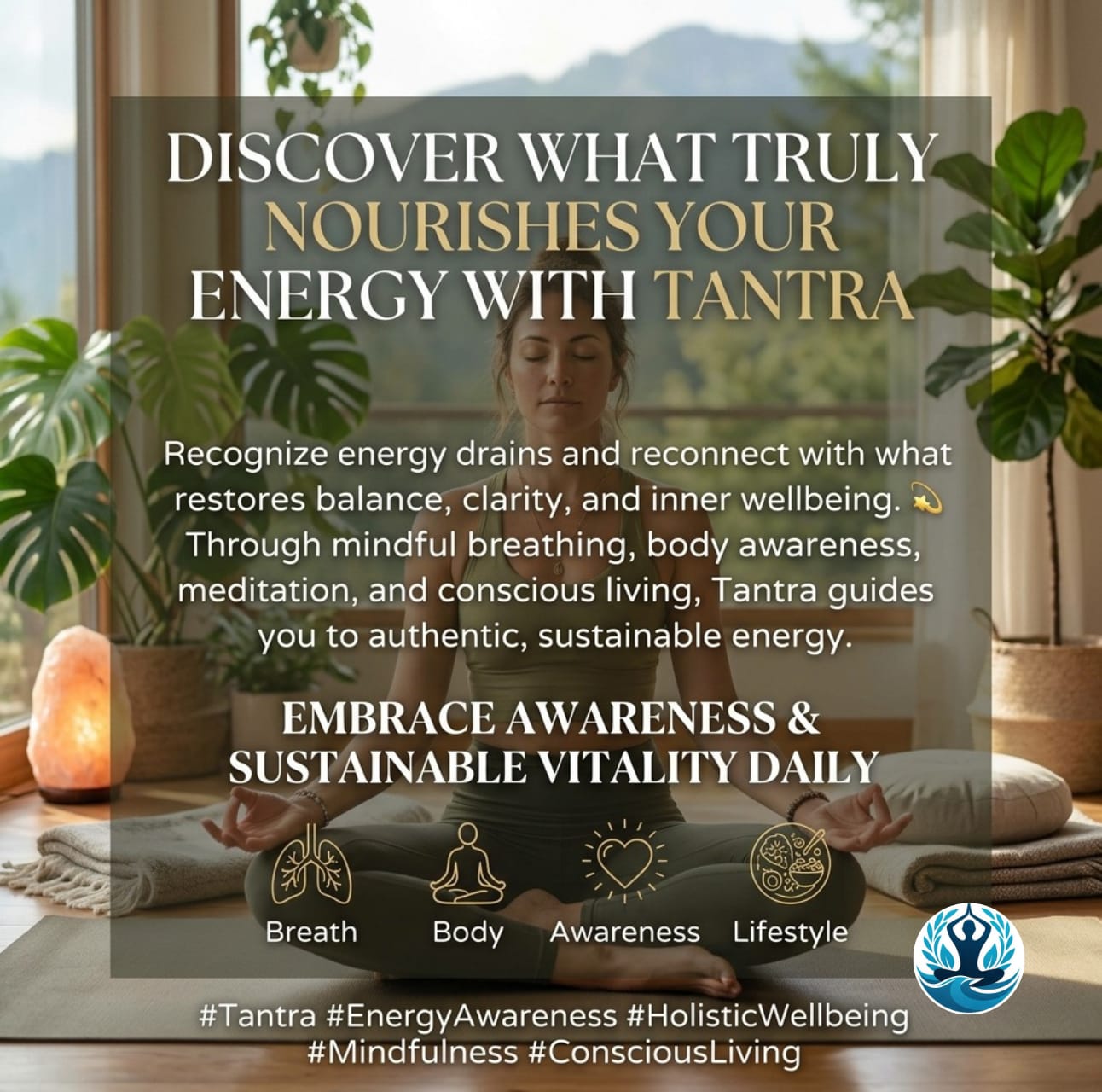
In modern life, it is easy to confuse being busy with being energized. A full schedule, constant communication, social commitments, digital stimulation, and the pressure to achieve can leave us feeling mentally exhausted even when we have not done anything physically demanding. We may continue moving from one responsibility to another without stopping to ask a simple but important question: What truly nourishes my energy?
Tantra offers a holistic approach to exploring this question. Rather than viewing wellbeing as something separate from everyday life, traditional Tantric approaches emphasize awareness of the body, breath, mind, emotions, senses, and inner experience. Through conscious practices, a person can become more aware of what supports their sense of balance and what repeatedly leaves them feeling depleted.
Tantra for discovering what truly nourishes your energy is therefore not simply about gaining more energy. It is about learning to recognize where your energy naturally flows, understanding what drains it, and becoming more intentional about the experiences, habits, relationships, and environments that support wellbeing.
This approach can encourage greater self-awareness and help create a lifestyle based on conscious choices rather than automatic patterns.
What Does It Mean to Nourish Your Energy?
Energy can mean different things in different contexts. In everyday wellness language, it may refer to physical vitality, mental clarity, emotional capacity, motivation, or a general feeling of being alive and engaged.
When we say that something “nourishes our energy,” we can think of experiences that leave us feeling more balanced, refreshed, grounded, connected, or capable of meeting life’s demands.
For example, nourishing experiences might include:
- Adequate rest
- Conscious breathing
- Time in nature
- Gentle movement
- Meaningful conversations
- Creative activities
- Meditation
- Healthy routines
- Quiet time
- Supportive relationships
- Time away from digital stimulation
- Activities that align with personal values
By contrast, certain experiences may repeatedly leave us tense, distracted, overwhelmed, or emotionally exhausted.
The important point is that what nourishes one person may not nourish another in exactly the same way. Tantra encourages observation rather than rigid rules.
Instead of asking, “What should give me energy?” you can begin asking:
“How does this experience actually affect me?”
That question can become the beginning of deeper self-awareness.
Understanding Energy Through a Tantric Perspective
Tantra is a broad and diverse family of Indian traditions with philosophical, meditative, ritual, yogic, and contemplative dimensions. Modern wellness discussions sometimes reduce Tantra to sexuality, but that is only one narrow interpretation of a much larger subject.
Many Tantric practices are concerned with awareness, transformation, embodiment, attention, breath, meditation, and the relationship between consciousness and experience.
From this perspective, energy is not something that needs to be forced. Instead, awareness allows us to notice how we experience ourselves throughout the day.
You might notice that:
- Some environments make you feel grounded.
- Certain conversations leave you mentally tired.
- Some activities increase your enthusiasm.
- Constant notifications make it difficult to concentrate.
- Quiet mornings help you feel centered.
- Creative work makes time feel more meaningful.
- Excessive multitasking creates internal tension.
- Being present with loved ones feels restorative.
These observations can become valuable information.
Tantra encourages us to become curious about our experience instead of immediately judging it.
Why We Often Ignore What Nourishes Us
One reason people feel chronically depleted is that modern life often rewards productivity more than restoration.
We may prioritize:
- Work over rest
- Achievement over enjoyment
- Productivity over presence
- External approval over inner satisfaction
- Constant stimulation over silence
- Multitasking over focused attention
Over time, these habits can make it difficult to recognize what we genuinely need.
A person may know exactly what they are expected to accomplish but have little awareness of what actually helps them feel well.
Tantric self-awareness offers another possibility: pause and observe.
Rather than constantly asking, “What should I do next?” we can occasionally ask:
“What is happening within me right now?”
This simple shift can help reveal patterns that often remain hidden beneath a busy lifestyle.
Tantra and the Practice of Self-Observation
Self-observation is one of the most useful principles for discovering what nourishes your energy.
This does not mean analyzing every thought or emotion. It means learning to observe your experience with greater clarity.
For example, after an activity, pause for a moment and notice:
- How does my body feel?
- Is my breathing relaxed or tense?
- Do I feel mentally clear?
- Do I feel emotionally lighter?
- Am I restless?
- Do I feel connected?
- Do I feel peaceful?
- Do I feel motivated?
- Do I feel drained?
There is no need to label an experience as good or bad immediately.
The purpose is simply to notice.
Over time, repeated observations can reveal personal patterns.
Perhaps you discover that spending several hours scrolling through social media leaves you restless, while reading quietly helps you feel centered.
Maybe you notice that certain social situations are enjoyable but require recovery afterward.
Perhaps morning movement improves your mood, while rushing immediately into work creates tension.
These discoveries can help you make more conscious decisions.
The Role of Breath in Energy Awareness
Breath is central to many yogic and Tantric practices because it provides a direct connection between attention and the body.
When we become stressed or emotionally activated, breathing patterns can change. Conscious breathing can provide an opportunity to pause and reconnect with bodily sensations.
A simple practice is to sit comfortably and observe your natural breathing.
Do not force the breath.
Simply notice:
Inhale.
Exhale.
Observe the movement of the abdomen or chest. Notice whether the breath feels shallow, deep, smooth, irregular, comfortable, or restricted.
After several breaths, ask:
“What is my current energy like?”
This practice does not require a particular belief system. It is simply an exercise in attention.
With regular practice, breath awareness can become a useful transition between external activity and internal awareness.
Discovering Physical Sources of Nourishment
The body provides continuous feedback, but we often ignore it.
You may continue working despite fatigue, skip breaks, remain seated for hours, or ignore physical tension because something else seems more important.
Tantra’s emphasis on embodied awareness can encourage a different relationship with the body.
Instead of treating the body as something that must simply perform tasks, you can learn to listen to its signals.
Ask yourself:
- When do I feel physically refreshed?
- What types of movement feel supportive?
- When does my body become tense?
- How much rest helps me function well?
- What environments help me relax?
- Do I spend enough time away from screens?
- Do I notice when I am becoming physically overstimulated?
Gentle movement, stretching, mindful walking, yoga, and conscious breathing can all become opportunities to reconnect with physical sensations.
The goal is not to force the body into a particular state.
The goal is to become more aware of it.
Emotional Energy and the Importance of Awareness
Energy is not only physical.
Emotional experiences can strongly influence how energized or depleted we feel.
Unresolved tension, constant worry, interpersonal conflict, resentment, fear, or excessive self-criticism can consume considerable mental and emotional attention.
Tantric approaches that emphasize awareness can encourage people to observe emotions without immediately suppressing or reacting to them.
For example, instead of thinking:
“I should not feel angry.”
You might observe:
“Anger is present right now. Where do I feel it in my body?”
Instead of:
“I should stop feeling anxious.”
You might notice:
“There is tension in my chest and my breathing has changed.”
This does not mean accepting harmful circumstances or ignoring problems. It means creating enough awareness to respond more consciously.
That space between feeling and reaction can be valuable.
Identifying Your Energy Drainers
Discovering what nourishes your energy also requires identifying what consistently drains it.
Energy drainers can be obvious, such as lack of sleep or excessive workload. Others may be subtle.
Common examples include:
1. Constant Digital Stimulation
Frequent notifications, endless scrolling, and continuous information consumption can make it difficult to experience mental quiet.
2. Excessive Multitasking
Moving repeatedly between tasks can fragment attention and create mental fatigue.
3. Lack of Boundaries
Constantly saying yes to requests can leave little space for personal restoration.
4. Suppressed Emotions
Avoiding difficult feelings does not necessarily make them disappear. Emotional tension can remain present in the background.
5. Perfectionism
The constant pressure to perform perfectly can consume significant mental energy.
6. Comparison
Comparing your life, appearance, achievements, or progress with others can create unnecessary emotional pressure.
7. Unconscious Habits
Some routines continue simply because they are familiar, not because they are genuinely beneficial.
Awareness makes these patterns easier to recognize.
Tantra and the Difference Between Stimulation and Nourishment
One of the most interesting distinctions is the difference between stimulation and nourishment.
Something can stimulate you without actually restoring you.
For example, entertainment may provide temporary excitement but leave you mentally scattered afterward.
A busy social environment may feel exciting while you are there but leave you exhausted afterward.
Similarly, constant achievement can provide short-term satisfaction without creating deeper fulfillment.
Nourishment tends to feel different.
It may create a sense of:
- Grounding
- Connection
- Clarity
- Ease
- Meaning
- Stability
- Presence
- Authenticity
This does not mean every nourishing activity feels relaxing. Challenging exercise, meaningful work, honest conversations, or learning something difficult can also nourish us.
The key is to observe the after-effect.
Ask:
“How do I feel after this experience?”
That question can reveal a great deal.
A Simple Tantric Energy Awareness Practice
You can create a short daily practice around this principle.
Step 1: Pause
Find a quiet place for five to ten minutes.
Sit comfortably.
Step 2: Observe Your Breath
Notice the natural rhythm of your breathing without trying to change it.
Step 3: Scan the Body
Bring attention gradually to different areas of the body.
Notice tension, relaxation, heaviness, warmth, movement, or stillness.
Step 4: Observe the Mind
Notice whether your thoughts feel:
- Busy
- Calm
- Scattered
- Focused
- Repetitive
- Clear
Do not judge them.
Step 5: Notice Your Emotional State
Ask yourself:
“What emotion is most present right now?”
You do not need to change it.
Simply recognize it.
Step 6: Ask the Nourishment Question
Ask:
“What would genuinely support my wellbeing today?”
The answer might be rest.
It might be movement.
It might be meaningful connection.
It might be completing an unfinished task.
It might be saying no.
It might simply be ten minutes of silence.
Step 7: Make One Conscious Choice
Choose one small action that supports your wellbeing.
The practice becomes meaningful when awareness turns into action.
Creating an Energy Nourishment Journal
Writing can make subtle patterns easier to recognize.
At the end of each day, record three things:
1. What gave me energy today?
2. What drained my energy today?
3. What do I want to change tomorrow?
You can also rate your energy from 1 to 10 at different points during the day.
After several days or weeks, patterns may become visible.
You might discover that your energy is highest after walking outdoors.
Or that certain meetings consistently leave you exhausted.
Perhaps you notice that your evenings become stressful when you stay online too long.
The purpose of journaling is not to create another productivity task.
It is to develop awareness.
Tantra and Conscious Use of Time
Time and energy are closely connected.
A schedule can be completely full while still feeling meaningless. Conversely, a simple day can feel deeply satisfying when your activities align with your priorities.
Tantric awareness encourages a more conscious relationship with time.
Instead of asking only:
“How much can I accomplish today?”
consider asking:
“How do I want to experience today?”
This does not mean abandoning responsibilities.
It means bringing greater awareness to how you move through them.
You can experiment with creating periods for:
- Focused work
- Rest
- Movement
- Reflection
- Social connection
- Creative activity
- Digital disconnection
- Quiet
The goal is balance rather than perfection.
Nourishment Through Nature
Nature can provide a powerful opportunity to slow down sensory and mental activity.
A walk through a park, sitting beneath a tree, gardening, watching the sky, or simply spending time outdoors can create space for observation.
Try walking without headphones occasionally.
Notice:
- Sounds
- Temperature
- Light
- Movement
- Smells
- The feeling of your feet touching the ground
This transforms an ordinary walk into an awareness practice.
You are not merely going somewhere.
You are experiencing the journey.
Nourishment Through Meaningful Relationships
Human connection can be deeply nourishing when relationships allow authenticity, trust, respect, and mutual support.
However, not every social interaction has the same effect.
Tantric awareness can help you distinguish between relationships that support your wellbeing and patterns that repeatedly create emotional depletion.
Ask:
- Can I be myself around this person?
- Do I feel heard?
- Do I feel respected?
- Can we communicate honestly?
- Do I leave interactions feeling connected or consistently exhausted?
This does not mean labeling people as positive or negative.
It means becoming aware of relational patterns.
Healthy boundaries can be an important part of protecting your energy.
Tantra and Learning to Say No
Sometimes the most nourishing choice is refusing something.
Many people experience exhaustion because they continuously agree to responsibilities, invitations, requests, and expectations that do not align with their actual capacity.
A conscious “no” can create space for a meaningful “yes.”
Saying no does not automatically mean being selfish.
It can mean recognizing your limits.
A simple question can help:
“If I say yes to this, what am I saying no to?”
Perhaps saying yes to another commitment means saying no to rest.
Perhaps saying yes to constant availability means saying no to focused work.
Perhaps saying yes to pleasing everyone means saying no to your own priorities.
Awareness makes these trade-offs visible.
Finding Energy Through Creativity
Creative activities can also be nourishing.
Writing, painting, music, photography, cooking, gardening, dancing, crafting, or any other creative expression can encourage presence.
Creativity does not have to produce something impressive.
The process itself can be valuable.
When attention becomes fully engaged in an activity, the mind may become less focused on repetitive concerns.
From a Tantric perspective, ordinary experiences can become opportunities for awareness.
You do not necessarily need a special environment to practice presence.
You can practice it while creating.
Tantra for Reconnecting With Joy
Many adults become highly focused on responsibility and gradually lose contact with simple enjoyment.
Joy does not always have to be dramatic.
It may come from:
- Listening to music
- Laughing with friends
- Preparing a favorite meal
- Watching the sunrise
- Spending time with a pet
- Moving the body
- Reading
- Creating something
- Exploring a new place
- Enjoying quiet
Tantra encourages greater presence with experience.
Instead of rushing through enjoyable moments while thinking about the next task, try experiencing them fully.
Notice the sensations.
Notice the emotions.
Notice the environment.
Let yourself actually be there.
From Energy Management to Energy Relationship
The phrase “energy management” can sometimes sound like another productivity strategy.
But discovering what nourishes your energy is deeper than becoming more productive.
It is about developing a relationship with yourself.
You begin to recognize:
What supports me?
What overwhelms me?
What inspires me?
What restores me?
What matters to me?
Where am I giving energy without receiving meaningful nourishment?
These questions can gradually reshape your lifestyle.
Instead of forcing yourself to maintain the same level of output regardless of your condition, you become more responsive to your actual needs.
Common Mistakes When Exploring Tantra for Energy
Expecting Instant Transformation
Tantric awareness is generally a gradual process. Consistency is more valuable than dramatic experiences.
Treating Energy as Something You Must Constantly Increase
The goal is not permanent high energy. Rest, stillness, and periods of lower activity are also natural.
Copying Someone Else’s Routine
A practice that works for another person may not suit your lifestyle.
Ignoring the Physical Foundations of Wellbeing
Meditation and awareness practices should complement, not replace, basic wellbeing habits such as sufficient sleep, nutritious food, movement, and appropriate professional care when needed.
Turning Spiritual Practice Into Another Performance
If your practice becomes another activity you feel pressured to perform perfectly, it may create more stress.
Awareness should create space, not another source of pressure.
Building a Daily Energy-Nourishing Routine
A simple routine might look like this:
Morning:
Spend five minutes observing your breath before checking your phone.
During the day:
Take short awareness pauses. Notice your body, breathing, and mental state.
Afternoon:
Move your body or spend a few minutes outdoors.
Evening:
Reduce unnecessary digital stimulation and spend time with an activity that genuinely restores you.
Before sleep:
Reflect on one thing that nourished your energy and one thing that drained it.
This routine does not need to be complicated.
The effectiveness comes from consistent awareness.
The Deeper Lesson of Tantra
Perhaps the deepest lesson is that energy is not only something we possess.
It is also something we experience through our relationship with life.
When we constantly resist ourselves, suppress emotions, ignore physical signals, chase external approval, and remain distracted, our experience can become fragmented.
When we develop greater awareness, we may begin to recognize what creates alignment.
Tantra invites us to become more fully present with our experience.
That means listening to the body.
Observing the breath.
Recognizing emotions.
Understanding patterns.
Appreciating the senses.
Creating conscious boundaries.
And choosing experiences that support a more balanced way of living.
Conclusion: Let Awareness Reveal What Nourishes You
Tantra for discovering what truly nourishes your energy is ultimately a journey of self-discovery.
You do not have to completely redesign your life overnight.
Start by paying attention.
Notice what leaves you feeling grounded.
Notice what repeatedly drains you.
Observe your breath.
Listen to your body.
Give emotions space to be understood.
Spend time with people who support authentic connection.
Create boundaries where necessary.
Make room for rest, nature, creativity, silence, and meaningful experiences.
Most importantly, remember that nourishment is personal.
There is no single formula for a balanced life.
The more consciously you observe yourself, the easier it becomes to distinguish between what merely stimulates you and what genuinely supports your wellbeing.
Through consistent mindfulness, conscious breathing, embodied awareness, and intentional living, Tantra can become less about searching for more energy and more about learning how to honor the energy you already have.
That awareness can help you create a life that feels not only more energetic, but also more meaningful, grounded, present, and authentic.