

Tantra for Letting Go of Limiting Self-Images: A Journey Toward Authentic Self-Awareness

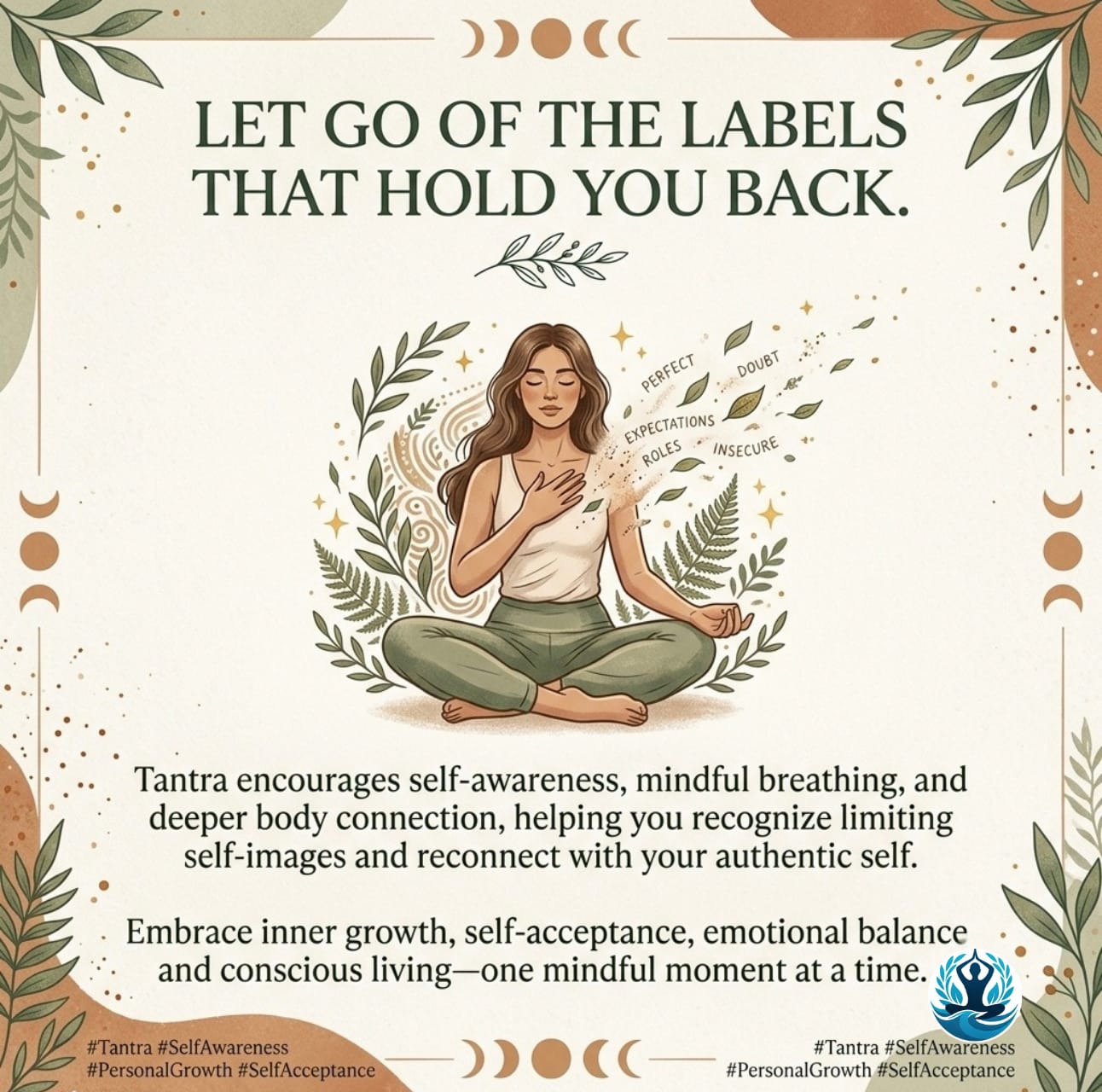
Every person carries an internal picture of who they believe they are. Sometimes that image can be empowering: I am capable, resilient, creative, caring, or courageous. At other times, however, the image becomes restrictive: I am not good enough. I am too shy. I always fail. I have to please everyone. I cannot change. I must always be strong.
These internal descriptions are often called self-images. They are formed through childhood experiences, relationships, social expectations, successes, disappointments, and repeated thoughts. While a sense of identity can provide stability, rigid self-images can prevent people from recognizing their ability to grow and change.
Tantra for letting go of limiting self-images offers a mindful approach to exploring these patterns through awareness, presence, breath, body consciousness, and compassionate self-observation. Rather than forcing someone to become a different person, Tantric-inspired practices can encourage a person to notice the difference between their authentic experience and the identities they have learned to carry.
Tantra, in its broader traditional context, encompasses diverse philosophical and contemplative traditions. Modern wellness approaches sometimes use selected Tantric practices such as meditation, breath awareness, conscious movement, and sensory awareness. These practices should not be treated as a substitute for professional mental-health care when someone is dealing with significant psychological distress.
The deeper message is simple: you are more than the labels you have placed on yourself.
What Are Limiting Self-Images?
A self-image is the mental picture you have about yourself. It influences how you interpret situations, how you behave around other people, and what possibilities you believe are available to you.
A limiting self-image becomes problematic when it turns into a fixed belief.
For example:
- “I am not confident.”
- “I am always anxious.”
- “I am not creative.”
- “People will judge me.”
- “I have to be perfect.”
- “I am not successful enough.”
- “I must always take care of everyone else.”
- “I cannot express my feelings.”
- “I am defined by my past.”
- “This is simply who I am.”
These statements may feel like facts, but they are often interpretations developed over time.
Tantra encourages a shift from identification to observation.
Instead of saying:
“I am an anxious person.”
A mindful approach might ask:
“What happens in my body and mind when anxiety appears?”
That small shift creates space between the experience and the identity.
How Self-Images Are Created
Limiting self-images rarely appear overnight. They can develop through repeated experiences.
Childhood experiences
Early feedback from parents, teachers, relatives, and peers can influence how a person sees themselves.
Repeated criticism may create the belief that someone is incapable. Excessive comparison may produce feelings of inadequacy. Being praised only for achievement may create the idea that personal worth depends on success.
Social expectations
Society can create powerful ideas about how people are supposed to look, behave, work, communicate, or succeed.
When these expectations are internalized, people may begin living according to an external definition of themselves.
Past failures
One difficult experience can become a generalized identity.
A person who experiences failure might start thinking:
“I failed at this.”
Later, the thought can become:
“I am a failure.”
Tantra-inspired self-awareness can help distinguish an experience from a definition of the self.
Comparison
Constant comparison can make people evaluate themselves through someone else’s achievements, appearance, lifestyle, or relationships.
This can create an exhausting cycle in which self-worth depends on external standards.
Repeated internal dialogue
Thoughts become influential when they are repeated frequently.
A person who repeatedly tells themselves that they are incapable may eventually behave according to that belief.
Awareness allows these automatic thoughts to become visible.
The Tantric Perspective on Self-Awareness
One of the most valuable ideas associated with contemplative Tantra is the cultivation of awareness.
Instead of immediately rejecting an uncomfortable thought, a practitioner can learn to observe it.
Instead of immediately reacting to an emotion, they can notice it.
Instead of judging a bodily sensation, they can experience it with curiosity.
This creates a different relationship with the inner world.
The goal is not necessarily to eliminate every negative thought. It is to stop allowing every thought to define who you are.
Awareness before identification
Imagine a thought arises:
“I am not good enough.”
Rather than accepting it immediately, pause.
Notice:
- Where do I feel this thought in my body?
- What emotion accompanies it?
- When does it usually appear?
- What triggered it?
- Is this a current reality or an old pattern?
- Does this belief support the person I want to become?
This type of inquiry can weaken the automatic connection between thought and identity.
Tantra for Letting Go of Limiting Self-Images
Letting go does not mean destroying your personality or abandoning your sense of identity.
It means becoming less dependent on rigid definitions.
A person can recognize:
“I have experienced insecurity, but insecurity does not define me.”
“I made mistakes, but mistakes do not define my entire life.”
“I have struggled with confidence, but I can still develop confidence.”
This distinction is central to personal growth.
1. Practice Witnessing Awareness
One simple practice is to sit quietly and observe thoughts without immediately following them.
Find a comfortable position.
Close your eyes if comfortable.
Allow the breath to settle naturally.
As thoughts appear, simply notice them.
You may hear internal statements such as:
“I should be doing more.”
“I am not enough.”
“I need everyone’s approval.”
“I am behind in life.”
Instead of arguing with the thoughts, mentally recognize:
“This is a thought.”
Then return attention to the breath.
Over time, this practice can help create psychological distance from repetitive self-narratives.
2. Use Breath as an Anchor
Breath awareness is an important component of many contemplative practices.
When limiting self-images become intense, attention can become trapped inside mental stories.
The breath provides a simple anchor in the present moment.
Try this:
- Sit comfortably.
- Relax your shoulders.
- Notice the natural movement of your breathing.
- Feel the inhalation.
- Feel the exhalation.
- Notice sensations around the chest, abdomen, or nose.
- When thoughts arise, acknowledge them.
- Gently return attention to breathing.
There is no need to force the breath or create a particular experience.
The purpose is simply to develop presence.
3. Develop Body Awareness
Self-image is not only a mental experience. It can also influence how people hold their bodies.
Someone who feels insecure may constantly contract their shoulders.
Someone who feels pressured may clench their jaw.
Someone who feels overwhelmed may hold tension in the stomach.
Tantric-inspired body awareness can encourage people to notice these patterns without immediately trying to change them.
Ask:
“What is my body communicating right now?”
You might discover that certain situations repeatedly produce particular physical responses.
Recognizing these patterns can help you respond more consciously.
4. Separate Your Identity From Your Roles
Modern life often requires people to perform multiple roles.
You may be:
- a professional,
- a parent,
- a partner,
- a friend,
- a caregiver,
- a business owner,
- a student,
- a leader,
- or a member of a community.
Roles are important, but they are not the entirety of a person.
When someone becomes completely identified with their responsibilities, they may struggle to answer:
“Who am I when I am not performing a role?”
Tantra-inspired self-inquiry can create space for this question.
Instead of constantly asking what you need to accomplish, ask:
“What am I experiencing right now?”
That shift moves attention from performance toward presence.
5. Practice Conscious Movement
Movement can help reconnect attention with the body.
It does not have to be complicated.
Slow stretching, walking meditation, gentle yoga-inspired movement, or mindful body movements can become opportunities for awareness.
Rather than focusing on how the body looks, focus on how movement feels.
Notice:
- balance,
- tension,
- breath,
- temperature,
- muscle engagement,
- relaxation,
- and subtle sensations.
This changes the relationship with the body from appearance to experience.
That can be particularly valuable when self-image is heavily influenced by appearance or comparison.
6. Observe Your Inner Critic
Most people have an internal voice that evaluates their behavior.
The inner critic may say:
“You should have done better.”
“You are too slow.”
“You are not attractive enough.”
“You are not successful enough.”
“You should be more confident.”
Rather than trying to silence the voice through force, observe it.
Ask:
“Whose standard am I trying to satisfy?”
This question can reveal whether a belief actually belongs to you or has been absorbed from family, culture, social media, education, or past experiences.
7. Replace Judgment With Curiosity
Judgment often reinforces limiting self-images.
If you think:
“I am terrible at this.”
You may stop trying.
Curiosity creates another possibility:
“What can I learn from this?”
Instead of:
“Why am I like this?”
Try:
“What experiences contributed to this pattern?”
Instead of:
“What’s wrong with me?”
Try:
“What do I need right now?”
Curiosity creates room for change.
8. Practice Present-Moment Awareness
Limiting self-images frequently depend on the past or future.
The past may say:
“This is who I have always been.”
The future may say:
“I will never become different.”
Presence offers another perspective.
Right now, you are experiencing something new.
Your thoughts may change.
Your emotions may change.
Your body may change.
Your environment may change.
Your understanding may change.
Mindfulness helps you notice this movement instead of assuming that every experience is permanent.
Tantra and Authentic Living
Authenticity does not mean expressing every thought or emotion without consideration.
It means developing greater alignment between your values, awareness, choices, and actions.
When limiting self-images become weaker, people may find it easier to ask:
- What actually matters to me?
- What do I genuinely enjoy?
- What boundaries do I need?
- What kind of relationships support my wellbeing?
- Which goals are truly mine?
- Which expectations am I carrying unnecessarily?
- What does a meaningful life look like for me?
These questions can lead toward more conscious living.
Letting Go of the Need for Approval
One common limiting self-image is the identity of “the person who must please everyone.”
This can create emotional exhaustion.
People may say yes when they want to say no.
They may hide opinions.
They may avoid healthy disagreement.
They may measure their worth through other people’s reactions.
Mindfulness can help create a pause before automatically seeking approval.
Before responding, ask:
“Am I choosing this because it aligns with my values, or because I am afraid of disappointing someone?”
This does not mean ignoring other people’s needs.
It means developing awareness around your own motivations.
Letting Go of Perfectionism
Perfectionism can create an identity built around achievement.
The person may believe:
“If I perform perfectly, I am worthy.”
But this creates pressure because perfection is impossible.
A more mindful approach recognizes the value of progress.
Tantric-inspired awareness can encourage people to experience the process rather than becoming completely attached to the outcome.
You can work sincerely while allowing yourself to be imperfect.
You can improve without constantly criticizing yourself.
You can pursue excellence without making achievement the foundation of your identity.
Tantra and Self-Acceptance
Self-acceptance does not mean refusing to grow.
It means beginning growth from an honest relationship with yourself.
You can acknowledge:
“I am still learning.”
“I have strengths and weaknesses.”
“I have made mistakes.”
“I have qualities I appreciate.”
“There are parts of myself I want to develop.”
Acceptance creates a stable foundation for transformation.
When people stop fighting against their entire identity, they often gain more energy for meaningful change.
A Simple Daily Tantra-Inspired Routine
A short daily practice can support awareness.
Morning: Five minutes of breathing
Sit quietly and observe your breath.
Set an intention:
“Today I will observe myself without immediately judging myself.”
During the day: Pause before reacting
When a strong emotional response appears, stop for a few breaths.
Ask:
“What am I experiencing?”
Evening: Self-reflection
Before sleeping, reflect on three questions:
- When did I feel most authentic today?
- When did I act according to an old self-image?
- What would I like to approach differently tomorrow?
This practice can gradually make unconscious patterns more visible.
Common Limiting Self-Images and Healthier Perspectives
| Limiting Self-Image | More Flexible Perspective |
|---|---|
| “I am not confident.” | “Confidence can develop through experience.” |
| “I always fail.” | “Some experiences have not worked out.” |
| “I have to please everyone.” | “I can care about others while respecting my boundaries.” |
| “I am too emotional.” | “My emotions provide information I can learn to understand.” |
| “I am behind in life.” | “My life does not have to follow someone else’s timeline.” |
| “I cannot change.” | “People can learn, adapt, and grow.” |
| “I must be perfect.” | “I can pursue growth without demanding perfection.” |
| “My past defines me.” | “My past influenced me, but it does not have to define my future.” |
Benefits of Letting Go of Limiting Self-Images
Practicing mindful self-awareness may support several aspects of wellbeing.
Greater self-awareness
You become more familiar with your thoughts, emotions, physical responses, and behavioral patterns.
Increased emotional flexibility
Instead of automatically reacting, you may become better at creating a pause and choosing your response.
Improved self-acceptance
You may develop a kinder and more realistic understanding of yourself.
Greater confidence
Confidence can grow when you stop defining yourself through old limitations and begin recognizing your capacity to learn.
Healthier relationships
Understanding your own patterns can make communication and boundaries more conscious.
Reduced dependence on external validation
You may become less dependent on constant approval from others.
Greater presence
Letting go of rigid self-narratives can bring more attention to what is happening in the present moment.
How Long Does It Take to Let Go of a Limiting Self-Image?
There is no universal timeline.
Some beliefs may shift quickly after a new insight. Others have been reinforced for years and require consistent practice.
The goal is not to force immediate transformation.
Instead, focus on small moments of awareness.
Notice one thought.
Pause before one reaction.
Listen to one bodily sensation.
Question one old belief.
Choose one action that reflects your values.
These small experiences can gradually create a different relationship with yourself.
Common Mistakes to Avoid
Trying to become a completely different person
The purpose is not to reject yourself.
The goal is to understand yourself more clearly.
Fighting negative thoughts
Trying to force thoughts away can sometimes make them more noticeable.
Observation can be more useful than suppression.
Expecting instant transformation
Personal growth is usually gradual.
Consistency matters more than dramatic experiences.
Turning mindfulness into another performance
You do not have to meditate perfectly.
You do not have to feel peaceful every time.
The practice is simply to notice.
Ignoring professional support
Meditation and self-awareness practices can complement wellbeing, but they are not a replacement for qualified professional support when someone is experiencing serious psychological difficulties.
The Deeper Lesson: You Are Not a Fixed Story
One of the most empowering insights of self-awareness is recognizing that identity is not always as fixed as it feels.
You have changed before.
Your interests have changed.
Your relationships have changed.
Your priorities have changed.
Your understanding has changed.
Your responses to life have changed.
Therefore, the statement “this is simply who I am” deserves curiosity.
Perhaps it is not your entire identity.
Perhaps it is a pattern.
Perhaps it is a habit.
Perhaps it is an old interpretation.
Perhaps it is an aspect of yourself that is ready to evolve.
Tantra-inspired awareness can help you witness these layers without immediately rejecting them.
Frequently Asked Questions
What is Tantra for letting go of limiting self-images?
It refers to using awareness-oriented practices associated with modern Tantric wellness, such as meditation, breath awareness, conscious movement, body awareness, and self-inquiry, to examine rigid beliefs about oneself.
Can Tantra help with negative self-perception?
Mindfulness and self-awareness practices may help people observe negative thoughts rather than automatically identifying with them. Individual experiences vary.
Does Tantra mean changing who I am?
No. The focus is not on creating an artificial identity. It is about becoming more aware of habitual patterns and creating space for authentic choices.
Can beginners practice Tantra?
Many awareness-based practices can be approached gradually by beginners. It is useful to learn from qualified teachers, particularly when exploring traditional Tantric practices.
How often should I practice?
Consistency is generally more useful than intensity. Even a few minutes of mindful breathing or self-observation can become a meaningful daily habit.
Conclusion
Tantra for letting go of limiting self-images is ultimately a journey from rigid identification toward greater awareness.
The beliefs you carry about yourself may have been shaped by your past, but they do not necessarily have to dictate your future.
Through mindful breathing, body awareness, meditation, conscious movement, self-inquiry, and present-moment observation, you can begin noticing the stories that influence your identity.
The aim is not to erase who you are.
It is to discover the space beyond the labels.
You are not only your achievements.
You are not only your mistakes.
You are not only your responsibilities.
You are not only other people’s opinions.
You are a person capable of awareness, learning, adaptation, and growth.
When you stop treating every thought as a definition of yourself, new possibilities become visible.
And sometimes, letting go does not mean becoming someone new.
It means becoming more fully aware of who you already are.