

Tantra and the Journey From Self-Protection to Self-Trust

Life often teaches us to protect ourselves.
We learn to hide vulnerability, control our emotions, avoid uncertainty, seek approval, and carefully manage how others perceive us. These patterns can develop gradually. What once helped us feel safe may eventually become a barrier to authentic living.
Self-protection is not inherently negative. Healthy boundaries, awareness, discernment, and the ability to recognize situations that do not feel right are important parts of wellbeing. However, when protection becomes a constant state of tension, it can make it difficult to trust ourselves, express our needs, or remain open to life.
This is where Tantra offers an interesting perspective.
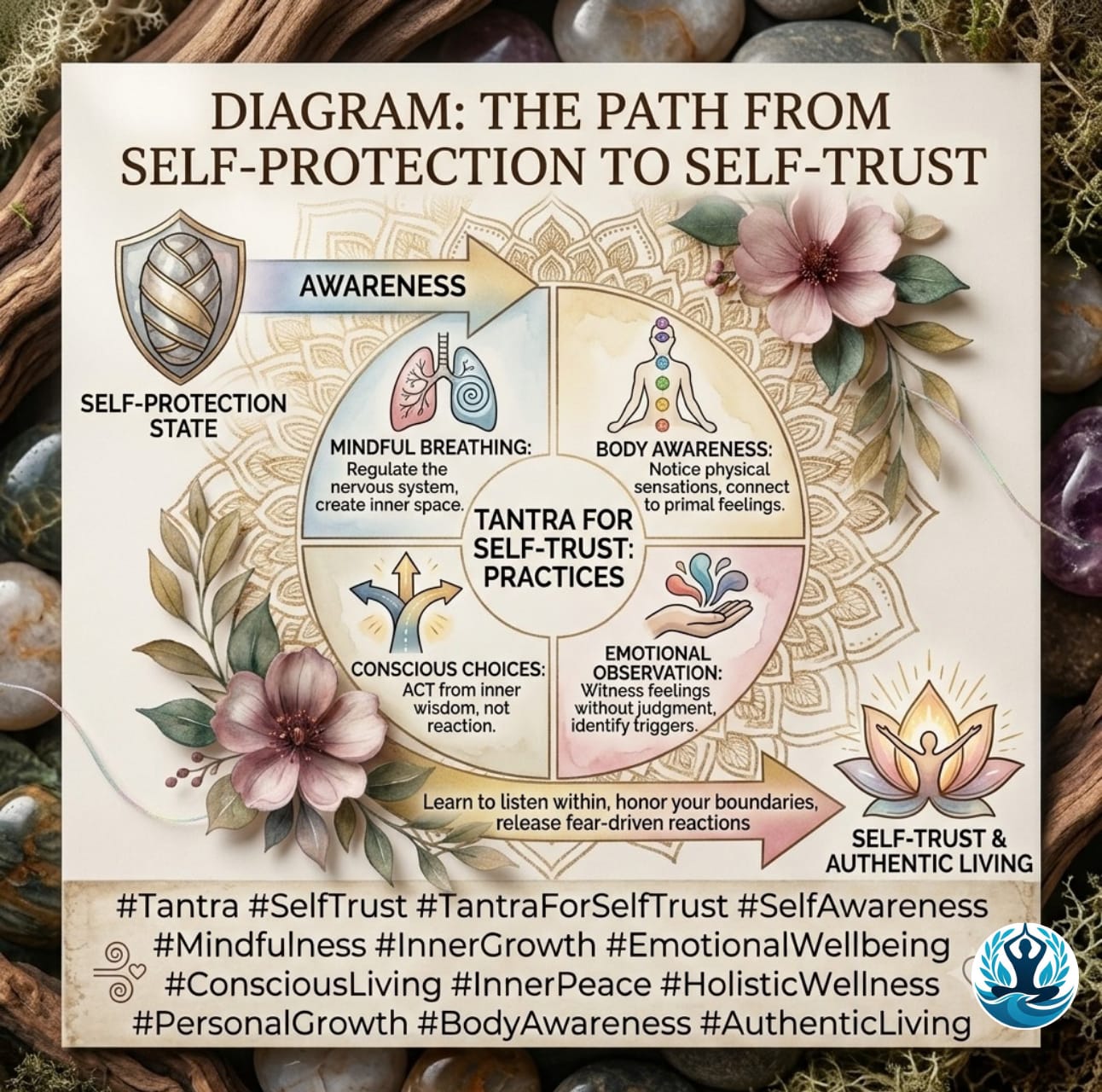
Rather than encouraging us to reject difficult experiences, Tantra traditionally emphasizes awareness, presence, and a conscious relationship with the body, mind, emotions, and life itself. In a modern wellness context, these principles can be explored as practices for becoming more aware of protective patterns and developing a more trusting relationship with ourselves.
The journey from self-protection to self-trust is not about becoming careless or ignoring boundaries. It is about developing enough inner awareness to recognize when protection is genuinely needed and when an old pattern is preventing growth.
What Is Self-Protection?
Self-protection is the collection of physical, emotional, mental, and behavioral responses we use to create a sense of safety.
For example, someone may protect themselves by:
- Avoiding difficult conversations
- Hiding their emotions
- Constantly seeking reassurance
- Trying to control every situation
- Saying yes when they actually want to say no
- Avoiding new experiences
- Overthinking decisions
- Keeping people at an emotional distance
- Suppressing personal desires
- Constantly trying to appear strong
These behaviors can sometimes provide temporary comfort.
However, excessive self-protection may also create distance from our authentic experiences. Instead of asking, “What do I genuinely feel?” we may automatically ask, “What will keep me safe?” or “What will others think?”
Over time, this can make self-trust weaker.
Understanding Self-Trust
Self-trust means developing confidence in your ability to listen to yourself, make thoughtful choices, respond to challenges, and learn from your experiences.
It does not mean believing that every decision will be perfect.
Instead, self-trust can involve knowing:
“I can listen to myself.”
“I can recognize my needs.”
“I can learn when something does not work.”
“I can change direction when necessary.”
“I can experience uncertainty without immediately losing myself.”
This kind of trust develops through awareness and experience.
Tantra can support this process by encouraging a deeper relationship with present-moment experience rather than automatically reacting to every thought or emotion.
How Tantra Relates to Self-Trust
Tantric traditions are diverse and historically complex, so Tantra cannot be reduced to a single modern wellness technique.
At a broad level, many Tantric practices emphasize awareness of embodied experience, consciousness, energy, attention, and the relationship between inner and outer life.
For modern wellness practice, this can translate into cultivating:
- Body awareness
- Conscious breathing
- Mindful attention
- Emotional awareness
- Present-moment presence
- Self-observation
- Acceptance of experience
- Intentional action
These practices may help a person notice protective reactions before automatically acting on them.
The goal is not to eliminate every protective response. The goal is to create a little more awareness between an internal reaction and an external response.
From Automatic Protection to Conscious Awareness
One of the first steps toward self-trust is noticing what happens inside you.
Imagine receiving unexpected criticism.
Your immediate reaction might be defensiveness.
Another person may become silent.
Someone else may immediately apologize, even when they have done nothing wrong.
Another person may begin analyzing the conversation for hours.
These reactions can happen quickly.
A conscious practice begins by observing the reaction.
Instead of immediately asking, “How do I make this feeling disappear?” you can ask:
“What is happening in me right now?”
Notice the breath.
Notice the body.
Notice the emotions.
Notice the thoughts.
Notice the impulse to act.
This pause does not require you to suppress your response. It simply creates awareness.
That awareness can become the foundation of self-trust.
Tantra and Body Awareness
The body often provides information before the conscious mind fully understands what is happening.
You may notice:
- Tight shoulders
- A clenched jaw
- Shallow breathing
- A tense stomach
- Restlessness
- Heaviness
- A desire to withdraw
- Increased physical alertness
These sensations are not automatically instructions. They are experiences to observe.
Tantric-inspired body awareness can encourage you to become curious about these sensations rather than immediately judging them.
For example, when you feel tension before an important conversation, instead of immediately thinking, “I cannot handle this,” you might observe:
“My chest feels tight.”
“My breathing has changed.”
“I feel nervous.”
“I want to avoid this conversation.”
This creates a distinction between experiencing a reaction and being controlled by the reaction.
The Role of Breath in Developing Self-Trust
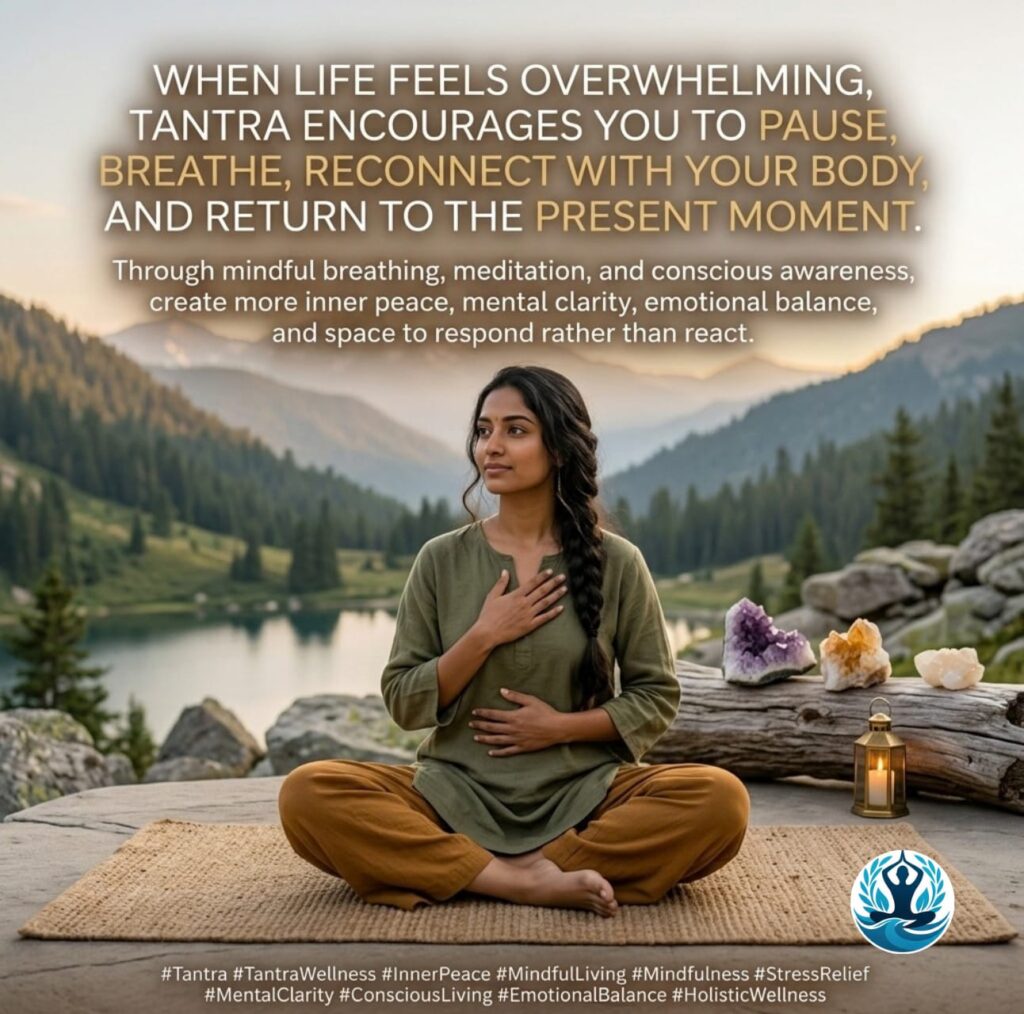
Conscious breathing is one of the simplest ways to return attention to the present moment.
When life feels overwhelming, attention often moves toward imagined future problems or repeated memories of the past.
Breath awareness can provide an immediate point of connection with the present.
A simple practice is to sit comfortably and observe your natural breathing for several minutes.
Do not force the breath.
Simply notice:
- The movement of the abdomen
- The expansion of the chest
- The sensation of air entering and leaving
- Changes in breathing when thoughts arise
- Physical sensations throughout the body
If your attention wanders, gently return to the breath.
This practice is simple, but consistency matters.
Over time, moments of conscious observation can help you become more familiar with your internal experience.
Self-Protection and the Need for Control
One common form of self-protection is the desire to control everything.
Control can feel reassuring.
We may try to control:
- How others perceive us
- What happens next
- Other people’s reactions
- Our emotional responses
- Every possible outcome
- Our productivity
- Our appearance
- Our relationships
But life contains uncertainty.
When the need for control becomes excessive, everyday experiences can become exhausting.
Tantra encourages a different relationship with experience: conscious participation rather than constant resistance.
This does not mean giving up responsibility.
It means recognizing the difference between what you can influence and what you cannot completely control.
Self-trust grows when you begin to believe:
“I may not control everything that happens, but I can remain present with myself.”
From Hypervigilance to Presence
Constant self-protection can keep the mind scanning for potential problems.
You may repeatedly ask:
“Did I say the wrong thing?”
“What if something goes wrong?”
“Does this person dislike me?”
“What if I fail?”
“What if I disappoint someone?”
This mental pattern can make it difficult to experience the present moment.
A mindfulness-oriented Tantric practice can encourage you to return attention to immediate experience.
Look around.
Feel your feet touching the ground.
Notice your breathing.
Listen to surrounding sounds.
Observe your posture.
Allow yourself to experience the current moment without immediately turning it into a problem that must be solved.
Presence creates space.
Within that space, self-trust can gradually develop.
Learning to Listen to Yourself
Self-trust requires listening.
However, listening to yourself does not mean automatically following every impulse.
Instead, it means becoming curious about your inner experience.
You might ask:
- What am I feeling?
- What do I need right now?
- What am I avoiding?
- What am I afraid will happen?
- Is this decision based on genuine desire or fear?
- Am I saying yes because I want to or because I fear disappointing someone?
- What would feel more aligned with my values?
These questions encourage reflection rather than automatic reaction.
Tantra can provide a framework for approaching these questions through awareness of the whole person—body, breath, emotions, thoughts, and consciousness.
Moving Beyond the Fear of Vulnerability
Self-protection often increases when vulnerability feels unsafe.
We may believe that showing emotions means becoming weak.
We may hide uncertainty.
We may avoid asking for help.
We may pretend that everything is fine.
But authentic connection often requires some degree of openness.
Self-trust does not mean becoming vulnerable with everyone.
Healthy discernment remains important.
Instead, it means becoming more comfortable acknowledging your own emotions.
You can tell yourself:
“I feel hurt.”
“I feel uncertain.”
“I need support.”
“I am afraid.”
“I do not know yet.”
Recognizing an emotion does not make it stronger. It can simply make the experience more conscious.
Tantra and Emotional Awareness
Emotions are part of human experience.
Rather than labeling every uncomfortable emotion as negative, mindful awareness allows us to observe emotions with curiosity.
Anger may signal that something feels important.
Sadness may accompany loss.
Fear may appear when something feels uncertain.
Joy may arise through connection or meaningful experience.
The purpose is not to interpret every emotion as a hidden message. Instead, emotional awareness can help you recognize what you are experiencing before deciding how to respond.
This distinction is important:
Feel the emotion. Observe the emotion. Then choose your response.
That process can strengthen self-trust.
Creating a Pause Before Reacting
One of the most practical ways to move from self-protection toward self-trust is developing a conscious pause.
When something triggers you:
Pause.
Breathe.
Notice.
Choose.
The pause does not have to be long.
Even a few seconds can create space between stimulus and response.
For example, if someone sends a message that makes you angry, you do not necessarily need to respond immediately.
Take a breath.
Notice the emotion.
Feel the body.
Ask what response aligns with your intention.
Then respond.
This is not emotional suppression.
It is conscious participation in your own life.
Rebuilding Trust Through Small Decisions
Self-trust is strengthened through everyday actions.
You do not need to make dramatic life changes.
Start with small choices.
For example:
- Take a break when you genuinely need one.
- Say no to something that does not align with your boundaries.
- Express your opinion respectfully.
- Spend time doing something meaningful to you.
- Allow yourself to rest without unnecessary guilt.
- Notice when you are overcommitting.
- Follow through on a small promise you make to yourself.
Each conscious action communicates:
“My inner experience matters.”
Over time, these small experiences can contribute to a stronger sense of self-trust.
The Importance of Healthy Boundaries
Moving away from self-protection does not mean removing boundaries.
In fact, healthy boundaries can support self-trust.
A boundary communicates what you are comfortable with and what you are not.
Examples include:
“I need some time before I answer.”
“I am not comfortable with that.”
“I cannot take this on right now.”
“I would prefer to discuss this later.”
“I need some personal space.”
Boundaries become healthier when they come from conscious awareness rather than fear alone.
The goal is not to close yourself off from life.
The goal is to participate in relationships while remaining connected to yourself.
Tantra and the Fear of Being Judged
The fear of judgment can become another form of self-protection.
You may change your behavior because you are constantly imagining how others will perceive you.
This can gradually create a gap between your external identity and your internal experience.
Tantra-inspired self-awareness encourages you to notice this gap.
Ask:
“Am I doing this because it is meaningful to me?”
“Or am I doing it primarily to avoid judgment?”
There may be situations where social expectations are important. The intention is not to reject society or relationships.
Instead, it is to become more conscious of when external expectations are shaping your choices.
Releasing the Need to Be Perfect
Perfectionism can also function as self-protection.
If everything is perfect, perhaps criticism can be avoided.
If every decision is carefully planned, perhaps mistakes can be prevented.
If you never show weakness, perhaps rejection can be avoided.
But perfection is impossible.
Self-trust grows when you learn that mistakes do not automatically destroy your sense of self.
You can make an imperfect decision and learn.
You can change your mind.
You can apologize.
You can begin again.
You can grow.
This flexibility is an important part of inner resilience.
A Simple Tantric-Inspired Self-Trust Practice
You can create a short daily practice using awareness, breath, and reflection.
Step 1: Sit Quietly
Find a comfortable place and sit for five minutes.
Keep your body relaxed without forcing a particular posture.
Step 2: Observe Your Breath
Notice the natural rhythm of your breathing.
Do not try to control it.
Step 3: Scan the Body
Bring attention slowly through the body.
Notice areas of tension, ease, warmth, heaviness, or movement.
Step 4: Observe Your Emotional State
Ask:
“What am I experiencing right now?”
There is no need to change the answer.
Step 5: Notice Protective Patterns
Ask:
“What am I trying to protect myself from?”
Allow the question to remain open.
Step 6: Ask What You Need
Instead of immediately searching for a solution, ask:
“What would support me right now?”
Step 7: Choose One Small Action
Take one realistic action based on awareness.
It might be resting, communicating a boundary, completing an important task, taking a walk, or simply allowing yourself to pause.
Consistency is more important than intensity.
Tantra and Self-Trust in Daily Life
The journey toward self-trust does not happen only during meditation.
It happens throughout ordinary life.
When you listen instead of interrupting yourself.
When you rest instead of constantly pushing.
When you communicate honestly.
When you recognize an emotional reaction without becoming overwhelmed by it.
When you make a decision based on conscious reflection.
When you allow uncertainty without demanding immediate answers.
These moments become opportunities for practice.
Everyday life becomes part of the journey.
What Self-Trust Is Not
It is helpful to understand what self-trust does not mean.
Self-trust does not mean:
- Never asking for advice
- Always being certain
- Ignoring other people’s perspectives
- Refusing to change your mind
- Acting impulsively
- Believing every thought
- Avoiding responsibility
- Rejecting healthy boundaries
- Assuming that every feeling is a fact
Instead, self-trust involves being able to listen inwardly while remaining open to information from the outside world.
It is a relationship with yourself, not isolation from others.
The Journey Is Gradual
Moving from self-protection to self-trust is rarely a straight line.
Some days you may feel open and confident.
Other days you may return to old patterns.
That does not mean you have failed.
Awareness itself is progress.
When you notice an old protective response, you can become curious rather than critical.
Ask:
“What happened?”
“What did I feel?”
“What did I need?”
“What could I choose differently next time?”
This approach transforms mistakes into opportunities for learning.
Creating a More Trusting Relationship With Yourself
The deeper purpose of this journey is not to eliminate fear.
Fear can be part of life.
The goal is to develop a relationship with yourself that can include fear without allowing fear to control every decision.
You can experience uncertainty and still move forward.
You can feel nervous and still communicate.
You can make mistakes and still respect yourself.
You can experience discomfort and still remain present.
This is where self-trust becomes meaningful.
You begin to understand that safety does not always come from controlling everything around you.
Sometimes it comes from knowing that you can remain connected to yourself while life changes.
Conclusion
The journey from self-protection to self-trust begins with awareness.
Tantra, approached as a practice of conscious presence and embodied awareness, can offer valuable tools for exploring this journey. Through breath awareness, body awareness, meditation, emotional observation, and intentional living, you can become more familiar with your internal world.
Self-protection does not need to be treated as an enemy. It may have developed for understandable reasons. The invitation is to understand it rather than automatically obey it.
With greater awareness, you can begin to recognize when protection is useful and when it has become restrictive.
You can pause before reacting.
You can listen to your body.
You can acknowledge your emotions.
You can establish healthy boundaries.
You can make small conscious choices.
And gradually, you can develop a deeper relationship with yourself.
Tantra and self-trust are ultimately connected through awareness: the more consciously you experience yourself, the more clearly you can respond to life from within rather than constantly reacting from fear.