

Rediscovering the Joy of Doing Something Without Needing a Result: A Tantric Approach to Mindful Living

Modern life often encourages us to measure everything by its results. We work to achieve goals, exercise to improve our bodies, meditate to reduce stress, and learn new skills to become more successful. Even our hobbies and moments of relaxation can become activities we evaluate according to progress, productivity, or personal improvement.
Although goals can provide direction, constantly focusing on outcomes can make us forget the simple pleasure of experiencing life as it unfolds. We may stop enjoying an activity because we are too busy thinking about what it should achieve. Instead of appreciating the present moment, we begin measuring our performance, comparing our progress, and worrying about whether our efforts are worthwhile.
Tantra offers a different perspective by inviting us to develop greater awareness of our experiences, including our breath, sensations, thoughts, emotions, and everyday activities. Rather than treating every moment as a means to an end, a mindful approach inspired by Tantra encourages us to become more fully present in what we are doing.
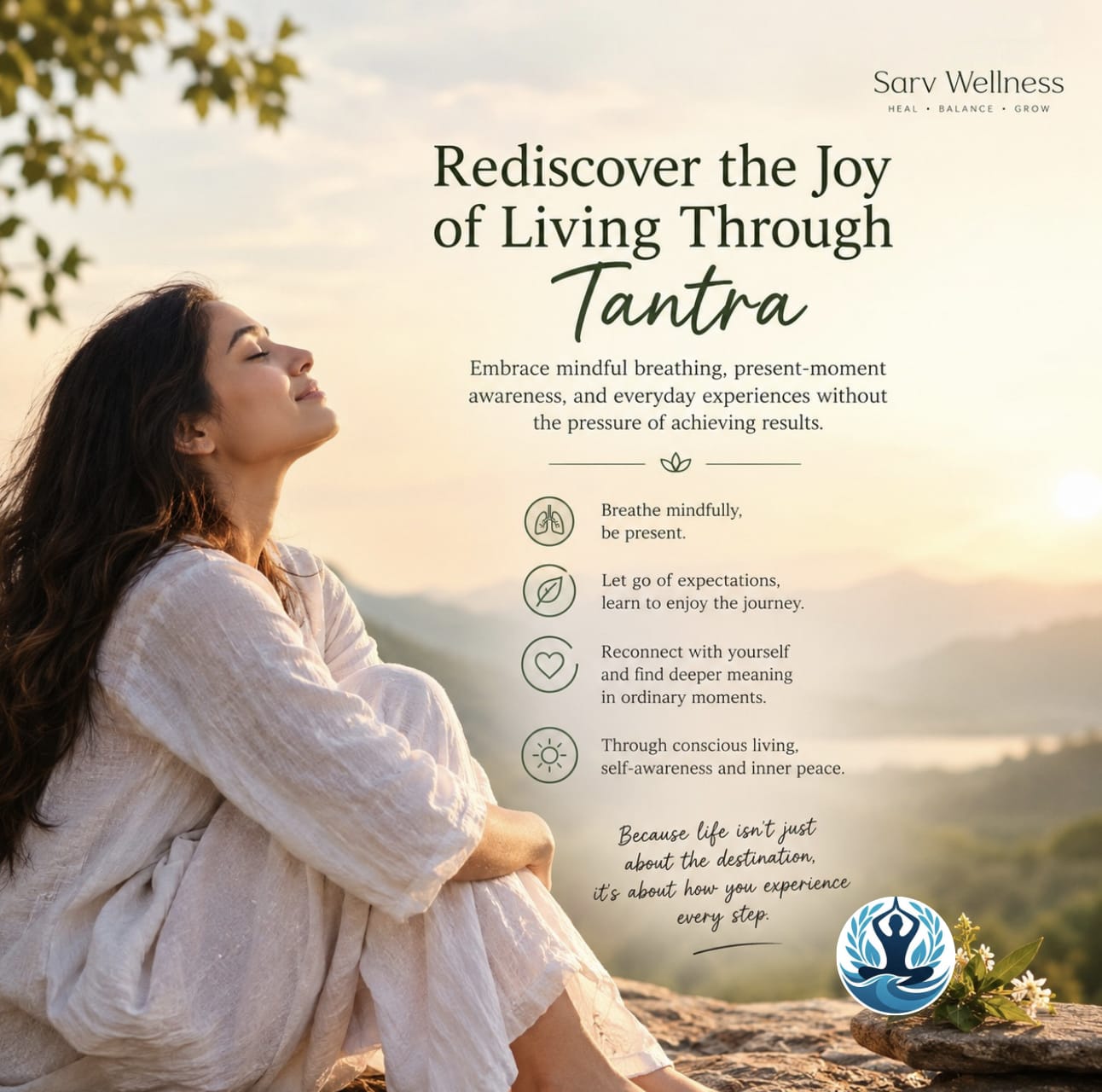
Rediscovering the joy of doing something without needing a result means learning to value the experience itself. It means walking because you enjoy the movement, painting because you appreciate the colours, breathing consciously because you want to feel present, or spending time in nature without needing to turn the experience into an achievement.
This approach does not require abandoning ambition or ignoring responsibilities. Instead, it helps create a healthier relationship with goals by allowing enjoyment, curiosity, and presence to exist alongside achievement.
1. Understanding Why We Constantly Seek Results
The desire for results is a natural part of human life. Goals help us make decisions, develop skills, solve problems, and move towards meaningful aspirations. Difficulties arise when we begin to believe that an activity has value only if it produces a measurable outcome.
For example, someone may begin meditation hoping to experience immediate calm. If their mind continues to wander, they might conclude that meditation is not working. A person who starts painting may become frustrated because their work does not look professional. Even a simple walk may turn into a competition involving distance, speed, or calories burned.
In each situation, attention shifts away from the activity itself and towards an expected result.
Several factors contribute to this habit:
- Social expectations: We often receive recognition for achievements rather than for curiosity, effort, or enjoyment.
- Comparison: Seeing other people’s accomplishments can make ordinary experiences feel insufficient.
- Fear of wasting time: We may feel uncomfortable doing something that does not improve our skills, income, health, or status.
- Perfectionism: We can become so concerned about doing something correctly that we forget to enjoy learning.
- The need for validation: External approval may become more important than our own experience of satisfaction.
Over time, this mindset can make life feel like a continuous performance. Activities that once brought happiness become obligations, and moments of rest become opportunities to achieve something else.
Tantric awareness encourages us to notice these patterns without judging ourselves. Recognising the constant search for outcomes is the first step towards choosing a more present and fulfilling way of living.
2. How Tantra Encourages Present-Moment Awareness
Tantra encompasses diverse philosophical and spiritual traditions, many of which explore awareness, embodiment, ritual, and the relationship between consciousness and lived experience. In a modern wellness context, selected awareness practices inspired by Tantra can help people pay closer attention to ordinary moments.
Present-moment awareness means noticing what is happening now rather than becoming completely absorbed in thoughts about the past or future.
Consider drinking a cup of tea. You might normally drink it while checking messages, planning your schedule, or thinking about unfinished tasks. A mindful approach invites you to notice the warmth of the cup, the aroma of the tea, its flavour, and the sensation of sitting quietly.
The tea has not changed, but your relationship with the experience has.
You are no longer treating the moment merely as a short break before returning to productivity. You are allowing the experience to have value in itself.
This principle can be applied to many ordinary activities, including cooking, gardening, listening to music, stretching, walking, and spending time with loved ones.
The purpose is not to force yourself to feel peaceful or to turn every activity into a formal spiritual practice. It is to become more aware of what you are experiencing without constantly asking whether it is useful.
Through this approach, everyday life can become an opportunity to practise attention, curiosity, and appreciation.
3. The Difference Between Enjoying a Process and Chasing an Outcome
There is nothing inherently wrong with wanting results. Learning a language, building a career, improving fitness, and developing relationships all involve intentions and outcomes.
The important distinction is whether the outcome becomes the only reason for participating.
When we focus exclusively on results, we may overlook the small discoveries, enjoyable sensations, and meaningful experiences that happen along the way. We can become impatient with learning because we want to be competent immediately. We might stop exercising because progress seems slow, even though movement itself could be enjoyable.
Process-oriented living offers another perspective.
Instead of asking only, “What will I achieve?” we can also ask:
- What am I noticing while I do this?
- What makes this activity interesting to me?
- Can I allow myself to learn without demanding perfection?
- Would I still value this experience if nobody noticed it?
- Can I appreciate the effort without judging the final result?
These questions help shift attention from evaluation to experience.
For instance, someone learning to play a musical instrument can focus on the feeling of creating sounds, discovering rhythms, and gradually developing coordination. Progress remains welcome, but every practice session does not need to prove that the learner is talented.
Similarly, a person practising yoga or mindful movement can pay attention to breathing, balance, and bodily sensations instead of comparing their flexibility with others.
The joy of the process does not eliminate the value of achievement. It allows us to enjoy life while working towards it.
4. Releasing the Pressure to Make Every Moment Productive
Productivity has an important place in daily life. Responsibilities need attention, commitments require effort, and meaningful goals often demand consistency. However, when productivity becomes the standard by which we judge every moment, it can become difficult to rest, explore, or enjoy activities without a practical purpose.
You might feel guilty reading a novel because it does not advance your career. You may hesitate to spend an afternoon outdoors because you could be completing household tasks. Even creative hobbies can become stressful when you start expecting every effort to produce something impressive.
A mindful approach invites you to question the belief that every moment must generate measurable value.
Some experiences are valuable because they provide enjoyment, connection, curiosity, or a sense of aliveness. Their worth does not depend on whether they lead to professional success or personal improvement.
Try giving yourself permission to participate in one enjoyable activity without tracking your performance. Draw without planning to display the picture. Listen to music without multitasking. Walk without checking your pace. Sit in a garden without feeling obligated to practise a technique.
At first, this may feel unfamiliar. You may notice thoughts telling you to do something more useful. Rather than fighting these thoughts, acknowledge them and gently return your attention to the experience.
Learning to enjoy unproductive moments can help create a more balanced relationship with work, rest, and personal fulfilment.
5. Tantra, the Body, and the Pleasure of Experience
A key feature of many Tantric traditions is attention to embodied experience. Rather than treating the body simply as a tool for completing tasks, embodied awareness invites us to notice physical sensations as part of being alive.
Modern routines often place attention in the mind. We plan, analyse, anticipate, and evaluate while barely noticing whether our shoulders are tense, our breathing is shallow, or our bodies need rest.
Reconnecting with bodily experience can offer a different way to participate in daily activities.
When walking, notice how your feet meet the ground. When stretching, pay attention to the sensation of movement without forcing yourself into a particular position. When eating, notice the taste and texture of food. When breathing, observe the natural movement of the abdomen or chest.
These simple practices do not need to produce a special state. There is no requirement to feel unusually calm, energetic, or spiritually connected.
The experience itself is enough to explore.
Body awareness can also help you recognise when an activity feels enjoyable, uncomfortable, tiring, or emotionally demanding. Instead of pushing through every sensation to reach a goal, you can respond with greater sensitivity to your needs and limits.
This does not mean that every uncomfortable sensation should be avoided. Learning sometimes requires effort. The aim is to distinguish purposeful effort from unnecessary pressure and to remain attentive to your experience while making choices.
By bringing awareness to the body, ordinary activities can become opportunities to reconnect with the present rather than merely instruments for achieving results.
6. Rediscovering Curiosity and Playfulness
Children often explore activities because they are interesting. They may build something, experiment with colours, dance to music, or investigate an object without needing a finished product.
As adults, we can gradually lose this freedom. We begin evaluating whether an activity is productive, impressive, profitable, or aligned with our long-term goals.
Curiosity becomes secondary to performance.
Rediscovering playfulness means allowing yourself to explore without demanding that the exploration lead somewhere important. You might try a new recipe, learn a few dance steps, experiment with photography, grow a plant, or listen to a type of music you have never explored.
The purpose is not necessarily to become skilled. It is to discover what attracts your attention and what you enjoy experiencing.
A Tantric-inspired attitude of awareness can support this process by encouraging you to notice the sensations, emotions, and thoughts that emerge as you explore something new.
Perhaps you feel excitement when experimenting with a colour. Maybe you become impatient when a task is difficult. You might discover that you enjoy learning more than you expected, even when the result is imperfect.
Instead of treating these responses as obstacles, view them as part of the experience.
Curiosity creates space for surprise. It reminds us that we do not need to know the destination before beginning something meaningful.
7. Letting Go of Perfectionism Without Losing Commitment
Perfectionism can make even enjoyable activities feel exhausting. When the mind insists that something must be done exceptionally well, the freedom to experiment becomes limited.
A person may avoid painting because they are afraid of creating something unattractive. Another may refuse to dance unless they can perform the movements correctly. Someone learning meditation may feel disappointed whenever distracting thoughts arise.
In these situations, the desire to achieve a particular standard interferes with participation.
Mindful awareness can help us recognise perfectionistic thoughts without automatically obeying them. Instead of waiting until we feel confident, we can allow ourselves to begin as learners.
Consider the difference between these two statements:
“I must make something excellent.”
“I am curious to discover what happens when I try.”
The first creates a condition for participation. The second opens the door to experience.
Letting go of perfectionism does not mean abandoning care or commitment. It means understanding that mistakes, uncertainty, and gradual improvement are natural parts of learning.
You can still practise consistently, refine your skills, and work towards meaningful goals. The difference is that your sense of worth does not need to depend on every outcome.
When the process is allowed to be imperfect, enjoyment has more room to develop.
8. How Outcome-Independent Activities Support Emotional Wellbeing
Activities that are enjoyable in themselves may provide opportunities for relaxation, emotional expression, and meaningful engagement. Their effects differ from person to person, and they should not be treated as guaranteed solutions to stress or other mental health concerns.
Nevertheless, allowing yourself to participate without constant evaluation can change how an activity feels.
First, it may reduce performance pressure. When you are not trying to prove something, you may feel freer to experiment and learn.
Second, it can encourage present-moment attention. Focusing on the activity may temporarily interrupt repetitive thinking about unfinished tasks or future expectations.
Third, it can create opportunities for self-discovery. You may notice which activities genuinely interest you, rather than choosing them only because they appear impressive or useful.
Fourth, it can support a more balanced view of personal worth. You are allowed to enjoy an experience even when you are not particularly good at it.
Finally, it may help you recognise the difference between genuine motivation and pressure driven by fear, comparison, or the need for approval.
These benefits are not guaranteed, and an enjoyable activity does not replace professional support when distress is persistent or overwhelming. However, making room for experiences that are meaningful without being performance-driven can be a useful part of a balanced wellness routine.
9. Practical Tantric-Inspired Practices for Enjoying the Process
You do not need to reorganise your entire life to begin experiencing more joy in the present. Small, intentional changes can help you explore a less outcome-focused approach.
Practice 1: Mindful Breathing Without a Target
Set aside two or three minutes to notice your natural breathing. Avoid trying to make every breath deeper, slower, or more perfect.
Notice the air moving in and out. If thoughts arise, acknowledge them and return your attention to breathing.
The goal is not to achieve a particular state. It is to experience the act of breathing with awareness.
Practice 2: Take a Walk Without Measuring Progress
Choose a safe, comfortable route and leave performance targets aside for a while.
Notice the light, sounds, movement of your body, and changing surroundings. You do not need to walk a particular distance or achieve a step count for the experience to matter.
If you prefer to track exercise for health or training reasons, you can continue doing so on other walks.
Practice 3: Create Something Without Judging It
Spend ten minutes writing, sketching, cooking, gardening, or making something with your hands.
Allow yourself to experiment. Avoid correcting every small mistake or deciding in advance what the final result must look like.
When you finish, notice how it felt to participate rather than immediately judging what you produced.
Practice 4: Enjoy a Daily Ritual With Full Attention
Choose an ordinary activity such as drinking tea, washing your hands, watering plants, or preparing a meal.
For a few moments, put away distractions and notice the sensory details of the experience.
You are not required to make the ritual sacred or extraordinary. The invitation is simply to be present.
Practice 5: Notice the Urge to Evaluate
During an activity, observe when thoughts such as “Am I good at this?” or “Is this worth my time?” appear.
You do not need to suppress these thoughts. Simply recognise them and return to what you are doing.
Over time, you may become more aware of how frequently evaluation interrupts enjoyment.
Practice 6: Spend Time in Nature Without an Agenda
Sit beneath a tree, observe the clouds, listen to birds, or walk through a green space.
Allow the environment to capture your attention naturally. There is no requirement to gain an insight, complete a meditation, or return feeling transformed.
The experience can be meaningful even when nothing remarkable happens.
Practice 7: Listen to Music Without Multitasking
Choose a song and listen to it from beginning to end without checking your phone or doing another task.
Notice the rhythm, melody, pauses, and emotions that arise. You do not need to analyse the music or decide whether it is improving your mood.
Let listening be the activity itself.
10. Bringing Awareness Into Work and Everyday Responsibilities
Enjoying activities without needing a result does not mean ignoring practical responsibilities. Most people need to complete tasks, earn a living, meet deadlines, and care for others.
The challenge is to maintain awareness while working towards outcomes.
You might approach cooking as both a responsibility and a sensory experience. You can work towards completing a project while noticing when you need a short break. You can practise a skill seriously while remaining curious about what each attempt teaches you.
One helpful approach is to distinguish between the purpose of an activity and the quality of your attention.
For example, the purpose of preparing a meal may be to feed yourself or your family. While doing so, you can also appreciate the ingredients, movements, aromas, and opportunity to care for others.
The practical result remains important, but it does not have to consume your entire experience.
Similarly, while completing a work assignment, you can focus on the next meaningful step rather than repeatedly worrying about how the final outcome will be judged.
This approach is not about pretending that deadlines or consequences do not matter. It is about reducing unnecessary mental pressure so that you can engage with responsibilities more consciously.
The result may still be uncertain. Your attention, effort, and choices remain available in the present.
11. Moving Beyond External Validation
Many people learn to judge their activities through the reactions of others. Praise, recognition, and approval can feel rewarding, but depending entirely on external validation can make enjoyment fragile.
An activity may feel worthwhile when others admire it and disappointing when nobody notices. Personal interests may be abandoned because they do not fit social expectations.
Tantric-inspired self-awareness invites reflection on what you experience independently of outside recognition.
Ask yourself whether you enjoy an activity even when nobody sees the result. Consider whether you would continue a hobby if it never became a source of income. Notice whether you choose certain activities because they interest you or because they help you maintain a particular image.
There are no universal right answers. People can genuinely enjoy recognition and still value the process itself.
The intention is to understand your motivations more clearly.
When external approval becomes one source of satisfaction rather than the only source, you may feel freer to explore interests that reflect your own curiosity.
This freedom can help you build a life that includes meaningful achievements without requiring every experience to prove your value.
12. Finding Balance Between Ambition and Presence
A common misunderstanding is that living in the present means giving up future plans. In reality, awareness and ambition can coexist.
You can want to develop your career while enjoying the work that teaches you new skills. You can train for a sporting event while appreciating the movement and discipline involved. You can save for a future goal while enjoying meaningful experiences today.
The key is to avoid postponing all happiness until a particular milestone has been reached.
If you tell yourself that you will relax only after completing every task, you may find that new tasks continually appear. If you believe that you will feel confident only after achieving a certain level of success, the standard may keep changing.
A more balanced approach allows you to work towards the future without treating the present as merely an obstacle to overcome.
Set goals where they are useful. Take practical steps towards them. At the same time, notice the experiences that make the journey worthwhile.
Progress is valuable, but it is not the only source of meaning.
Sometimes, the most satisfying part of an activity is the attention you bring to it, the discoveries you make, or the simple pleasure of participating.
13. Common Challenges When Learning to Enjoy the Present
Changing an outcome-focused mindset takes time. It is normal to encounter resistance, especially if you have spent years connecting achievement with self-worth.
Feeling guilty when you are not productive
You may initially believe that relaxing or exploring without a goal is wasteful. Rather than criticising yourself for this feeling, notice it and remind yourself that rest, play, and enjoyment can have value beyond productivity.
Becoming impatient with slow progress
You might find yourself checking whether an activity is producing results. Gently return to the process and remember that not every session needs to demonstrate improvement.
Comparing yourself with others
Comparison can quickly turn an enjoyable activity into a competition. If you notice this happening, bring your attention back to your own experience and reasons for participating.
Expecting mindfulness to make you happy
Mindfulness itself can become another performance goal. You might expect every mindful moment to feel peaceful or inspiring.
However, awareness can include boredom, distraction, frustration, and uncertainty. You do not need to manufacture a positive feeling to practise being present.
Struggling to stop measuring everything
Tracking progress can be useful, especially for work, fitness, finances, and learning. You do not need to eliminate measurement altogether.
Instead, choose when measurement is useful and when it interferes with enjoyment. Keep the tools that serve your goals, while creating some space for experiences that do not require evaluation.
14. Creating a More Joyful Relationship With Everyday Life
A meaningful life is not made up only of major milestones. It also contains ordinary moments that may be easy to overlook: a conversation with a friend, a familiar song, the taste of a favourite meal, the feeling of sunlight, or the pleasure of learning something new.
When attention is constantly directed towards the next achievement, these experiences can pass unnoticed.
Developing a more present relationship with life begins with small choices.
You might leave a few minutes between tasks to breathe naturally. You could choose a hobby because it interests you rather than because it improves your résumé. You may spend time with loved ones without trying to make the gathering perfect.
You can also ask yourself a simple question at the end of the day: “What did I enjoy experiencing today, regardless of what I achieved?”
The answer does not need to be impressive. It may be a quiet moment, a shared laugh, or the satisfaction of completing an ordinary task with care.
These reflections can help you recognise that a worthwhile day does not have to be measured entirely by accomplishments.
Tantric awareness, when approached with curiosity and respect for its diverse traditions, can provide a framework for exploring the relationship between attention, embodiment, and everyday experience.
The invitation is not to reject goals, but to stop making every moment prove that it deserves to exist.
Conclusion
Rediscovering the joy of doing something without needing a result is an invitation to experience life more fully. It encourages us to move beyond constant evaluation and reconnect with the activities, sensations, and relationships that make everyday life meaningful.
Through mindful breathing, embodied awareness, creative exploration, and ordinary daily rituals, Tantra-inspired practices can help us notice when the pursuit of achievement begins to overshadow the experience itself.
We can remain ambitious without turning every activity into a test. We can work towards meaningful goals without postponing all enjoyment until we reach them. We can learn, create, rest, and explore without requiring every experience to produce a measurable improvement.
The next time you choose an activity, consider allowing yourself to participate simply because you want to experience it.
Take a walk without racing towards a destination. Listen to music without multitasking. Create something without demanding perfection. Spend a few moments breathing without expecting a special outcome.
You may discover that the activity becomes more enjoyable when it no longer has to prove its value.