

Tantra for Understanding Energy Leaks in Everyday Life: A Guide to Conscious Energy Management

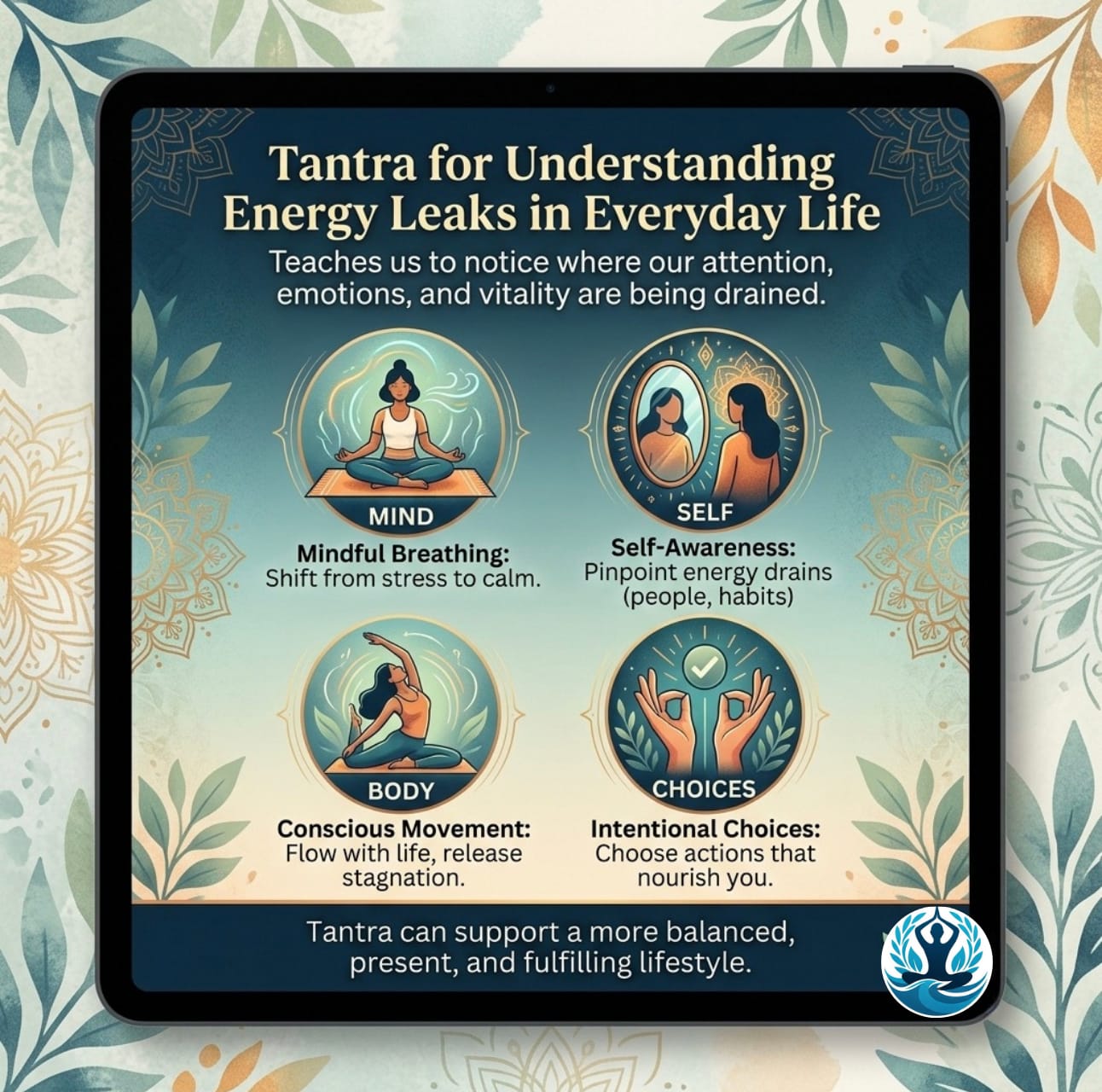
In modern life, feeling tired does not always mean that we have done too much physical work. Sometimes exhaustion comes from constant thinking, emotional pressure, digital stimulation, unhealthy routines, unresolved feelings, or spending time in situations that continuously drain our attention.
This is where the concept of energy leaks becomes useful. In a general wellness sense, an energy leak is anything that repeatedly consumes our attention, emotional capacity, or sense of vitality without providing meaningful restoration.
Tantra for understanding energy leaks in everyday life offers a mindful way to observe these patterns. Rather than encouraging people to escape ordinary life, Tantric philosophy can inspire greater awareness of the body, breath, thoughts, emotions, relationships, and daily choices.
The goal is not to eliminate every demanding experience. Instead, it is to recognize where attention is being unnecessarily scattered and learn to respond more consciously.
What Are Energy Leaks?
The phrase “energy leak” can be understood as a metaphor for the ways our physical, mental, and emotional resources become depleted.
For example, constantly checking notifications may fragment attention. Replaying an argument in your mind may consume emotional energy. Saying yes to every request may leave little time for yourself. Comparing your life with others may create unnecessary dissatisfaction.
These experiences may not appear dramatic individually, but repeated patterns can influence how present and refreshed you feel.
Common everyday energy leaks include:
- Constant overthinking
- Excessive digital stimulation
- Negative self-talk
- Unhealthy boundaries
- Unresolved emotional tension
- Constant comparison
- Fear of disappointing others
- Perfectionism
- Multitasking
- Lack of meaningful rest
- Living according to external expectations
- Suppressing emotions
- Staying in repetitive thought loops
- Ignoring bodily signals
- Consistently prioritizing everyone except yourself
Tantra encourages awareness of experience rather than automatic reaction. By observing these patterns, a person can begin to understand where their attention and vitality are going.
Understanding Energy Through a Tantric Perspective
Tantra is a diverse collection of spiritual and philosophical traditions, particularly associated with Hindu and Buddhist traditions. Its historical forms are much broader than the modern popular association of Tantra with sexuality.
Many Tantric approaches emphasize awareness, embodiment, transformation, ritual, meditation, breath, visualization, and the relationship between consciousness and lived experience.
From a modern wellness perspective, one useful interpretation is that awareness changes our relationship with everyday experiences.
Instead of automatically following every thought, emotion, desire, or external demand, we can learn to notice what is happening.
This creates a space between stimulus and response.
For example:
You receive a stressful message.
An automatic reaction might be:
“I have to respond immediately.”
A more conscious response might be:
“I notice tension in my body. I feel pressured to answer immediately. Do I actually need to respond right now?”
That small moment of awareness can change the entire experience.
Why Do Energy Leaks Happen?
Energy leaks often develop gradually.
A person may begin checking their phone for a few minutes each morning. Eventually, they may spend the first hour of the day consuming information before becoming aware of it.
Someone may occasionally agree to plans they do not want. Over time, they may develop a pattern of ignoring their own needs.
Another person may repeatedly worry about future possibilities. Eventually, worrying can become a habitual mental state.
The important point is that many energy leaks are not caused by one major event. They are created by repeated small behaviors.
1. Overthinking
Thinking can be valuable. It helps us plan, solve problems, and learn from experience.
However, repetitive thinking that does not lead to useful action can become exhausting.
Questions such as:
“What if something goes wrong?”
“Did I say the wrong thing?”
“What will people think?”
“What should I have done differently?”
can keep the mind occupied without producing resolution.
A mindful Tantric approach encourages observing thoughts instead of automatically believing every thought.
You can notice:
“I am having a worrying thought.”
This is different from:
“Something bad is definitely going to happen.”
That distinction can create psychological space.
2. Constant Digital Stimulation
Phones, social media, emails, videos, advertisements, and notifications continuously compete for attention.
Even when the body is physically resting, the mind may remain engaged.
This can create a feeling of being busy without necessarily accomplishing anything meaningful.
A simple Tantric-inspired practice is conscious technology use.
Before opening an application, pause and ask:
“Why am I opening this?”
If the answer is unclear, take one slow breath before continuing.
This simple pause can turn an automatic habit into a conscious choice.
3. Emotional Suppression
Another common energy leak is constantly avoiding uncomfortable emotions.
People may suppress anger, sadness, disappointment, fear, or frustration because they believe they should always remain positive.
But avoiding an emotion does not necessarily make the underlying experience disappear.
Mindfulness-based Tantric practices can encourage observing emotions without immediately acting on them.
For example:
“I notice anger.”
“I feel tightness in my chest.”
“My breathing has become faster.”
“I want to react.”
This observation does not mean approving harmful behavior. It simply creates awareness before action.
4. People-Pleasing
Constantly trying to satisfy everyone can become exhausting.
People-pleasing may involve:
- Saying yes when you want to say no
- Avoiding necessary conversations
- Taking responsibility for other people’s emotions
- Seeking constant approval
- Changing yourself to fit expectations
Conscious living involves recognizing your own limits.
A healthy boundary can be an important form of energy management.
Saying “no” respectfully can sometimes protect more energy than repeatedly agreeing and later feeling resentful.
5. Comparison
Social comparison can quietly consume attention.
You may compare your career, appearance, relationships, finances, achievements, or lifestyle with someone else’s.
The problem is that comparison rarely provides a complete picture.
Tantric awareness encourages returning attention to direct experience.
Instead of:
“Why am I not where they are?”
try:
“What matters to me at this stage of my life?”
This shifts attention from external measurement toward personal awareness.
6. Perfectionism
Perfectionism can appear productive while secretly consuming enormous mental energy.
A person may repeatedly edit, check, delay, or criticize their work because they fear making mistakes.
Conscious practice involves recognizing when excellence is useful and when perfection becomes unnecessary pressure.
Ask:
“Does this need to be perfect, or does it need to be completed with care?”
That question can reduce unnecessary mental expenditure.
Tantra and the Practice of Self-Observation
One of the most useful concepts for understanding energy leaks is self-observation.
Self-observation means noticing what happens inside you without immediately trying to change it.
You might observe:
- Your breathing
- Muscle tension
- Thoughts
- Emotional reactions
- Energy levels
- Habits
- Desires
- Resistance
- Restlessness
- Feelings of connection or disconnection
The purpose is awareness.
For example, you may notice that every time you enter a certain type of conversation, your shoulders tighten.
Instead of ignoring the sensation, you become curious.
“What is happening here?”
Perhaps the conversation involves criticism.
Perhaps you feel responsible for solving another person’s problems.
Perhaps you are afraid of disagreement.
Awareness helps reveal patterns.
The Role of Breath in Managing Energy
Breathing is closely connected with our experience of stress and relaxation.
A simple conscious-breathing practice can help create a pause during the day.
Sit comfortably.
Relax your shoulders.
Notice your natural breathing.
Do not force it.
Simply observe the inhalation and exhalation for a few moments.
Then ask:
“What am I carrying right now?”
You might notice physical tension, emotional pressure, or racing thoughts.
The purpose is not to force yourself into a particular emotional state. It is to become aware of your current condition.
In traditional Tantric practices, breath can have a much deeper spiritual significance. Modern wellness practices may use breath awareness more simply as a tool for grounding and attention.
Tantra for Recognizing Attention Leaks
Not every energy leak is physical.
Your attention is also a resource.
Imagine starting your morning with ten different demands:
Messages.
Emails.
News.
Social media.
Work notifications.
Household responsibilities.
Personal worries.
Before the day has properly begun, your attention may already be fragmented.
A conscious morning ritual can help.
Instead of immediately reaching for your phone:
- Sit quietly for two minutes.
- Notice your breathing.
- Feel your body.
- Identify your most important priority.
- Decide what deserves your attention.
- Delay unnecessary digital stimulation.
This does not require an elaborate spiritual routine.
Even a few minutes of intentional awareness can make the beginning of the day more deliberate.
Tantra and Conscious Movement
The body can provide information that the thinking mind overlooks.
When you move consciously, you may notice:
- Where you hold tension
- How you breathe
- Whether you rush
- Where movement feels restricted
- When you feel comfortable
- How emotions influence posture
Conscious movement does not necessarily mean complicated yoga or Tantric exercises.
Walking slowly, stretching gently, or moving with attention can become an awareness practice.
Instead of thinking only about reaching the destination, experience the movement itself.
Feel your feet.
Notice your posture.
Observe your breathing.
Pay attention to your surroundings.
This brings attention back into the present moment.
Identifying Your Personal Energy Leaks
Everyone has different patterns.
One person may be drained by social media.
Another may be drained by constant work.
Someone else may lose energy through unresolved relationship conflicts.
Therefore, there is no universal list of energy leaks.
A useful exercise is to keep an energy-awareness journal.
At the end of each day, write down:
What gave me energy today?
Perhaps:
- Meaningful conversation
- Nature
- Exercise
- Creative work
- Quiet time
- Laughter
- Meditation
- Rest
What drained my energy?
Perhaps:
- Excessive phone use
- Arguments
- Unnecessary meetings
- Negative thinking
- Overcommitting
- Lack of sleep
- Constant interruptions
What did I repeatedly think about?
This question can reveal hidden mental energy leaks.
Where did I ignore my own needs?
This can reveal boundary-related patterns.
After several days, look for repetition.
Patterns are often more informative than individual experiences.
Energy Leaks and Relationships
Relationships can be deeply nourishing, but they can also become sources of emotional exhaustion when boundaries and communication are unhealthy.
An energy leak may occur when you constantly:
- Explain yourself
- Seek approval
- Avoid honest communication
- Take responsibility for another person’s feelings
- Stay involved in unnecessary conflict
- Suppress your needs
Conscious relationships require awareness from both people.
Tantric philosophy, in many contexts, places importance on presence and conscious engagement.
In a modern interpretation, this can mean being genuinely present when listening rather than preparing your response while someone else is speaking.
It can mean noticing your emotional reaction before responding.
It can mean communicating honestly while respecting another person’s boundaries.
Energy Leaks at Work
The workplace can create significant demands on attention.
Meetings, deadlines, emails, interruptions, multitasking, and uncertainty can leave people feeling mentally exhausted.
A conscious approach to work does not mean avoiding responsibility.
Instead, it means identifying unnecessary sources of mental fragmentation.
Try:
- Working on one priority at a time
- Taking short awareness pauses
- Limiting unnecessary notifications
- Creating realistic boundaries
- Separating work time from personal time
- Taking genuine breaks
- Noticing when perfectionism is slowing progress
A two-minute pause can sometimes be more restorative than spending two additional hours working while mentally exhausted.
Tantra and the Difference Between Rest and Escape
One important distinction is the difference between genuine rest and distraction.
Scrolling endlessly through social media may feel like rest, but it can sometimes leave the mind more stimulated.
Similarly, constantly watching entertainment may temporarily distract from difficult emotions without providing deeper restoration.
Conscious rest involves intentionally allowing the body and mind to reduce stimulation.
Examples include:
- Sitting quietly
- Walking in nature
- Gentle stretching
- Listening to calming music
- Practicing meditation
- Taking a technology-free break
- Sleeping adequately
- Spending time with supportive people
Rest becomes more meaningful when it actually restores you.
A Simple Tantric-Inspired Daily Energy Practice
You can experiment with a simple five-step practice.
Step 1: Pause
Stop what you are doing for a moment.
Step 2: Breathe
Take several comfortable, natural breaths.
Step 3: Observe
Notice your body, thoughts, emotions, and surroundings.
Step 4: Identify
Ask:
“Where is my attention going right now?”
Then ask:
“Is this where I want my attention to go?”
Step 5: Choose
Make one conscious decision.
Perhaps you put the phone away.
Perhaps you finish one task.
Perhaps you communicate a boundary.
Perhaps you take a break.
The power of the practice comes from repetition.
Morning Practice for Conserving Energy
A simple morning routine could include:
First 2 minutes: Sit quietly and observe breathing.
Next 2 minutes: Notice how your body feels.
Next 2 minutes: Identify your main priority.
Next 2 minutes: Decide what you will avoid until later.
Final 2 minutes: Set an intention for the day.
Your intention could be:
“I will respond rather than react.”
“I will protect my attention.”
“I will listen to my body.”
“I will not say yes automatically.”
“I will make space for rest.”
This transforms the morning from an automatic sequence into a conscious beginning.
Evening Practice for Releasing the Day
Evenings can also become opportunities for reflection.
Before sleeping, ask yourself:
What did I carry today that I no longer need to carry tonight?
Then notice:
- One thing that drained you
- One thing that supported you
- One emotion you experienced
- One moment when you were fully present
- One choice you would like to make differently tomorrow
This is not about judging yourself.
It is about learning.
How to Stop an Energy Leak
Once you identify an energy leak, the next step is to experiment with a small change.
Suppose social media is draining your attention.
Do not necessarily attempt a complete digital transformation overnight.
Start with one boundary:
“No social media during the first 30 minutes after waking.”
If overcommitment is draining you, try:
“I will pause before accepting new requests.”
If constant notifications are distracting you:
“I will check messages at specific times.”
If overthinking is exhausting you:
“I will write down the concern and identify one practical action.”
Small changes are easier to sustain than extreme rules.
Tantra for Creating Conscious Boundaries
Boundaries are not about becoming disconnected from others.
They are about understanding what you can realistically give.
A conscious boundary may sound like:
“I cannot do that today, but I can help tomorrow.”
“I need some quiet time before we continue this conversation.”
“I would prefer to think about it before answering.”
“I am not available outside my working hours.”
These statements protect attention without requiring hostility.
Energy Conservation Is Not Laziness
Many people feel guilty about resting.
Modern culture often rewards constant productivity.
If you are always busy, you may feel valuable.
If you slow down, you may feel guilty.
But conscious rest is not necessarily laziness.
Rest supports the ability to participate in life with greater attention.
Tantric approaches that emphasize awareness can remind us that life is not simply a sequence of tasks to complete.
Presence matters too.
The Deeper Meaning of Energy Awareness
Understanding energy leaks is ultimately about understanding how we live.
Where does your attention go?
What repeatedly creates tension?
What relationships nourish you?
What activities leave you feeling connected?
What habits make you feel scattered?
What are you doing because you genuinely choose it?
What are you doing because you fear judgment?
These questions can lead beyond basic stress management into self-understanding.
The objective is not to protect yourself from every difficult experience.
Life will always contain challenges.
The deeper practice is learning to distinguish between necessary expenditure of energy and unnecessary depletion.
Some efforts are meaningful even when they are difficult.
Caring for family can require energy.
Building a career can require energy.
Learning something new can require energy.
Having an honest conversation can require energy.
The goal is not to avoid effort.
The goal is to invest energy consciously.
Common Misconceptions About Tantra
Tantra is often misunderstood in modern popular culture.
One common misconception is that Tantra is primarily about sexuality. In reality, traditional Tantric traditions are diverse and include spiritual practices involving meditation, ritual, visualization, mantra, embodiment, and philosophical inquiry.
Another misconception is that Tantra promises instant transformation.
Authentic personal development generally requires consistency, reflection, and patience.
Tantra should not be presented as a replacement for professional medical or psychological care when someone needs it.
Instead, mindfulness, breath awareness, conscious movement, and reflective practices can be considered complementary wellness approaches.
Benefits of Understanding Everyday Energy Leaks
Developing greater awareness of energy leaks may help people:
- Recognize unhelpful habits
- Improve attention
- Become more aware of bodily tension
- Create healthier boundaries
- Reduce unnecessary multitasking
- Make more intentional choices
- Develop greater self-awareness
- Notice emotional patterns
- Create more space for meaningful activities
- Build a more conscious relationship with technology
- Appreciate rest
- Become more present in everyday experiences
These are not guaranteed medical outcomes. Individual experiences vary.
The primary benefit is increased awareness.
And awareness can become the foundation for intentional change.
Conclusion: From Energy Drain to Conscious Living
Tantra for understanding energy leaks in everyday life is ultimately a practice of awareness.
Your energy is influenced not only by how much you physically do, but also by where your attention goes, how you respond to emotions, how you use technology, how you communicate, and how consciously you make everyday choices.
Tantra offers a perspective in which ordinary life itself can become a field of awareness.
A conversation can become a practice of presence.
Breathing can become a reminder to pause.
Movement can become an opportunity to reconnect with the body.
Rest can become intentional.
Boundaries can become an expression of self-respect.
And difficult emotions can become invitations to understand yourself more deeply.
You do not need to eliminate every source of stress or difficulty.
Instead, begin by noticing.
Where does your attention disappear?
What repeatedly leaves you feeling depleted?
What restores you?
What are you doing automatically?
And what would change if you approached your daily life with greater awareness?
The journey begins with a pause.
From that pause comes observation.
From observation comes understanding.
And from understanding comes the possibility of conscious choice.