

Tantra for Reclaiming Your Natural Rhythm in a Busy World


Modern life often encourages us to move faster than we naturally want to. From demanding work schedules and constant notifications to social commitments, digital distractions, and endless responsibilities, everyday life can feel like a continuous race against time.
We wake up thinking about what needs to be completed. We move from one task to another, check messages while eating, work beyond our natural energy levels, and sometimes continue thinking about responsibilities even when the day is over.
Over time, this constant acceleration can make us disconnected from our own natural rhythm.
We may stop noticing when the body needs rest. We may ignore emotional signals, rush through meals, postpone relaxation, and measure our days by productivity rather than presence. Although being busy can sometimes feel unavoidable, living continuously against our natural pace can make life feel exhausting and disconnected.
This is where Tantra for reclaiming your natural rhythm offers a different perspective.
Tantra encourages conscious awareness of the body, breath, emotions, senses, thoughts, and present-moment experience. Rather than asking us to escape everyday life, Tantra invites us to experience life more consciously.
Reclaiming your natural rhythm does not necessarily mean abandoning responsibilities or becoming slow in every aspect of life. It means learning to recognize your personal cycles of activity and rest, understanding your energy, becoming present with your experiences, and creating space for conscious choices.
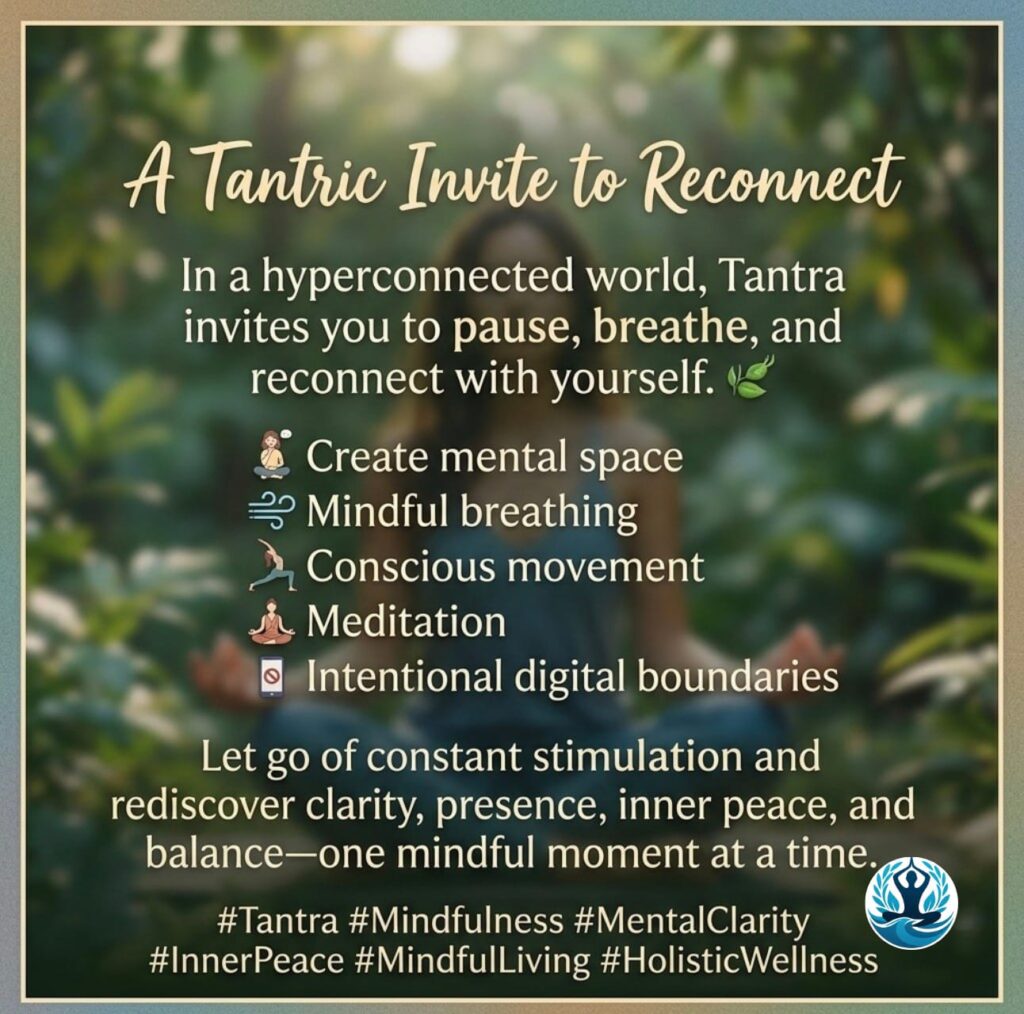
Through mindful breathing, meditation, conscious movement, sensory awareness, and self-observation, Tantra can become a practical approach to creating greater balance in a busy world.
What Does “Natural Rhythm” Mean?
Natural rhythm refers to the way your body, mind, emotions, and energy naturally move through different states.
There are moments when you feel energetic and motivated. There are other moments when you need quiet, recovery, reflection, or sleep.
However, modern lifestyles can encourage us to maintain the same level of activity regardless of what we actually need.
For example:
- Working when you are mentally exhausted
- Staying connected to screens late at night
- Ignoring hunger or tiredness
- Filling every quiet moment with stimulation
- Feeling guilty about taking breaks
- Constantly switching between tasks
- Treating rest as something that must be earned
Over time, these habits can make it difficult to recognize your body’s signals.
Your natural rhythm is not about being productive all the time. It is about learning when to act, when to pause, when to engage, and when to restore.
Tantra places awareness at the center of this process.
How Modern Life Disconnects Us From Our Natural Rhythm
Technology has created remarkable opportunities for communication and productivity. At the same time, constant connectivity can make it difficult to experience genuine pauses.
Notifications, emails, social media, online meetings, entertainment, and information can keep the mind continuously stimulated.
Even when the body is physically still, the mind may continue moving rapidly.
This creates a lifestyle where:
The body wants rest, but the mind wants stimulation.
The mind wants silence, but the environment provides constant information.
The emotions need processing, but there is little time to feel them.
The body signals tiredness, but responsibilities encourage us to continue.
This disconnect can gradually make people feel restless, overwhelmed, or emotionally distant from themselves.
Tantra offers an opportunity to notice this disconnect rather than automatically continuing the same pattern.
Tantra and the Art of Slowing Down
One of the most valuable principles associated with a conscious Tantric approach is awareness.
Slowing down does not mean becoming inactive.
Instead, it means becoming aware of what you are doing while you are doing it.
Consider something as simple as drinking water.
You can drink water while checking your phone, thinking about work, and planning your next task.
Or you can pause for a moment, notice the glass in your hand, feel the temperature of the water, take a breath, and actually experience the action.
The activity is the same.
The quality of awareness is different.
This is an important part of reclaiming your natural rhythm.
Instead of constantly rushing toward the next experience, you begin experiencing the present one more completely.
1. Reconnecting With Your Body
The body often communicates before the conscious mind recognizes what is happening.
Tension in the shoulders, shallow breathing, clenched muscles, fatigue, restlessness, or heaviness can all become signals worth noticing.
Yet many people learn to ignore these signals because they have become accustomed to functioning through discomfort.
Tantra encourages greater body awareness.
You can begin by asking yourself:
- How does my body feel right now?
- Am I breathing naturally?
- Where am I holding tension?
- Do I need movement or rest?
- Am I tired, hungry, overstimulated, or emotionally tense?
- What is my body communicating?
These questions do not require complicated practices.
They simply require attention.
The more regularly you listen to the body, the easier it can become to recognize when you are moving too quickly or demanding too much from yourself.
2. Using Breath to Create a Pause
Breathing is one of the simplest ways to reconnect with the present moment.
During stress or intense activity, breathing may become shallow or irregular. Conscious breathing can provide a simple transition from automatic activity toward greater awareness.
A basic practice is:
- Sit comfortably.
- Relax your shoulders.
- Close your eyes if comfortable.
- Notice your natural breathing.
- Avoid trying to force the breath.
- Observe the inhale.
- Observe the exhale.
- Continue for several slow breaths.
The purpose is not to achieve a particular state.
The purpose is to notice.
This small pause can become a reminder that you do not have to respond to every demand immediately.
3. Learning to Recognize Your Energy Patterns
Everyone experiences changes in energy throughout the day.
Some people feel naturally energetic in the morning. Others become more active later. Some tasks require intense concentration, while others require creativity, communication, or physical activity.
A conscious lifestyle involves learning your own patterns instead of constantly comparing yourself with others.
You can begin keeping a simple energy journal.
At different points during the day, record:
Energy: Low / Medium / High
Mood: Calm / Neutral / Restless
Mental clarity: Low / Medium / High
Body: Relaxed / Tense / Tired
After several days, patterns may become easier to notice.
This awareness can help you make more conscious decisions about your schedule.
4. Creating Conscious Transitions
Many people move directly from one activity into another.
Work ends, but the mind continues working.
A meeting ends, and another task immediately begins.
A stressful conversation ends, but its emotional impact remains.
Conscious transitions create small spaces between experiences.
For example, after finishing work, take five minutes before beginning your evening routine.
You might:
- Take several slow breaths
- Walk quietly
- Stretch
- Sit without your phone
- Drink water
- Notice your surroundings
This creates a psychological transition from one part of life to another.
These small pauses can become powerful rituals for restoring balance.
5. Tantra and Conscious Movement
Movement does not always have to be intense exercise.
Conscious movement can include gentle stretching, walking, yoga-inspired practices, or simply moving with awareness.
The goal is to reconnect movement with sensation.
Instead of thinking only about completing a workout, notice:
- Your breathing
- Muscle sensations
- Balance
- Posture
- Movement speed
- Physical comfort
This approach encourages you to experience the body rather than treating it simply as a tool for productivity.
6. Reclaiming the Rhythm of Rest
Rest is not laziness.
Rest is a natural part of human functioning.
Yet many people feel uncomfortable resting unless they have completed everything on their to-do list.
The problem is that the list rarely ends.
There is always another email, another responsibility, another goal, or another task.
A conscious Tantric approach encourages a different relationship with rest.
Instead of seeing rest as wasted time, consider it as a necessary part of a balanced rhythm.
Rest may involve:
- Sleeping adequately
- Sitting quietly
- Spending time in nature
- Practicing meditation
- Taking technology breaks
- Enjoying an unhurried meal
- Listening to music
- Doing nothing for a few minutes
The quality of rest matters as much as the quantity.
7. Moving Beyond Constant Productivity
Modern culture often connects productivity with personal value.
This can create thoughts such as:
“I should be doing more.”
“I am wasting time.”
“I need to achieve more.”
“I should always be improving.”
Tantra offers an opportunity to question this constant pressure.
Your value does not need to depend entirely on how much you accomplish.
A meaningful life can include productivity, ambition, relationships, creativity, rest, contemplation, and simple enjoyment.
Reclaiming your natural rhythm means creating space for all of these dimensions.
8. Practicing Single-Task Awareness
Constant multitasking can make everyday experiences feel fragmented.
You may eat while watching videos, work while answering messages, and talk to someone while checking notifications.
Try occasionally practicing one activity at a time.
When eating, simply eat.
When walking, notice walking.
When talking, listen.
When resting, rest.
This practice may appear simple, but it can significantly change the quality of everyday experience.
It brings awareness back into ordinary activities.
9. Creating Digital Boundaries
Digital technology can be useful, but constant access can make it difficult to experience genuine mental space.
Consider creating small technology-free periods during the day.
For example:
Morning: Avoid immediately checking notifications.
Meals: Keep the phone away when possible.
Evening: Create a period without unnecessary digital stimulation.
Before sleep: Allow the mind some quiet time.
The goal is not to reject technology.
It is to create a healthier relationship with it.
10. Listening to Emotional Signals
Your natural rhythm is not only physical.
Emotional awareness is equally important.
Sometimes irritation, sadness, anxiety, frustration, or emotional exhaustion may indicate that you have been pushing yourself beyond your current capacity.
Instead of immediately distracting yourself from difficult feelings, you can practice observing them.
Ask:
What am I feeling?
Where do I notice it in my body?
What might this feeling be communicating?
Can I allow myself to experience it without immediately reacting?
This approach encourages emotional awareness rather than automatic suppression.
11. Tantra for Reconnecting With Nature
Human beings are part of nature, yet modern environments can make us feel disconnected from natural cycles.
Spending time outdoors can provide opportunities to slow down and observe.
You might walk through a garden, sit under a tree, watch the changing sky, listen to birds, or simply spend a few quiet minutes outside.
The purpose is not necessarily spiritual achievement.
It is awareness.
Nature reminds us that not everything operates according to deadlines.
There are cycles of activity and stillness, growth and rest, movement and renewal.
Reconnecting with these rhythms can inspire a more balanced relationship with your own life.
12. Creating a Personal Daily Rhythm
You do not need to completely redesign your life.
Start with a few consistent practices.
Morning
Begin with a few minutes of conscious breathing before checking your phone.
Midday
Pause briefly between major tasks.
Afternoon
Notice your energy level instead of automatically pushing through fatigue.
Evening
Create a transition between work and personal life.
Night
Reduce unnecessary stimulation and prepare your mind for rest.
The objective is consistency rather than perfection.
A Simple Tantric Practice for Reclaiming Your Rhythm
Try this five-minute practice once or twice a day.
Step 1: Pause
Stop what you are doing.
Step 2: Breathe
Take several natural, comfortable breaths.
Step 3: Feel
Notice physical sensations throughout the body.
Step 4: Observe
Notice your thoughts and emotions without immediately changing them.
Step 5: Ask
Ask yourself:
“What do I genuinely need right now?”
Perhaps the answer is movement.
Perhaps it is water.
Perhaps it is rest.
Perhaps it is completing an important task.
Perhaps it is simply a moment of silence.
Step 6: Respond Consciously
Choose your next action based on awareness rather than automatic habit.
This simple process can gradually create a stronger connection with your internal rhythm.
Signs You May Need to Reclaim Your Natural Rhythm
Certain everyday patterns may suggest that your current pace is not sustainable.
You may notice:
- Constant rushing
- Difficulty sitting quietly
- Feeling guilty while resting
- Frequent digital checking
- Difficulty focusing on one activity
- Ignoring physical tiredness
- Feeling disconnected from your emotions
- Difficulty enjoying simple experiences
- Constant thoughts about the next task
- Feeling that there is never enough time
These experiences do not automatically indicate a specific health condition. They can simply be reminders to examine how you are relating to your time, energy, attention, and responsibilities.
Tantra Does Not Mean Escaping Modern Life
An important misunderstanding is that reclaiming your natural rhythm requires leaving behind modern responsibilities.
It does not.
You can have a career, relationships, goals, family responsibilities, technology, and ambitions while practicing conscious living.
Tantra is not necessarily about escaping life.
It can be understood as an invitation to experience life with greater awareness.
The question changes from:
“How can I do everything faster?”
to:
“How can I experience what I am doing more consciously?”
That shift can influence how you work, communicate, rest, eat, move, and relate to yourself.
Benefits of Reclaiming Your Natural Rhythm
A more conscious daily rhythm may support several aspects of wellbeing.
Greater self-awareness
You become more familiar with your physical, emotional, and mental patterns.
Better presence
You may find it easier to focus on the experience happening now.
More intentional living
You become more deliberate about how you use your attention and energy.
Healthier relationship with rest
Rest becomes part of your lifestyle rather than something reserved for exhaustion.
Greater body connection
You become more attentive to physical sensations and signals.
Reduced sense of constant rushing
Small pauses can create more space within the day.
Emotional awareness
You may become more comfortable noticing emotions before automatically reacting to them.
These are possibilities rather than guaranteed outcomes, and individual experiences vary.
Common Mistakes When Trying to Slow Down
Reclaiming your natural rhythm can itself become another productivity project if approached incorrectly.
You do not need to meditate perfectly.
You do not need to wake up extremely early.
You do not need to follow an elaborate spiritual routine.
You do not need to completely eliminate technology.
You do not need to transform your life overnight.
Instead, focus on awareness.
A single conscious breath can be meaningful.
A mindful meal can be meaningful.
Five minutes without your phone can be meaningful.
A quiet walk can be meaningful.
Small practices become powerful when they are repeated consistently.
How to Make Tantra Part of Everyday Life
You can integrate Tantric awareness into ordinary activities.
While drinking tea
Notice the aroma, warmth, taste, and sensations.
While walking
Feel your feet touching the ground.
While speaking
Listen completely before responding.
While eating
Slow down and notice each bite.
While working
Focus on one task for a defined period.
While resting
Allow yourself to rest without mentally working.
Before sleeping
Take several conscious breaths and release the day’s activities.
These practices turn ordinary moments into opportunities for awareness.
Reclaiming Your Natural Rhythm Is a Journey
There is no single ideal rhythm that everyone should follow.
Your natural rhythm may change throughout your life.
Work demands may change.
Relationships may change.
Your priorities may change.
Your body may change.
Your interests may change.
Therefore, reclaiming your rhythm is not about discovering one permanent routine.
It is about developing the awareness to recognize what you need in different seasons of life.
Some days may require action.
Some days may require rest.
Some moments require speaking.
Others require listening.
Some situations require ambition.
Others require surrender.
Awareness allows you to recognize the difference.
Conclusion
In a world that constantly encourages us to move faster, Tantra for reclaiming your natural rhythm offers an invitation to pause, listen, and become more conscious of how you are living.
Reclaiming your rhythm does not mean abandoning ambition or responsibilities. It means creating a healthier relationship with your energy, attention, body, emotions, time, and everyday experiences.
Through conscious breathing, body awareness, mindful movement, meditation, sensory awareness, digital boundaries, and intentional pauses, you can begin reconnecting with the natural patterns that often become hidden beneath a busy lifestyle.
The journey begins with a simple question:
“Am I living according to my own rhythm, or am I constantly trying to keep up with the rhythm of the world?”
You do not have to change everything today.
Start with one pause.
Take one conscious breath.
Listen to your body.
Notice the present moment.
Then take your next step with greater awareness.
That is where reclaiming your natural rhythm can begin