

Tantra and Mindful Living: Creating Calm in Everyday Life

Modern life can feel overwhelming. Busy schedules, constant notifications, work responsibilities, family commitments, and an endless stream of information can make it difficult to slow down. Even when the body is resting, the mind may continue thinking about the past, planning for the future, or worrying about everyday responsibilities.
This is where Tantra and mindful living can offer a meaningful approach to creating greater calm and awareness.
Tantra is often misunderstood as being primarily about sexuality. In reality, traditional Tantric approaches encompass broader practices involving awareness, meditation, breath, energy, contemplation, ritual, and the relationship between mind and body. When adapted thoughtfully to modern wellness, Tantra can encourage people to become more present and aware of their everyday experiences.
Mindful living shares a similar principle: instead of moving through life automatically, we learn to pay attention to what is happening in the present moment.
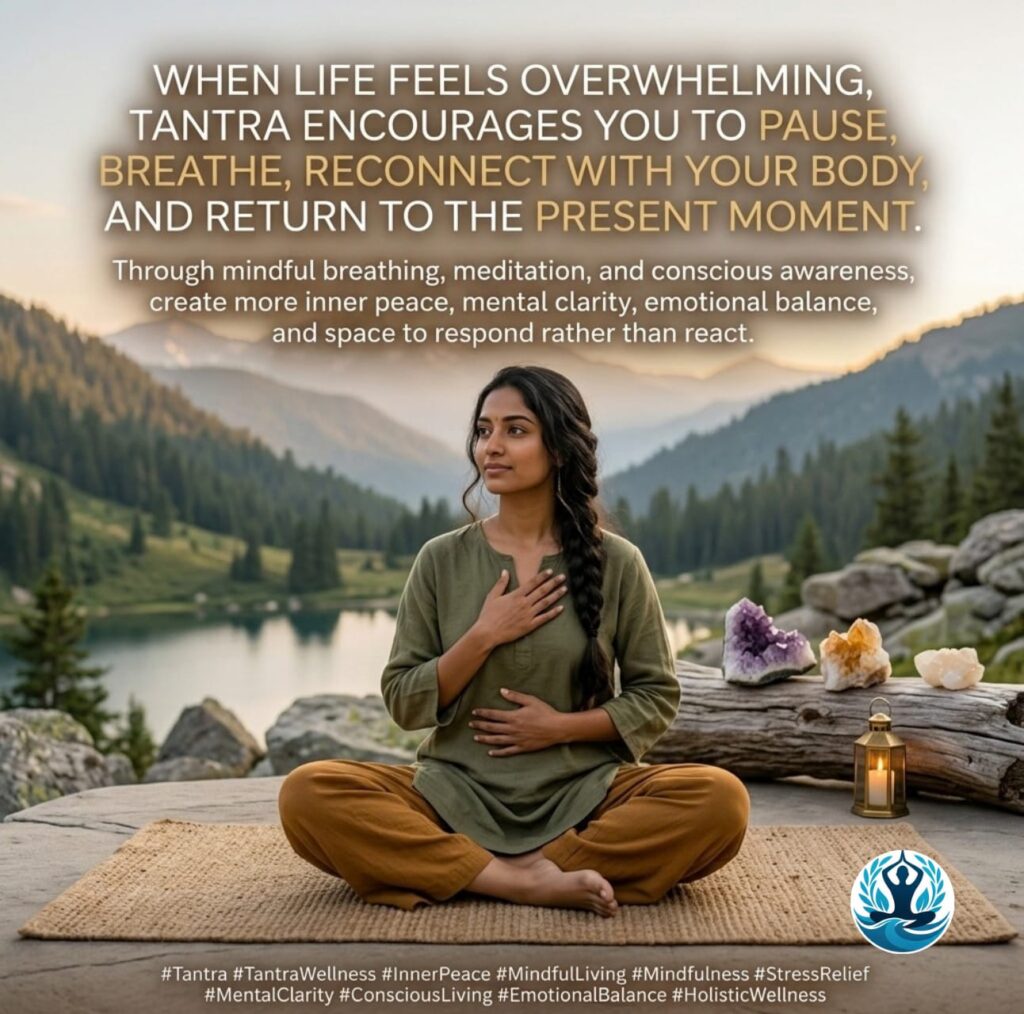
Together, Tantra and mindful living can provide practical ways to slow down, reconnect with the body, observe thoughts without immediately reacting to them, and approach everyday experiences with greater awareness.
This article explores how a mindful Tantric lifestyle can support calm, emotional balance, self-awareness, relaxation, and overall wellbeing.
What Is Tantra?
Tantra is a diverse spiritual and philosophical tradition with roots in South Asia. It includes many different schools and practices, so there is no single definition that describes every Tantric tradition.
At its heart, many Tantric approaches emphasize awareness and the transformation of ordinary experience into an opportunity for deeper consciousness.
Tantric practices may include:
- Meditation
- Breath awareness
- Mantra
- Visualization
- Contemplation
- Ritual
- Body awareness
- Mindful movement
- Energy practices
- Self-observation
Rather than encouraging people to escape everyday life, many Tantric philosophies emphasize becoming more conscious within life itself.
This makes Tantra particularly relevant to modern mindful living.
What Is Mindful Living?
Mindful living means intentionally paying attention to the present moment rather than constantly operating on autopilot.
It does not mean that you must stop thinking or eliminate every stressful experience. Instead, mindfulness encourages you to notice thoughts, emotions, physical sensations, and surroundings without immediately judging or reacting to them.
For example, while drinking tea, mindful living means actually noticing the warmth of the cup, the aroma, the taste, and your breathing instead of drinking while scrolling through your phone.
During a conversation, mindfulness means listening instead of mentally preparing your response.
While walking, it means noticing your movement, surroundings, breathing, and physical sensations.
These simple moments can become opportunities to return to the present.
How Tantra and Mindful Living Work Together
The connection between Tantra and mindful living comes from their shared emphasis on awareness.
Tantric practices can encourage you to become more conscious of your body, breath, thoughts, emotions, and energy. Mindfulness can then bring that awareness into ordinary activities.
Instead of separating meditation from daily life, you can begin practicing awareness while:
- Eating
- Walking
- Working
- Resting
- Communicating
- Exercising
- Preparing meals
- Spending time in nature
- Getting ready for sleep
The goal is not to create a perfect lifestyle. The goal is to become more present within the life you already have.
1. Tantra Encourages You to Slow Down
One of the biggest challenges of modern living is the constant feeling that everything must happen quickly.
We rush through breakfast, respond immediately to messages, move rapidly between tasks, and often fill every quiet moment with entertainment.
This constant stimulation can make it difficult to recognize when the body needs rest.
Tantric mindfulness encourages a different approach: slow down enough to notice.
You might begin with something as simple as taking three conscious breaths before starting a new task.
Pause.
Feel your feet.
Relax your shoulders.
Notice your breathing.
Then continue.
These small pauses can help interrupt automatic patterns and create a greater sense of intentionality.
2. Breath Awareness Can Support Calm
The breath is one of the simplest tools for developing present-moment awareness.
You do not need complicated breathing techniques to begin. Simply observing your natural breathing can create a moment of stillness.
Sit comfortably and notice:
- The movement of your abdomen
- The sensation of air entering and leaving the body
- The rhythm of your breath
- Areas of tension
- Whether your breathing feels fast or slow
Avoid forcing the breath.
The purpose is awareness rather than performance.
A few minutes of conscious breathing can become a useful transition between stressful activities.
For example, before opening your work email, take a moment to breathe consciously. Before responding to a difficult message, pause and notice your body. Before going to bed, spend several minutes observing your breath.
These simple habits can make mindful living more practical.
3. Tantra Can Encourage Greater Body Awareness
Many people spend most of their day inside their thoughts.
They may think about deadlines, relationships, finances, responsibilities, or future plans while barely noticing what is happening physically.
Tantric mindfulness brings attention back to the body.
Try a simple body-awareness practice.
Sit comfortably and slowly notice different parts of your body.
Begin with your feet.
Then move your attention upward through your legs, abdomen, chest, shoulders, arms, neck, and face.
Notice sensations without trying to change them.
You may notice warmth, tightness, relaxation, movement, heaviness, or subtle sensations.
This practice can help you reconnect with physical experience and recognize tension earlier.
4. Mindful Living Helps Reduce Autopilot
Autopilot is useful for many routine activities, but too much automatic behavior can make life feel disconnected.
You may arrive at work without remembering the journey.
You may eat a meal while watching a screen and barely notice the food.
You may finish an entire conversation while thinking about something else.
Mindfulness invites you back.
Choose one ordinary activity each day and practice doing it consciously.
For example, when brushing your teeth, notice the movement of your hand, the sensation of the brush, the taste of toothpaste, and your breathing.
This activity takes only a few minutes, but it trains attention.
Over time, everyday moments can become opportunities for mindfulness.
5. Tantra and Emotional Awareness
Emotions are a natural part of human experience.
Stress, frustration, sadness, excitement, fear, and joy can all arise throughout the day.
The problem is often not the emotion itself but our automatic reaction to it.
Tantric approaches can encourage observation rather than immediate suppression or reaction.
When a difficult emotion appears, pause and ask:
What am I experiencing right now?
Notice where the emotion appears in the body.
Is there tightness in your chest?
A clenched jaw?
Tension in your stomach?
Restlessness?
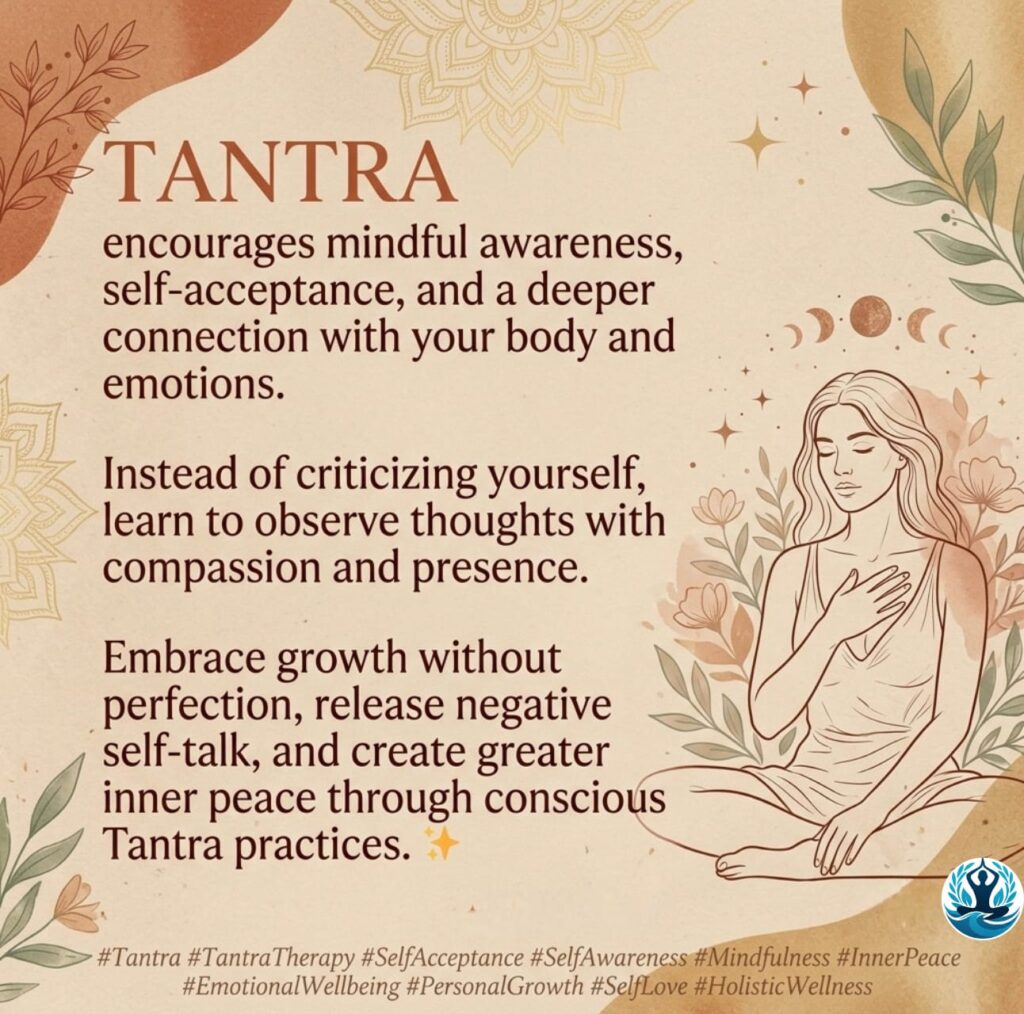
Instead of immediately judging the emotion, observe it.
This does not mean ignoring serious emotional difficulties. Rather, it creates space between experiencing an emotion and automatically reacting to it.
6. Creating a Morning Tantra and Mindfulness Routine
The way you begin the day can influence how intentionally you move through it.
Instead of immediately checking your phone, consider creating a short morning mindfulness ritual.
A simple routine might include:
- Sit quietly for two minutes.
- Take several comfortable breaths.
- Notice your body.
- Set a simple intention for the day.
- Spend a moment appreciating something in your life.
- Begin your activities slowly and consciously.
Your intention could be:
“Today, I will return to the present whenever I notice myself becoming overwhelmed.”
The practice does not need to be long.
Consistency is often more useful than complexity.
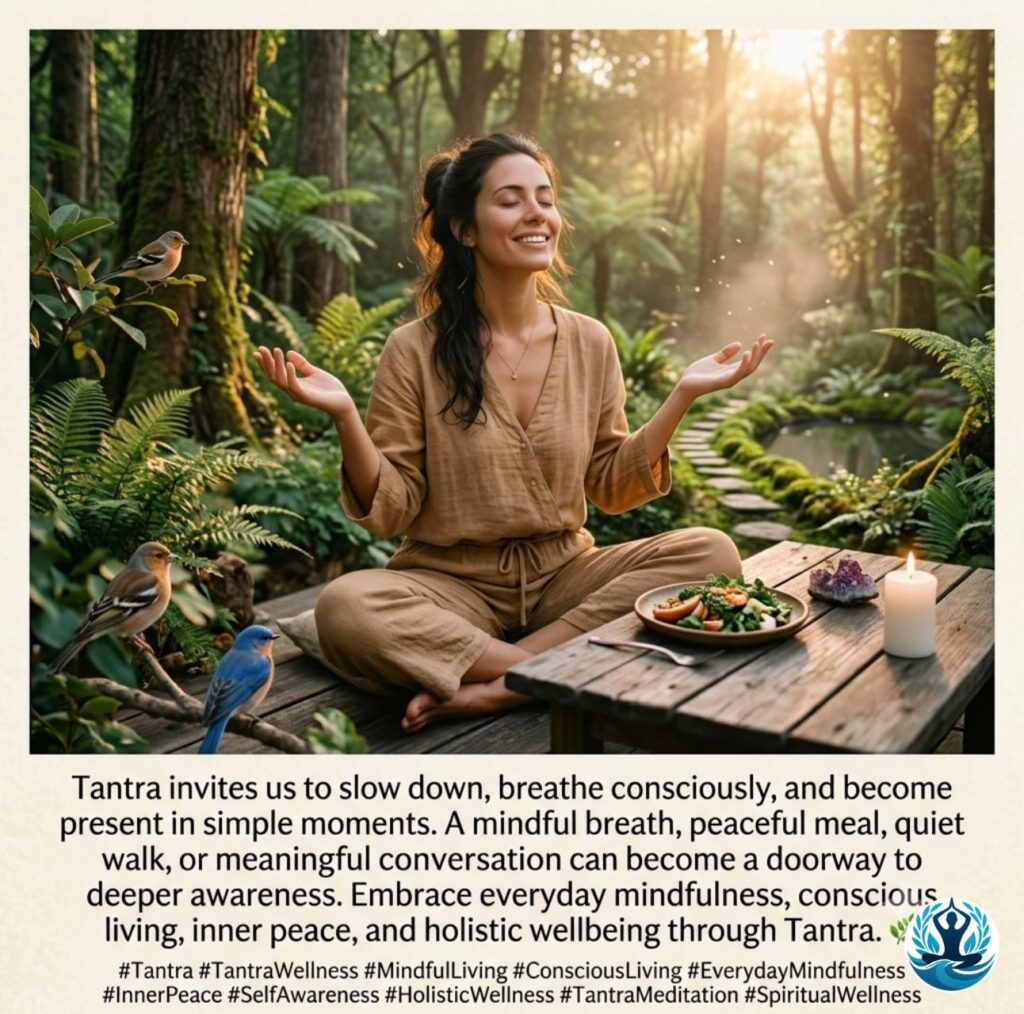
7. Mindful Eating
Eating is another opportunity to practice Tantra and mindful living.
Instead of rushing through meals, put away distractions whenever possible.
Notice the appearance, smell, texture, temperature, and flavor of your food.
Chew slowly.
Notice when you feel satisfied.
Mindful eating does not require strict dietary rules. It simply encourages greater awareness of your relationship with food and the experience of eating.
This can turn an ordinary meal into a moment of presence.
8. Mindful Movement
Tantra does not have to be limited to sitting meditation.
Movement can also become a practice of awareness.
Try walking slowly for several minutes while paying attention to your feet touching the ground.
Notice your posture.
Feel your breathing.
Observe the movement of your arms and legs.
You can also incorporate gentle stretching or yoga-inspired movement while maintaining awareness of your body.
The goal is not athletic performance.
The goal is presence.
9. Creating Calm During a Busy Workday
Work can easily pull attention into constant activity.
Emails, meetings, deadlines, notifications, and multitasking can create a sense of continuous pressure.
A mindful Tantric approach can introduce short moments of intentional pause.
Try a 60-second reset between tasks.
Stop what you are doing.
Relax your shoulders.
Take a comfortable breath.
Feel your feet.
Notice your surroundings.
Then consciously choose the next task.
These small pauses can make the workday feel less like one continuous rush.
10. Digital Mindfulness
Technology is useful, but constant digital stimulation can make it difficult to remain present.
Mindful living does not require completely eliminating technology.
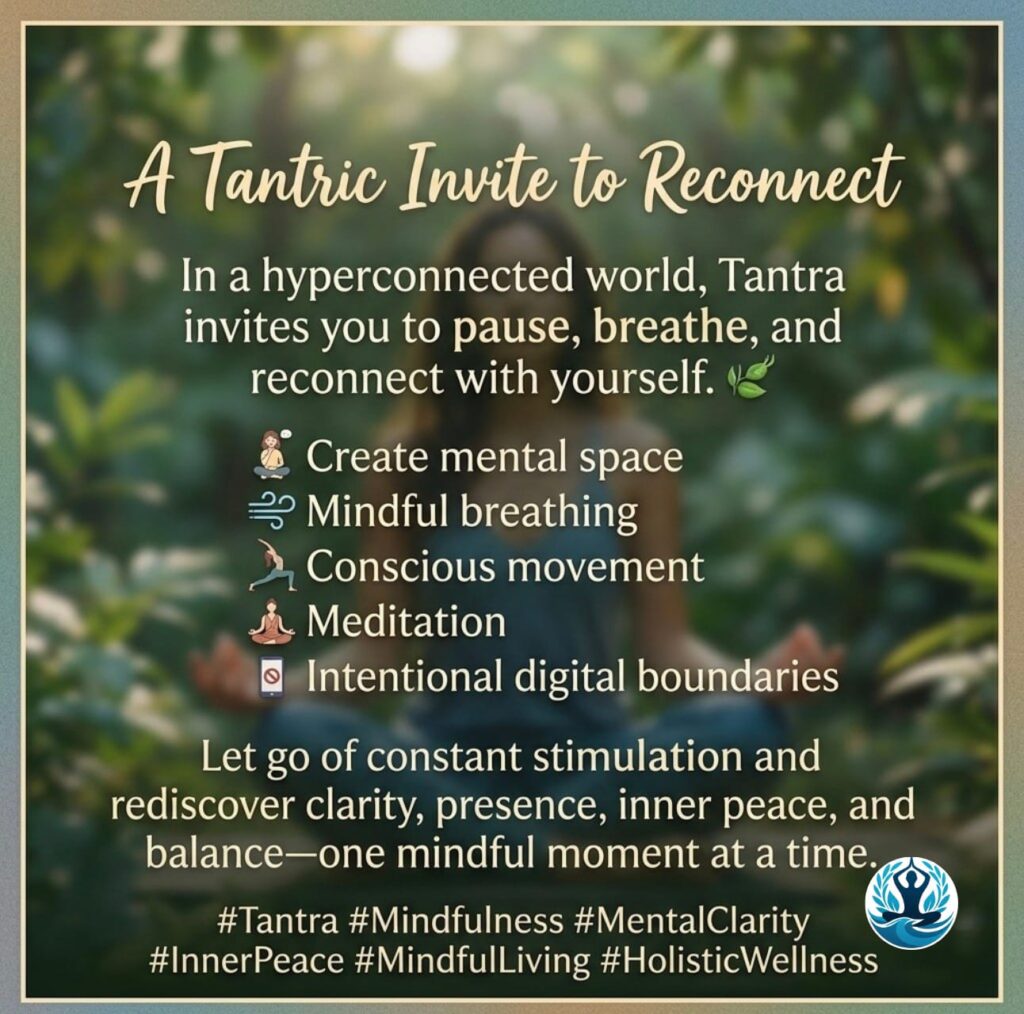
Instead, create conscious boundaries.
For example:
- Avoid checking your phone immediately after waking.
- Turn off unnecessary notifications.
- Take screen-free breaks.
- Avoid scrolling during meals.
- Create a relaxing evening routine.
- Keep your phone away during meditation.
The purpose is not to reject technology but to choose when and how you engage with it.
11. Tantra for Managing Overthinking
Overthinking often involves repeatedly analyzing the past or imagining possible future problems.
Mindfulness does not require you to force thoughts away.
Instead, notice when thinking becomes repetitive.
You can mentally say:
“I am noticing a lot of thinking right now.”
Then bring attention back to your breath or physical surroundings.
For example, feel your feet against the floor.
Notice five things around you.
Take a comfortable breath.
Return to the activity in front of you.
This practice can help create distance from repetitive thought patterns.
12. Creating an Evening Mindfulness Ritual
Evenings are an ideal time to transition from activity to rest.
A simple evening Tantric mindfulness ritual might include:
- Turning down bright lights
- Putting away unnecessary devices
- Taking a warm shower or bath
- Practicing gentle breathing
- Sitting quietly for five minutes
- Reflecting on the day
- Practicing gratitude
- Preparing for sleep without rushing
Ask yourself:
What can I release from today?
You do not have to solve everything before going to bed.
Sometimes creating space to acknowledge the day is enough.
13. Practicing Presence in Relationships
Mindful living is not only an individual practice.
It can also transform communication.
When someone is speaking, practice listening without immediately preparing your response.
Notice your urge to interrupt.
Notice your emotional reactions.
Take a breath before responding.
This can create more thoughtful communication.
Tantric philosophy’s emphasis on awareness can be applied to relationships by encouraging people to become more conscious of their words, reactions, boundaries, and emotional patterns.
Presence can make conversations more meaningful.
14. Nature as a Mindfulness Practice
Nature can provide a simple environment for reconnecting with the present.
You do not need to travel to a remote location.
A garden, park, balcony, or quiet outdoor space can be enough.
Spend several minutes noticing:
- The movement of leaves
- Sounds around you
- Sunlight
- Temperature
- Wind
- Colors
- Your breathing
Allow yourself to experience the environment without needing to photograph or document it.
Simply be there.
15. Building Self-Awareness
One of the deeper benefits of mindful living is increased self-awareness.
You begin noticing patterns such as:
- What situations create tension?
- When do you become distracted?
- What causes unnecessary worry?
- When do you need rest?
- How do you respond to conflict?
- What activities restore your energy?
- Which habits make you feel disconnected?
Awareness does not automatically change every habit.
But awareness creates the possibility of intentional change.
16. Tantra and Self-Care
Self-care is often presented as something external: taking a vacation, buying something, going to a spa, or taking time off.
Those things can be enjoyable, but mindful self-care goes deeper.
It asks:
What does my body and mind need right now?
Sometimes the answer is rest.
Sometimes movement.
Sometimes connection.
Sometimes silence.
Sometimes a healthy boundary.
Sometimes simply taking a few minutes to breathe.
Tantra and mindful living can encourage you to listen more carefully to those needs.
17. A Simple Daily Tantra and Mindfulness Practice
You can create a simple daily routine without spending hours practicing.
Morning — 5 Minutes
Sit quietly.
Notice your breathing.
Feel your body.
Set an intention for the day.
Midday — 2 Minutes
Pause between tasks.
Relax your shoulders.
Take several conscious breaths.
Notice your surroundings.
Evening — 5 to 10 Minutes
Sit quietly.
Reflect on the day.
Notice any remaining tension.
Practice gratitude.
Allow the day to come to an end.
This routine is simple enough to fit into many lifestyles.
18. Consistency Matters More Than Perfection
One common mistake is believing that mindfulness requires perfect concentration.
It does not.
Your mind will wander.
You will forget to practice.
Some days will feel peaceful, while others will feel chaotic.
The important part is returning.
Every time you notice that your attention has wandered and gently bring it back, you are practicing awareness.
This is why mindful living is a process rather than a destination.
19. Common Misunderstandings About Tantra
Because the word Tantra is sometimes associated primarily with sexuality, many people are unfamiliar with its broader spiritual and contemplative dimensions.
Tantra is a diverse tradition with different historical schools, practices, and interpretations.
Not every modern practice marketed as “Tantra” represents traditional Tantric teachings.
For this reason, anyone exploring Tantra should approach teachers, courses, and practices thoughtfully and consider their background and training.
A healthy approach should emphasize consent, personal boundaries, respect, awareness, and psychological safety.
Tantra does not need to be sensationalized to be meaningful.
Its contemplative and mindful dimensions can be valuable on their own.
20. How to Make Mindful Living a Lifestyle
Mindfulness becomes more powerful when it moves beyond a formal meditation session.
Instead of thinking:
“I practice mindfulness for ten minutes.”
Consider:
“I practice returning to awareness throughout the day.”
Use ordinary moments as reminders.
When you open a door, breathe.
When your phone rings, pause.
Before eating, notice your food.
When someone speaks, listen.
When stress appears, notice your body.
Before sleeping, slow down.
These moments gradually transform mindfulness from an activity into a way of living.
Benefits of Tantra and Mindful Living
A consistent mindful lifestyle may support:
- Greater present-moment awareness
- Better recognition of stress
- Emotional self-awareness
- Relaxation
- More intentional decision-making
- Improved connection with the body
- Greater appreciation for everyday experiences
- Reduced reliance on automatic reactions
- More meaningful communication
- A stronger sense of inner balance
These benefits are not guaranteed, and mindfulness should not be viewed as a replacement for professional care when someone is experiencing significant mental or physical health concerns.
Instead, mindful practices can complement a broader approach to wellbeing.
Simple Tips for Beginners
If you are new to Tantra and mindful living, start small.
Start With Your Breath
Spend two minutes observing your natural breathing.
Choose One Daily Activity
Practice mindfulness while eating, walking, showering, or drinking tea.
Reduce Distractions
Create short periods without unnecessary notifications.
Listen to Your Body
Notice tension, fatigue, and physical sensations.
Practice Without Judgment
Do not criticize yourself when your mind wanders.
Keep It Simple
You do not need an elaborate ritual to begin.
Be Consistent
A few mindful minutes every day may be easier to maintain than a complicated routine once a week.
Conclusion
Tantra and mindful living offer a practical invitation to slow down and become more conscious of everyday experience.
In a world that constantly encourages speed, multitasking, and distraction, creating moments of presence can be deeply valuable.
Through breath awareness, meditation, body awareness, mindful movement, conscious communication, and intentional daily rituals, you can begin reconnecting with the present moment.
The goal is not to eliminate every stressful thought or create a life without challenges.
The goal is to develop a different relationship with those experiences.
Instead of constantly rushing through life, you learn to pause.
Instead of automatically reacting, you learn to observe.
Instead of living primarily in the past or future, you practice returning to now.
This is where Tantra and mindful living can meet: in the simple act of becoming fully present.
Even a few conscious breaths can be a beginning.
Slow down.
Notice.
Breathe.
And give yourself permission to experience the moment you are already living.